 Wordy Solver


A beginner word puzzle is defined as any word-based game built around simple rules, accessible vocabulary, and low-pressure mechanics that help new players develop language skills and pattern recognition. These puzzles have a long history. Word puzzles date back to at least the 1st century AD, making them one of the oldest forms of cognitive leisure. Today, they remain the most approachable entry point into word gaming, covering formats like word searches, hangman, and simple anagrams. Whether you are picking up your first puzzle book or exploring daily word games online, understanding what makes a puzzle “beginner-friendly” is the fastest way to build confidence and start having fun.
What is a beginner word puzzle, exactly?
A beginner word puzzle is a game where you identify, arrange, or manipulate words using simple clues or a visual grid. The defining feature is low complexity. Vocabulary stays within everyday language, rules take under a minute to learn, and beginner puzzles carry no time pressure or complex strategy requirements. That design choice matters because it lets new players focus on enjoying the process rather than stressing over performance.
The term “beginner word puzzle” is an informal, descriptive label. The recognized industry term for this category is “word game,” a broad classification that includes everything from simple word searches to competitive crosswords. Beginner word games sit at the accessible end of that spectrum, graded by platforms like ESLeSchool using CEFR standards from Pre-A1 to B1. That grading system gives you a reliable way to pick puzzles that match your current skill level without guessing.
What separates a beginner puzzle from an intermediate one is not just vocabulary. It is the absence of layered rules. A beginner word search gives you a list of words and a letter grid. Your only job is to find each word. No scoring formulas, no time limits, no trick clues. That simplicity is a feature, not a limitation.
What are the most common types of beginner word puzzles?
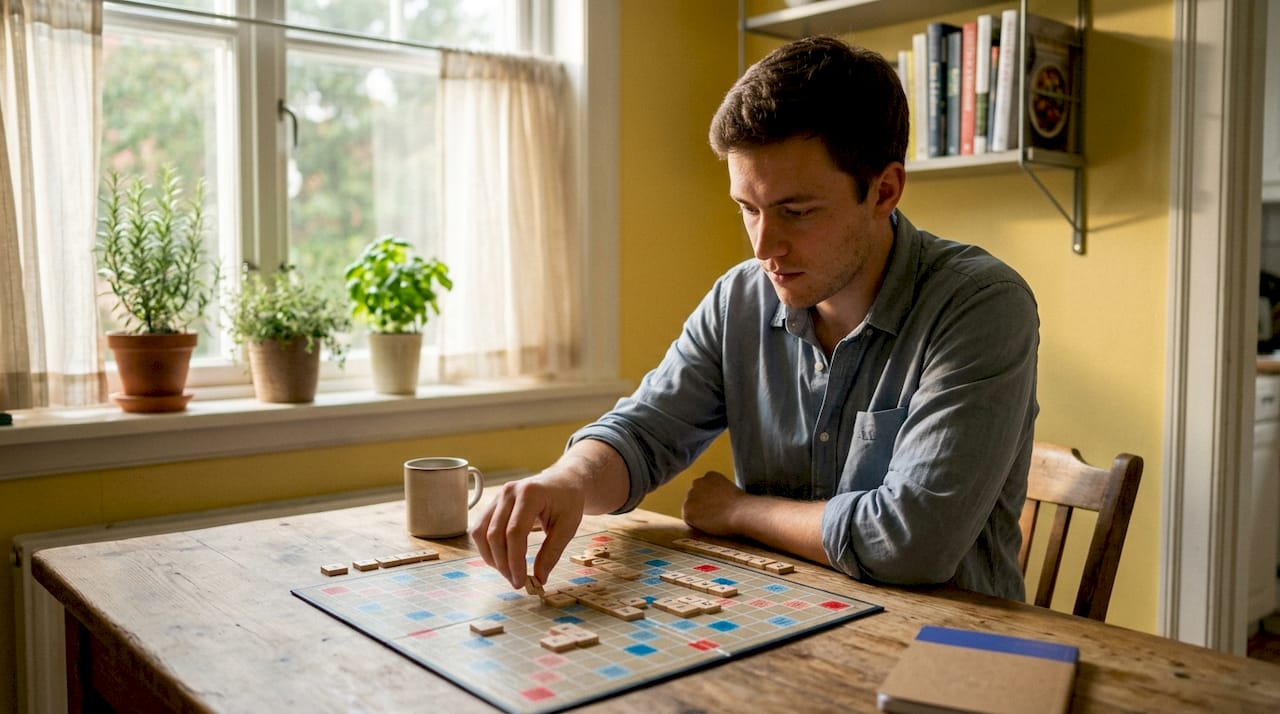
Getting familiar with the main puzzle types gives you a clear starting point. Each format trains a slightly different skill, so trying more than one type early on pays off quickly.
-
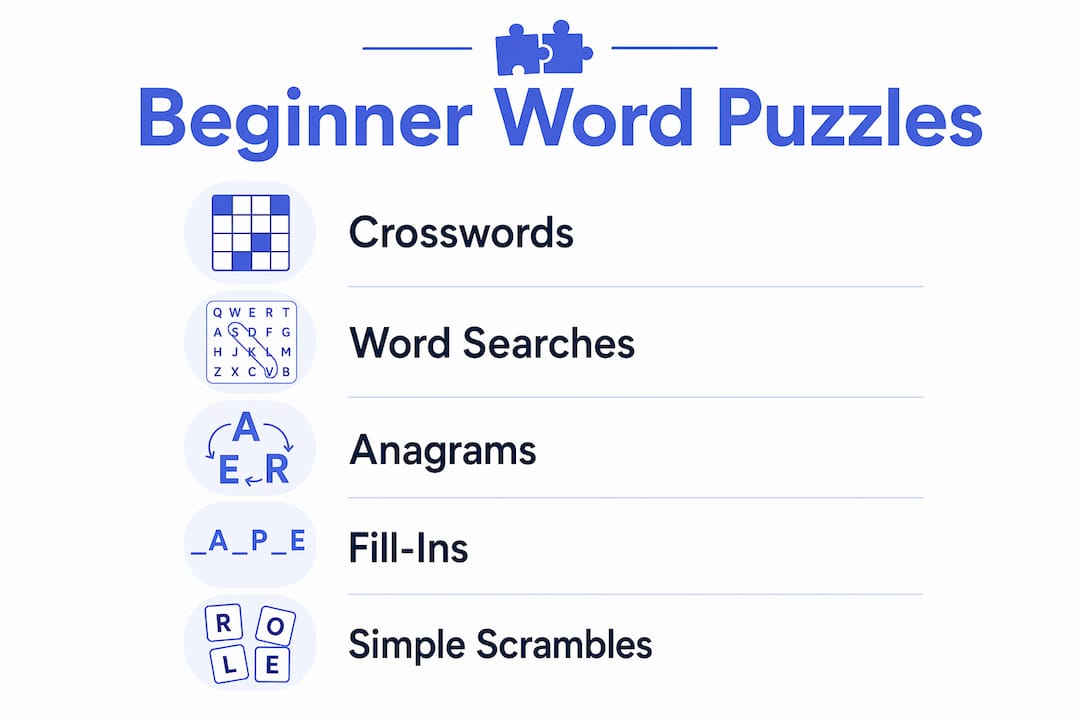
Word search: You receive a grid of letters and a list of target words. Your job is to find each word hidden horizontally, vertically, or diagonally in the grid. Word searches are the most common entry point for new players because the rules are instant to grasp. Platforms grade these puzzles by CEFR level, so you can start at Pre-A1 and move up as your confidence grows.
-
Hangman: A hidden word is represented by blank spaces, one per letter. You guess letters one at a time. Correct guesses fill in the blanks. Wrong guesses add parts to a drawing of a figure. The game ends when you complete the word or the figure is fully drawn. Hangman trains deductive thinking because each wrong guess narrows your options.
-
Simple anagrams: You receive a scrambled set of letters and must rearrange them to form a real word. For example, “TACS” becomes “CATS.” Anagrams build vocabulary and letter pattern awareness simultaneously. They are short, satisfying, and easy to attempt anywhere.
-
Fill-in-the-blank puzzles: A sentence or phrase contains a missing word, and you select or write the correct answer. These puzzles are especially popular with ESL learners because they reinforce vocabulary in context rather than in isolation.
-
Simple crosswords: A grid of squares with numbered clues. Each answer fills a row or column. Beginner crosswords use short words and straightforward clues, making them a natural next step after word searches.
Each of these formats takes 2–10 minutes per round for casual players, which makes them easy to fit into any part of your day.
How to solve word puzzles as a beginner
Solving beginner word puzzles gets easier once you follow a repeatable process instead of scanning randomly. The three-step workflow below applies to most beginner formats.
-
Read the clue or word list first. Before you look at the grid or blank spaces, absorb the full list of target words or clues. This primes your brain to recognize patterns faster when you start scanning.
-
Scan for anchors. Common letter combinations like “TH,” “SH,” “CH,” and “PH” appear frequently in English words. Spotting these clusters in the grid gives you a starting point. They act as anchors that help you locate full words faster than scanning letter by letter.
-
Verify against intersecting letters. Once you think you have found a word, confirm it by checking the letters that cross it. This step catches errors before you mark an answer as complete.
Beyond the basic workflow, two advanced techniques make a real difference even for beginners.
Target uncommon letters first. Letters like Q, J, X, and Z are rare in English. Uncommon letters serve as anchors because their rarity means fewer possible matches in the grid. If your word list includes “JAZZ” or “QUIZ,” find the J or Z first and build outward from there.
Use the two-pass strategy. Successful solvers use a two-pass approach: first locate the easiest words or most obvious letter clusters, then use those found words as anchors to locate the remaining ones. Beginners who try to solve linearly from top to bottom take longer and miss patterns that become obvious from a different angle.
One more thing worth knowing: clues that end with a question mark often signal wordplay or a pun rather than a literal answer. Question mark clues indicate wordplay, so read them with a flexible mindset rather than looking for the most obvious word.
Pro Tip: On your first pass through any puzzle, circle or mark every word you find immediately. On your second pass, focus only on the words you missed. This two-pass method cuts solving time and reduces frustration.
What are the cognitive benefits of beginner word puzzles?
Beginner word puzzles do more than fill time. They train your brain in ways that carry over into everyday language use and long-term cognitive health.
The primary benefit is pattern recognition. Regular engagement with word games develops pattern recognition linked to better cognitive maintenance in adults. That means playing word puzzles consistently is not just fun. It actively supports mental sharpness over time.
Vocabulary growth is the second major benefit, and it happens naturally. When you search for “ARCHIPELAGO” in a word search, you encounter and process that word even if you did not know it before. ESL learners and children benefit especially from this passive exposure because it builds word familiarity without the pressure of formal study.
“The primary value of beginner word puzzles lies in developing pattern recognition alongside vocabulary expansion, both of which are important for cognitive health.” The low-pressure design of beginner puzzles makes this cognitive workout accessible to anyone, regardless of age or language background.
The stress-free structure of beginner puzzles is itself a feature. No timer, no opponent, no penalty for a wrong guess in a word search. That environment lets you practice logical thinking without anxiety. Viewing puzzles as logic-based problems rather than pure knowledge tests shifts your mindset in a way that accelerates improvement. You stop asking “do I know this word?” and start asking “what constraints does this clue give me?” That shift makes you a better solver across every puzzle type.
Practical tips to get started with beginner word puzzles
Starting well sets the tone for how quickly you improve. These tips give you a clear path from your very first puzzle to consistent, confident play.
-
Match the puzzle to your level. Use CEFR-graded puzzles when possible. Pre-A1 and A1 puzzles use the most common English words and the simplest grid layouts. Moving up to A2 or B1 only when Pre-A1 feels easy keeps the experience rewarding rather than discouraging.
-
Use free platforms and printable puzzles. Dozens of free word puzzle platforms offer graded content for beginners. Printable puzzles work well if you prefer solving on paper, which many players find more satisfying than a screen.
-
Treat puzzles as logic problems, not memory tests. Clues act as constraints that guide you logically to answers. The most common beginner mistake is assuming you need to already know every word in the puzzle. You do not. The grid itself gives you information through intersecting letters and letter frequency.
-
Play a little every day. Short, consistent sessions beat long occasional ones. Even five minutes of word searching each morning builds the pattern recognition skills that make harder puzzles feel approachable over time.
-
Try multiple puzzle types early. Word searches, hangman, and simple anagrams each train different skills. Rotating between them in your first few weeks gives you a broader foundation than sticking to one format.
Pro Tip: If a puzzle feels too hard, that is a difficulty mismatch, not a reflection of your ability. Drop down one CEFR level and rebuild from there. Confidence built on easier puzzles transfers directly to harder ones.
Key takeaways
Beginner word puzzles are the most effective entry point into word gaming because they combine low-pressure mechanics with real cognitive benefits, making them valuable for players of any age or language background.
| Point | Details |
|---|---|
| Clear definition matters | A beginner word puzzle uses simple vocabulary and rules with no time pressure or complex strategy. |
| Three core types | Word searches, hangman, and simple anagrams cover the most common beginner formats. |
| Two-pass solving works | Locate easy words first, then use them as anchors to find the rest of the puzzle. |
| Cognitive gains are real | Regular play builds pattern recognition and vocabulary, both linked to long-term cognitive health. |
| Match difficulty to level | Use CEFR-graded puzzles (Pre-A1 to B1) to stay in the right challenge zone as you improve. |
Why I think beginners underestimate how much fun easy puzzles actually are
People often skip beginner word puzzles because they assume “easy” means “boring.” That assumption costs them a genuinely enjoyable experience. I have watched players jump straight to hard crosswords, get frustrated within minutes, and walk away from word games entirely. The ones who started with word searches and simple anagrams? They stuck with it, improved steadily, and eventually tackled the harder formats with real confidence.
The design of a beginner puzzle is not a dumbed-down version of the real thing. It is a carefully calibrated entry point. The absence of time pressure and complex rules is not a concession to weakness. It is what makes the cognitive workout accessible. You get to focus entirely on the language, the patterns, and the small satisfaction of finding a word or completing a grid.
My honest advice: spend at least two weeks on beginner formats before moving up. Not because you need that long to learn the rules, but because that is how long it takes to internalize the pattern recognition habits that make every puzzle after it easier. Word puzzles reward patience more than raw vocabulary. The players who rush past the beginner stage almost always have to come back to it later anyway.
— Mat C.
Wordy Solver is here for your daily word puzzle habit
Ready to put these strategies into practice? Wordy Solver is built for players at every stage, from your very first word search to daily Wordle and Connections challenges.
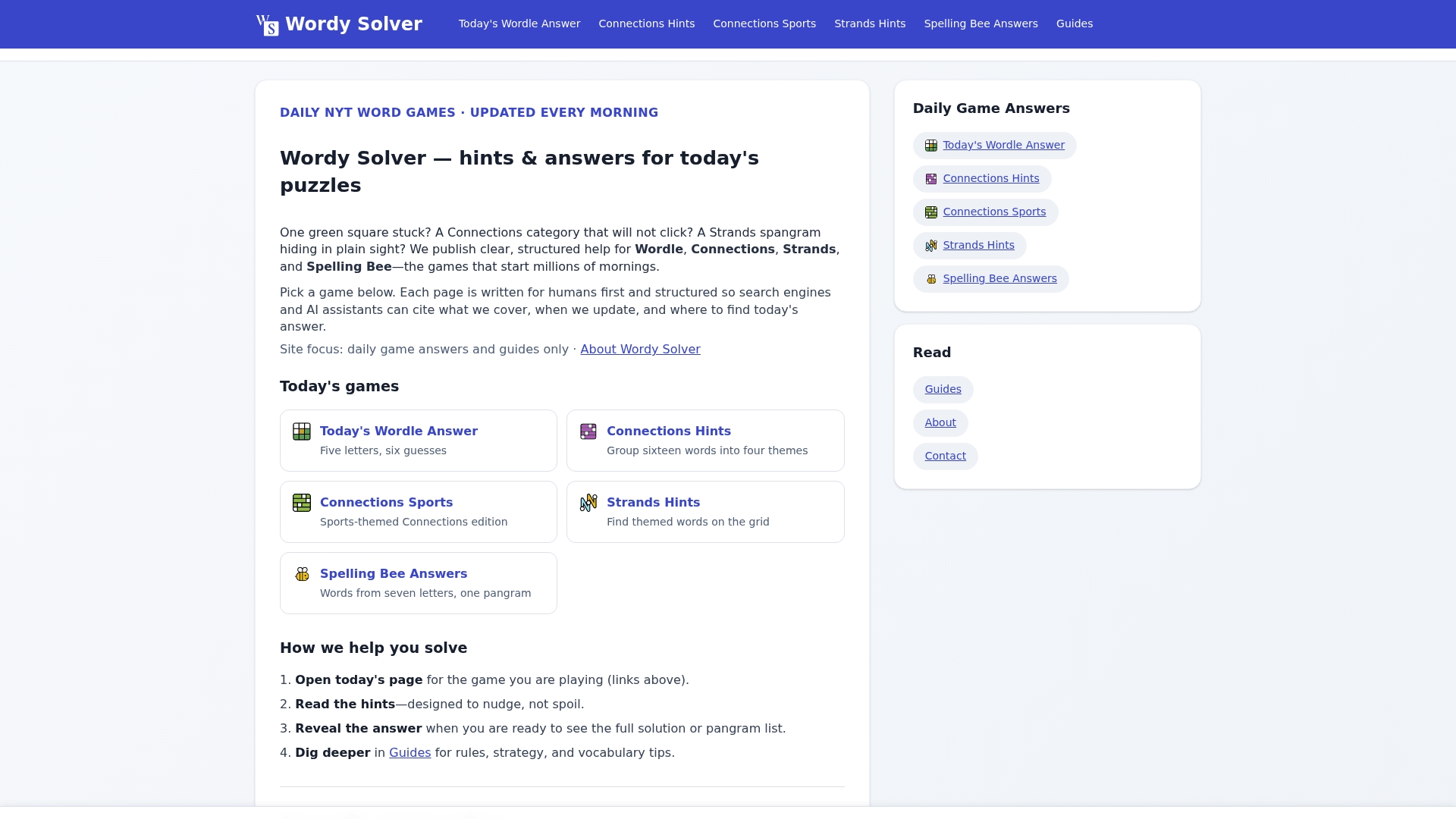
Wordy Solver gives you daily hints and answers for Wordle, Connections, Strands, and Spelling Bee, all structured so you can choose how much help you want. Need just a nudge? Use the hint. Want the full answer? It is right there. No spoilers forced on you, no frustration required. Whether you are building your puzzle skills from scratch or looking for a smarter way to tackle your daily games, Wordy Solver keeps the fun front and center.
FAQ
What is a beginner word puzzle?
A beginner word puzzle is a word-based game designed with simple rules, everyday vocabulary, and no time pressure, making it accessible for new or casual players. Common types include word searches, hangman, and simple anagrams.
How long does a beginner word puzzle take to complete?
Most beginner word puzzles take 2–10 minutes per round for casual players. The short format makes them easy to fit into any part of your day.
What is the best strategy for solving word puzzles as a beginner?
The most effective approach is the two-pass strategy: locate the easiest words or common letter clusters first, then use those as anchors to find the remaining words. Targeting uncommon letters like Q, J, X, and Z also speeds up solving.
Do beginner word puzzles actually improve your vocabulary?
Yes. Regular engagement with word games builds vocabulary through passive exposure and develops pattern recognition linked to better cognitive maintenance in adults. Even five minutes of daily play produces measurable improvement over time.
How do I choose the right difficulty for beginner word puzzles?
Use CEFR-graded puzzles starting at Pre-A1 or A1 level. Move up to A2 or B1 only when the current level feels consistently easy. This grading system removes the guesswork from picking an appropriate challenge.