 Wordy Solver


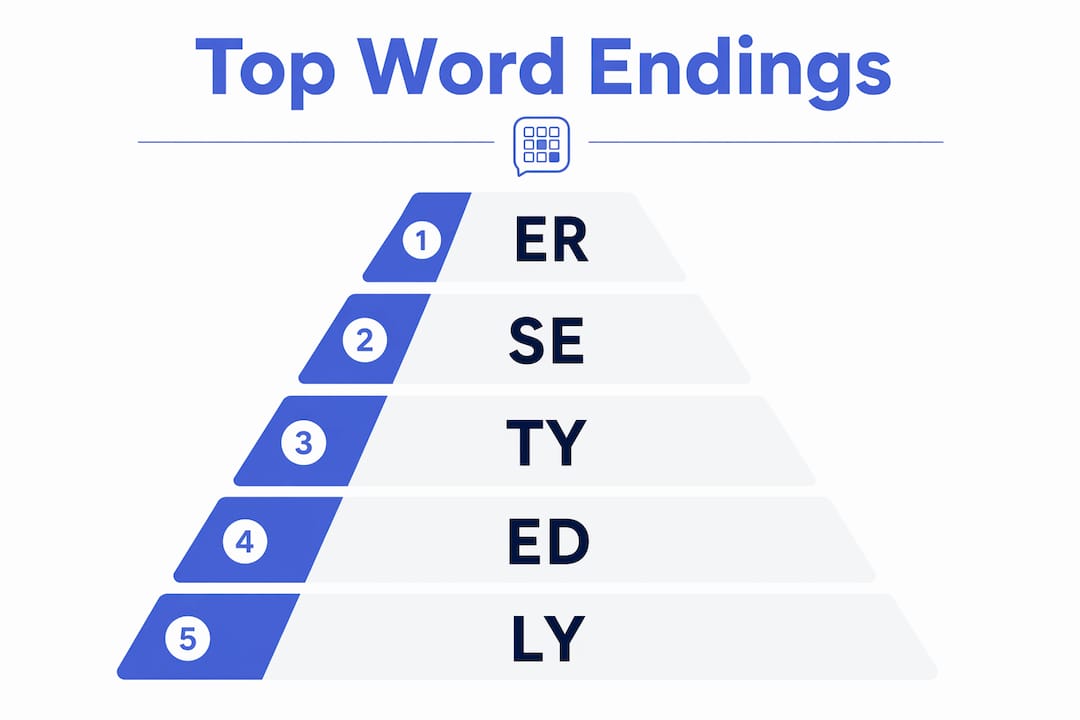
Recognizing the role of common word endings in Wordle is the single fastest way to cut your average guess count. Suffix patterns, the formal linguistic term for recurring word endings, give you a structural shortcut that raw letter frequency alone cannot match. Analysis of the full Wordle answer list shows that among 203 distinct endings, “ER” leads by a wide margin, followed by “SE” and “TY.” That means a large share of daily puzzles end in just a handful of predictable letter pairs. Wordy Solver uses exactly this kind of pattern data to help players guess smarter, not harder.
What is the role of common word endings in Wordle?
Suffix patterns give you positional certainty. When you know a word likely ends in “ER,” you can lock in two tiles and focus all remaining guesses on the first three letters. That is a fundamentally different approach from guessing random five-letter words and hoping for green tiles.
Vowels cluster in the middle of Wordle answers, specifically in the second and third positions. The ends of words are dominated by consonant pairs and short vowel-consonant combos. This positional reality means your opening guess should not waste its final tile on a lone vowel.
The table below shows the most common Wordle endings and why each one matters strategically.
| Ending | Example words | Why it matters |
|---|---|---|
| ER | COVER, TIGER, MOVER | Most frequent ending in the Wordle answer list |
| SE | GOOSE, NURSE, LOOSE | Common in both noun and verb forms |
| TY | DUSTY, RUSTY, NASTY | Signals adjective structure; narrows word class |
| CH | BEACH, TEACH, POUCH | Almost always a digraph block, not solo letters |
| TH | TEETH, CLOTH, BROTH | H almost never ends a word alone |
Pro Tip: Test “ER” as your target ending early. If you confirm those two letters in positions 4 and 5 by guess two, you have eliminated a massive portion of the candidate pool before guess three.
The positional frequency of “S” is a great example of how the curated Wordle word list defies everyday English intuition. In normal English, “S” ends thousands of words as a plural marker. Wordle excludes most simple plurals, so “S” appears far more often as a starting letter than a final one. Players who reflexively guess words ending in “S” are wasting a tile on a low-probability position.
What are rhyme traps and how do you avoid them?
A rhyme trap is what happens when you confirm a word ending and then guess a sequence of rhyming words without testing any new letters. Imagine you know the answer ends in “IGHT.” You guess LIGHT, then NIGHT, then FIGHT, burning three guesses on words that share four identical letters. You have learned almost nothing new about the first letter.
Players who fall into rhyme traps consume unnecessary guesses and reduce their puzzle-solving efficiency significantly. The pattern is extremely common among casual players who feel confident after confirming an ending.
The fix is the burner word strategy. A burner word, sometimes called a scout word, is a guess you make specifically to test multiple new consonants at once, even if you are fairly sure it is not the answer. It sacrifices one guess to eliminate several candidates simultaneously.
These endings are the most common rhyme trap triggers in Wordle:
- IGHT (LIGHT, NIGHT, FIGHT, MIGHT, SIGHT, RIGHT, TIGHT)
- ATCH (CATCH, MATCH, PATCH, WATCH, LATCH)
- OWN (BROWN, CROWN, DROWN, FROWN, GROWN)
- OAT (BLOAT, FLOAT, GLOAT, MOAT, GOAT)
- ANG (BANG, GANG, HANG, RANG, SANG)
- OOL (COOL, FOOL, POOL, TOOL, WOOL)
Burner words that test multiple debated consonants at once are the most efficient escape from a rhyme trap. If you are stuck between LIGHT, NIGHT, and FIGHT, a word like FUNGI or BLEND tests the F, N, and G in one shot.
Pro Tip: When you confirm an ending by guess three, resist the urge to guess rhyming words. Pick a burner word that tests the most likely starting consonants instead. You will almost always solve it in one or two more guesses.
How do you build a Wordle strategy around common endings?
Applying suffix knowledge to your guessing sequence requires a simple three-stage approach.
-
Open with consonant-rich words. Your first guess should target high-frequency consonants like R, T, L, N, and S. Words like CRANE, STOLE, or TRAIL cover multiple common ending consonants while also testing vowel positions. This sets up ending recognition from the very first feedback.
-
Identify the ending block by guess two. Use the feedback from guess one to target the final two positions directly. If you got a yellow “E” from position three, shift it to position five. If “R” was gray, you know “ER” is off the table and can pivot to “SE” or “TY.”
-
Lock the ending, then solve the front. Once you have confirmed the ending, treat it as fixed and focus entirely on positions 1, 2, and 3. This mental separation prevents you from second-guessing confirmed tiles and keeps your remaining guesses efficient.
Common endings provide structural clues that are more actionable than general letter frequency alone. Knowing that “E” often sits in position five tells you less than knowing the specific pair “ER” sits in positions 4 and 5. The pair gives you two confirmed tiles at once.
Pay special attention to digraph endings. Letter combinations like “TH,” “CH,” and “SH” function as single units at the end of words. The letter “H” almost never ends a word by itself in the Wordle answer list. When you see a yellow “H” from a mid-word position, move it to the end as part of a digraph, not as a solo letter.
A strong mid-game pivot word for ending confirmation is ETHER. It tests “E,” “TH,” and “ER” in one guess, covering two of the most common ending structures simultaneously.
How do ending strategies compare to consonant and vowel approaches?
The three main Wordle letter strategies are vowel-heavy openers, consonant-frequency openers, and ending-focused play. Each has a different strength, and the best players combine all three.
Mathematical models show that opening words built around high-frequency consonants like R, T, L, and N narrow the candidate pool faster than vowel-heavy openers like ADIEU. Vowel-heavy words identify letter presence but rarely confirm position, which is the more valuable piece of information.
| Strategy | Best stage | Strength | Weakness |
|---|---|---|---|
| Vowel-heavy opener | Guess 1 | Confirms vowel presence quickly | Weak positional data |
| Consonant-frequency opener | Guess 1–2 | Narrows pool fast | May miss vowel placement |
| Ending-focused play | Guess 2–4 | Locks two tiles, focuses remaining guesses | Requires some prior feedback |
Over-reliance on vowels delays word resolution because vowels carry less differentiating power than consonants in the Wordle answer pool. Ending-focused play solves this by combining positional certainty with consonant structure. You get the best of both approaches.
The practical takeaway is this: use a consonant-rich opener, then shift to ending recognition from guess two onward. Vowel placement will reveal itself as a byproduct of good consonant and ending coverage.
Key takeaways
Mastering common word endings in Wordle is the fastest path to consistent low guess counts because suffix patterns lock in two tiles at once and eliminate entire word families in a single move.
| Point | Details |
|---|---|
| “ER” is the top ending | It leads all 203 distinct Wordle endings; target it early to eliminate large word groups. |
| Avoid rhyme traps | Use burner words to test new consonants instead of guessing sequences of rhyming words. |
| Digraphs act as units | Treat “TH,” “CH,” and “SH” as single blocks when placing letters in end positions. |
| Consonants beat vowels | High-frequency consonants narrow the candidate pool faster than vowel-heavy opening words. |
| Lock the ending, solve the front | Once positions 4 and 5 are confirmed, focus all remaining guesses on positions 1 through 3. |
Why endings changed how I play Wordle
I spent months treating Wordle like a pure letter-frequency puzzle. I memorized which letters appeared most often across all positions and built my opening guesses around that data. My average was stuck at four guesses. The breakthrough came when I stopped thinking about individual letters and started thinking about endings as fixed anchors.
The shift felt counterintuitive at first. You would think knowing that “E” is common is useful. It is, but only when you know it belongs in position five as part of “ER” or “SE,” not floating somewhere in the middle. Once I started locking endings by guess two, the first three positions became a much smaller puzzle to solve.
The mistake I see most often is players confirming an ending and then immediately guessing the most obvious rhyming word. That instinct feels logical but it is a trap. The smarter move is always to test new information first. One well-chosen burner word after confirming an ending will almost always set up a clean solve on the next guess.
If you want to build this skill fast, try a vocabulary building checklist to expand your mental word bank. A wider vocabulary means you recognize more ending patterns instantly rather than having to work them out under pressure.
— Mat C.
Wordy Solver puts ending patterns to work for you
Knowing the theory behind suffix patterns is one thing. Having a tool that applies it in real time is another.
Wordy Solver analyzes letter position data and common ending frequencies to surface the most likely answers for each daily puzzle. Whether you want a gentle hint that points you toward the right ending or the full answer when you are truly stuck, Wordy Solver gives you exactly the level of help you need. It covers Wordle, Connections, Strands, and Spelling Bee, so your entire daily word game routine gets sharper. Give it a try and watch your guess count drop.
FAQ
What are the most common word endings in Wordle?
The most common Wordle ending is “ER,” followed by “SE” and “TY.” These three endings appear across a large share of the full answer list.
How do word endings affect Wordle strategy?
Confirming a two-letter ending by guess two locks in two tiles at once, letting you focus all remaining guesses on just the first three positions. This cuts the candidate pool dramatically faster than guessing random words.
What is a rhyme trap in Wordle?
A rhyme trap happens when you guess multiple words with the same ending in sequence, like LIGHT, NIGHT, and FIGHT, without testing any new letters. It wastes guesses and slows your solve.
Should I use vowel-heavy or consonant-heavy opening words?
Consonant-heavy openers narrow the candidate pool faster. Words built around high-frequency consonants like R, T, L, and N give you more positional information than vowel-heavy words like ADIEU.
How does the letter “H” behave at the end of Wordle words?
The letter “H” almost never ends a Wordle word by itself. It nearly always appears as part of a digraph like “TH,” “CH,” or “SH,” so treat it as a unit when placing it in end positions.