 Wordy Solver


A daily word puzzle language learning checklist is a structured set of daily actions that turns casual word games into deliberate vocabulary practice. Puzzles like Wordle, Connections, and Strands are not just entertainment. Rapid recall and reasoning are strengthened when puzzles deliver immediate feedback and bite-sized repetition, making them genuinely effective study tools. The key is structure. Without a checklist to anchor your practice, you play. With one, you learn.
1. What should a daily word puzzle language learning checklist include?
An effective daily word puzzle checklist targets one micro-skill per session, tracks your results, and keeps sessions short enough to sustain every day. That combination is what separates learners who improve from those who just play.
Your checklist should cover these core components:
- Time block: Allocate 5–10 minutes for Wordle-style games and 10–15 minutes for complex puzzles like Strands. Keeping sessions short prevents burnout and fits any schedule.
- Micro-skill focus: Assign one linguistic goal per session. Examples include synonyms, spelling patterns, collocations, or category inference. Focusing on one micro-skill per puzzle day improves retention and reduces cognitive overload.
- Outcome tracking: Record your number of attempts, the words you learned, and any patterns you noticed. This turns a five-minute game into a data point you can review later.
- Process notes: Write one sentence about what your guesses revealed about the language. Did you discover a new word family? A spelling rule? That note is worth more than the score.
- Vocabulary extension: After each puzzle, write the new word in a sentence or find one synonym. This step moves words from short-term recognition into active use.
Pro Tip: Keep your checklist in a physical notebook or a simple notes app. The act of writing reinforces memory far better than just tapping through a game.
The checklist does not need to be complex. Five focused fields per day, completed consistently, produce measurable gains over weeks.

2. Which word puzzles work best for targeted language practice?
Wordle, Connections, and Strands each train different cognitive and vocabulary skills. Choosing the right puzzle for your daily goal is as important as playing it.
| Puzzle | Primary skill trained | Best for |
|---|---|---|
| Wordle | Vocabulary precision, phonics-like pattern scanning | Spelling awareness, letter frequency |
| Connections | Semantic categorization, flexible thinking | Word relationships, thematic grouping |
| Strands | Visual search, persistence, word recognition | Reading speed, spatial vocabulary |
Wordle trains vocabulary precision through pattern scanning, while Connections builds the ability to group words by meaning. Strands adds a visual layer that strengthens word recognition under pressure. Each puzzle serves a distinct function, and that distinction matters for your checklist.
Alternating puzzle types across the week maintains engagement and supports transfer of skills between contexts. A learner who only plays Wordle gets better at five-letter words. A learner who rotates all three develops cognitive flexibility across vocabulary, categorization, and visual search. That flexibility is what real language fluency looks like.
Pro Tip: Match your puzzle to your weakest skill. If you struggle with word categories, prioritize Connections three days a week until that gap closes.
3. How to build a weekly schedule using your checklist
A weekly schedule built around your checklist turns individual puzzle sessions into a coherent learning program. The goal is balance: vocabulary input, active recall, and reflection spread across seven days.
Here is a practical weekly structure:
- Monday: Wordle + spelling focus. Play Wordle and note every word you considered but rejected. Those near-misses reveal your spelling blind spots.
- Tuesday: Connections + category mapping. After solving, write down the four categories and add two related words to each. This extends the vocabulary beyond the puzzle itself.
- Wednesday: Strands + visual review. Time yourself finding each word. Track whether your speed improves week over week.
- Thursday: Vocabulary extension day. Review your notes from Monday through Wednesday. Write three new sentences using words you encountered this week.
- Friday: Wordle + synonym challenge. For every word you guessed, write one synonym. This builds the word network that fluent speakers rely on.
- Saturday: Free puzzle choice. Play whatever puzzle you enjoy most. Enjoyment sustains the habit when discipline alone would not.
- Sunday: Weekly reflection. Spend five minutes reviewing your checklist notes. What patterns appeared? What words stuck? What still feels unfamiliar?
A 30-day tracking method that captures outcome, process, and vocabulary insights creates a spaced repetition effect with minimal extra time. That means your Sunday review is not just satisfying. It is scientifically sound.
Pro Tip: Do not skip the Sunday reflection. Metacognition, thinking about how you learned, is one of the most powerful retention tools available to language learners.
Vocabulary extension activities like synonym hunting and sentence writing are not optional extras. They are the mechanism that moves puzzle words into your active vocabulary. Without them, you recognize words in puzzles but cannot produce them in conversation.
4. Strategies that improve puzzle performance and deepen language learning
The best puzzle players treat each guess as a test, not a shot in the dark. Efficient players choose guesses to confirm or eliminate common letters systematically, rather than guessing solutions directly. That approach is also the best language learning strategy: use the puzzle as a hypothesis-testing lab.
Here is how to apply that mindset to your daily practice:
- Test letter frequency first. In Wordle, open with words that cover high-frequency letters like E, A, R, I, O, T, N, and S. This is not just good strategy. It teaches you which letters dominate English vocabulary.
- Use wrong answers as data. A failed guess tells you exactly what the word is not. In language learning terms, that is negative evidence, and it is just as valuable as a correct answer.
- Treat Connections categories as vocabulary clusters. When you see a group of words, ask why they belong together. The reasoning process builds semantic networks faster than flashcards.
- Notice what surprises you. If a word appears in a puzzle and you did not know it, that is your checklist entry for the day. Look it up, use it, and track it.
Puzzle success does not equal vocabulary mastery. The cognitive process of hypothesis-testing builds semantic flexibility. The best learners transform puzzle rounds into data extraction sessions to understand language structure better.
Consistency and a fixed daily routine reduce dropout and improve long-term gains. A simple, repeatable habit outperforms an ambitious one you abandon after two weeks. Keep your checklist boring enough to sustain and specific enough to produce results.
Key takeaways
A structured daily checklist transforms word puzzles from entertainment into a deliberate vocabulary practice system that builds retention, cognitive flexibility, and language fluency over time.
| Point | Details |
|---|---|
| Time allocation matters | Spend 5–10 minutes on Wordle-style games and 10–15 minutes on complex puzzles like Strands. |
| One micro-skill per day | Assign a single focus, such as synonyms or spelling, to reduce overload and sharpen retention. |
| Rotate puzzle types | Alternating Wordle, Connections, and Strands each week builds cognitive flexibility across skills. |
| Track process, not just outcome | Recording guesses, insights, and new words creates a spaced repetition effect over 30 days. |
| Reflection drives retention | A weekly review of checklist notes activates metacognition and locks in vocabulary gains. |
Why checklists changed how I think about puzzle-based learning
I spent years playing daily word puzzles without a system. I enjoyed them, but my vocabulary gains were slow and hard to measure. The shift happened when I started treating each session like a micro-lesson with a defined goal. Suddenly, a five-minute Wordle game became a spelling diagnostic. A Connections round became a vocabulary clustering exercise.
The checklist was the difference. Not because it added complexity, but because it added intention. I started noticing patterns I had always missed: which letter combinations tripped me up, which semantic categories felt thin, which words I recognized but could not define. That awareness is what separates a player from a learner.
The biggest pitfall I see is treating the checklist as a performance tracker rather than a learning tool. Your goal is not a perfect score. Your goal is one new word, one new pattern, one new connection per day. Over 30 days, that compounds into something real. Gamifying study by treating puzzles as logic constraint problems encourages systematic learning that casual play never reaches.
Stick with it even when it feels repetitive. The “boring” consistency is exactly what makes it work.
— Mat C.
Wordy Solver fits right into your daily checklist routine
Your checklist works best when you have reliable support on the days a puzzle stops you cold. Wordy Solver provides structured hints and full solutions for Wordle, Connections, Strands, and Spelling Bee, so you stay in control of how much help you get.
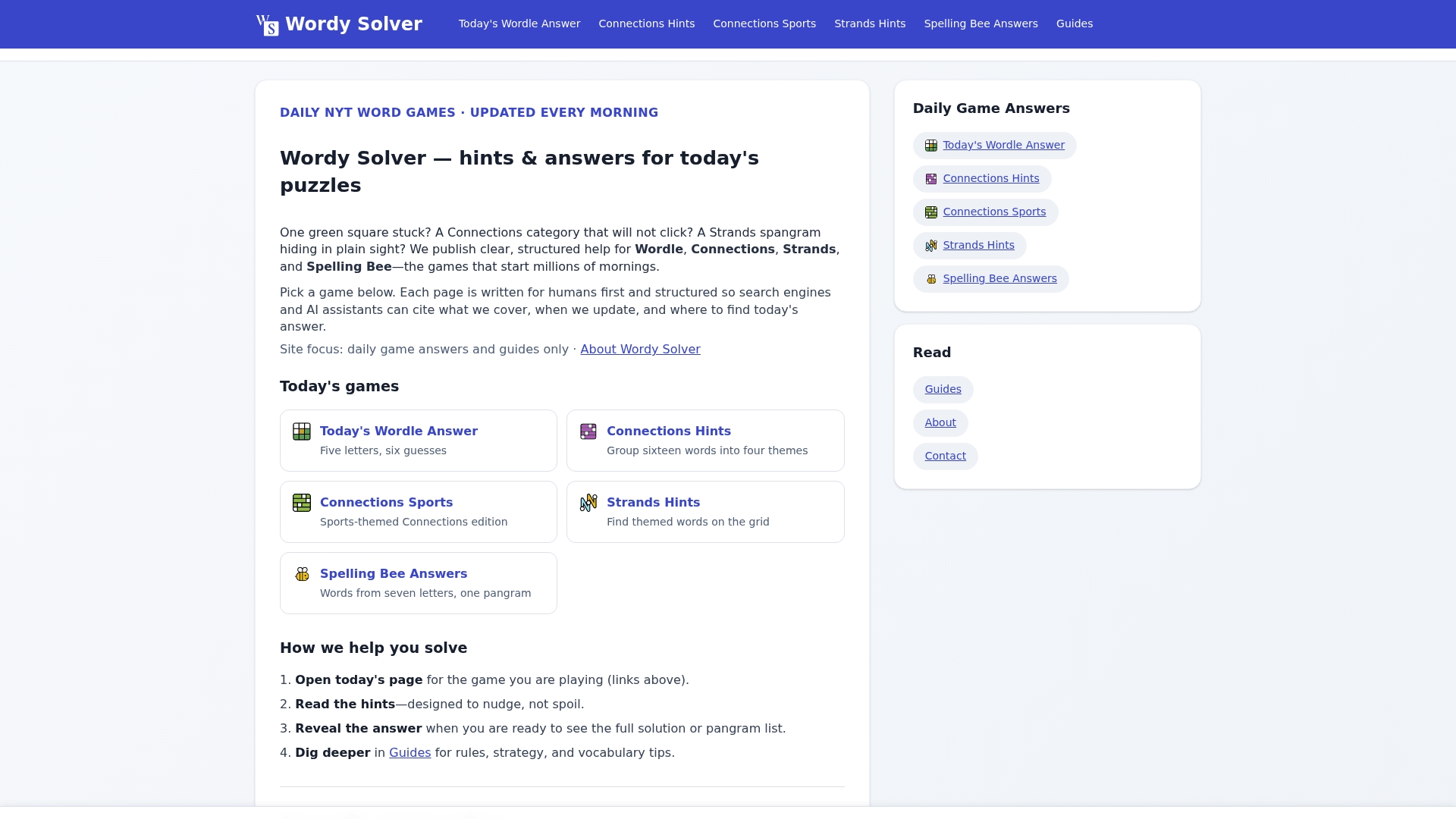
You can choose a nudge that keeps the challenge alive, or reveal the full answer when you need to move on and learn from it. Either way, you keep your streak, your session stays on schedule, and your checklist gets completed. Visit Wordy Solver to get daily hints and solutions that fit your puzzle practice without breaking your flow.
FAQ
What is a daily word puzzle language learning checklist?
A daily word puzzle language learning checklist is a structured set of daily actions that guides learners through focused puzzle sessions, micro-skill practice, and vocabulary tracking to build language skills consistently.
How long should each daily puzzle session last?
Sessions should run 5–10 minutes for Wordle-style games and 10–15 minutes for more complex puzzles like Strands, keeping practice sustainable without fatigue.
Which puzzle is best for vocabulary building?
Wordle builds vocabulary precision and spelling awareness, Connections strengthens semantic categorization, and Strands develops visual word recognition. Rotating all three produces the broadest vocabulary gains.
How does tracking improve language learning through puzzles?
A 30-day consistency loop with daily notes creates a spaced repetition effect that reinforces vocabulary with minimal extra time, turning puzzle play into a high-retention study habit.
Can word puzzles replace traditional vocabulary study?
Word puzzles work best as a daily supplement to traditional study, not a replacement. They build pattern recognition, semantic flexibility, and recall speed, skills that textbooks alone rarely develop.