 Wordy Solver


The elimination strategy in Wordle is a systematic method that uses information theory to shrink the pool of candidate words as fast as possible by maximizing the informational value of each guess. Most players treat Wordle as a guessing game. The elimination approach treats it as a data-collection exercise. That shift in mindset is the single biggest factor separating players who solve puzzles in three guesses from those who burn all six. Research shows this method, grounded in Shannon entropy, achieves a 99% success rate compared to roughly 90% for traditional vowel-heavy approaches. The role of elimination strategy in Wordle is not just helpful. It is the most effective framework for consistent wins.
How does the elimination strategy work in Wordle?
Elimination tactics in Wordle flip the goal of every guess. Instead of asking “what word could this be?”, you ask “what guess will tell me the most?” That question is answered by Shannon entropy, a concept from Claude Shannon’s 1948 information theory work that measures uncertainty in a system.

Each time you guess a word, Wordle returns color feedback: green for a correct letter in the correct position, yellow for a correct letter in the wrong position, and gray for a letter not in the word. Each guess splits the remaining candidate words into smaller groups based on that feedback pattern. The goal is to choose a guess that creates the most even split, leaving the smallest possible group of candidates no matter what colors come back.
Here is how the process works step by step:
- Start with a high-entropy opening word. Choose a word that covers common, spread-out letters. The word “tares” scores about 6.23 bits of expected information, making it one of the strongest openers by entropy calculation.
- Read the color feedback carefully. Every gray letter eliminates all words containing that letter. Every yellow letter eliminates words missing that letter or placing it in the same position. Every green letter locks a position.
- Update your candidate list mentally. After each guess, your working list of possible answers shrinks. Your next guess should target the letters that divide that remaining list most evenly.
- Prioritize information over likelihood. Even if you think you know the answer, an elimination guess on guess three often beats a direct attempt. It protects you from wasting guesses on wrong hunches.
- Commit to the answer only when the list is small. Once two or three candidates remain, guessing the answer directly makes sense. Before that point, keep gathering data.
Pro Tip: Never guess a word you already know is wrong just because it “sounds right.” Every guess is a data point. Make each one count.
The optimal strategy prioritizes maximizing expected uncertainty reduction over the immediate likelihood of a guess being correct. That is the core mechanic that makes elimination so powerful.
What evidence supports elimination strategies in Wordle?
The science behind Wordle elimination methods is not theoretical speculation. Researchers have tested these approaches with large-scale simulations, and the results are clear.
“Information-theory-based elimination strategies transform Wordle into a dynamic feedback system where each guess progressively reduces uncertainty about the solution, splitting remaining candidates into smaller groups and enhancing clue usefulness.”
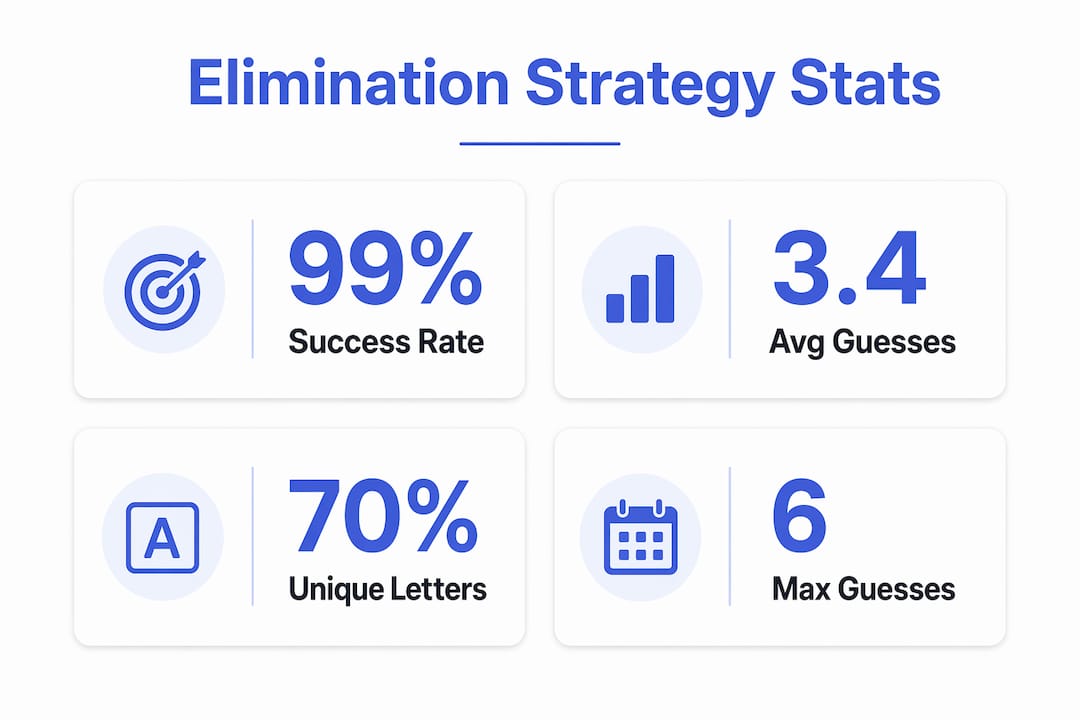
A study applying Shannon entropy to Wordle found that entropy-based solvers achieve a 99% success rate within six guesses. Traditional strategies that prioritize vowels and common letters like A, E, and R land closer to 90%. That 9-percentage-point gap represents a massive difference in daily puzzle outcomes over weeks of play.
Research published via Zenodo found that a greedy heuristic focused on pattern-count maximization, which minimizes the number of remaining possible word groups after each guess, averages about 3.42 guesses per puzzle. This approach approximates near-optimal play without requiring full entropy computation, making it accessible for human players.
| Strategy type | Avg. guesses per puzzle | Success rate within 6 guesses |
|---|---|---|
| Vowel-heavy / traditional | 4.5+ | ~90% |
| Pattern-count maximization | ~3.42 | Near-optimal |
| Full Shannon entropy solver | ~3.4 or fewer | ~99% |
The numbers tell a direct story. Narrowing the candidate word pool beats guessing common or vowel-heavy words every time. The entropy approach does not just improve your odds slightly. It nearly eliminates failure.
What are common misconceptions about elimination tactics in Wordle?
The biggest misconception is that guessing the most likely word first is the best move. It feels logical. If you think the answer is “crane,” why not just guess it? The problem is that a wrong guess on a likely word wastes a turn and gives you minimal information about the remaining candidates.
Most casual players treat Wordle as a direct guessing exercise rather than an information-gathering system. This mindset leads to streaks of five or six guess solutions, and occasional failures, that a structured elimination approach would avoid entirely.
Here are the most common pitfalls players fall into:
- Repeating letter types too early. Guessing “audio” on turn one loads up on vowels but scores only 4.87 bits of expected information. “Tares” scores 6.23 bits. The difference is real and measurable.
- Ignoring gray letters. Gray feedback is just as valuable as green. Every gray letter eliminates a large chunk of the word list. Players who mentally discard gray results miss half the data.
- Guessing intuitively after two turns. After two guesses, the remaining candidate list may still contain 30 or 40 words. Jumping to a direct answer guess at this stage is premature.
- Avoiding “weird” words as guesses. Elimination guesses do not need to be likely answers. A word like “lymph” might be a terrible answer candidate but an excellent third guess for the letters it tests.
Pro Tip: Treat gray letters like gold. Build a mental “dead letter” list after every guess and refuse to use those letters again. This single habit cuts your average guess count faster than any other adjustment.
About 70% of Wordle answers contain all unique letters, which means rare letters like J, Q, X, and Z almost never appear. Knowing this helps you focus your elimination guesses on the letters that actually matter.
How can players apply elimination strategies to improve their gameplay?
Applying Wordle elimination methods in daily play does not require a math degree. A few consistent habits produce most of the benefit.
Start with a proven high-entropy opener. “Tares,” “soare,” and “crane” all score well on expected information gain. Pick one and stick with it. Consistency with your opener builds pattern recognition over time.
After your first guess, follow this process:
- List what you know. Write down confirmed letters, eliminated letters, and position data. Even a quick mental note helps.
- Think in groups, not words. Ask yourself: “Which guess splits my remaining candidates into the most even groups?” This is the core of elimination thinking.
- Use your third guess as a second elimination round if needed. If you still have more than five candidates after two guesses, a third elimination guess is almost always worth it.
- Switch to direct guessing only when the list is short. Two or three candidates is the right time to start guessing answers directly.
For players who want software support, Wordy Solver provides daily hints and solver tools that align with entropy-based approaches. You can use it to check your reasoning or get a nudge when the candidate list feels overwhelming.
The real-time application of full entropy computation requires inputting color feedback into a solver after each guess. For casual players, the pattern-count maximization heuristic, which simply asks “what guess creates the most distinct feedback patterns?”, delivers most of the benefit with far less mental effort.
Key Takeaways
Elimination strategy in Wordle, grounded in Shannon entropy, achieves a near 99% success rate by prioritizing information gain over direct guessing, making it the most effective method for consistent puzzle wins.
| Point | Details |
|---|---|
| Entropy beats intuition | Shannon entropy-based guessing achieves ~99% success vs. ~90% for vowel-heavy methods. |
| Best opener by data | “Tares” scores 6.23 bits of expected information, outperforming popular openers like “audio” at 4.87 bits. |
| Gray letters matter | Every gray result eliminates a large portion of candidates. Ignoring gray feedback wastes the most valuable data in the game. |
| Greedy heuristics work | Pattern-count maximization averages ~3.42 guesses per puzzle without requiring full entropy computation. |
| Switch late to direct guessing | Reserve direct answer guesses for when two or three candidates remain. Eliminate first, guess second. |
Why the “gather information first” mindset changed how I play
The moment I stopped trying to guess the word and started trying to shrink the list, my average solve dropped noticeably. That sounds obvious in hindsight, but it runs against every instinct you have when you think you see the answer forming.
The hardest part is resisting a confident guess on turn three when you think you know the word. I have lost streaks that way. You guess “brave” because it fits everything you know, it comes back wrong, and suddenly you have three guesses left and a list that is still wide open. An elimination guess on turn three, even a word you know is not the answer, almost always leaves you in a better position on turn four.
What I find genuinely satisfying about this approach is that it turns a five-letter word game into something closer to a logic puzzle. You are not hoping to get lucky. You are working through a decision tree. When you solve it in three guesses using pure elimination, it feels earned in a way that a lucky second-guess never does.
The one caution I would offer: do not let the strategy kill the fun. You do not need to calculate entropy in your head. Learning two or three strong opener words and building the habit of reading gray feedback carefully gets you 80% of the benefit. The rest is refinement.
— Mat C.
Wordy Solver makes elimination-based play easier
Knowing the theory behind elimination tactics is one thing. Putting it into practice every day is another, especially when you are short on time or stuck after two guesses.
Wordy Solver gives you structured daily hints and full answer access for Wordle, Connections, Strands, and Spelling Bee. The platform is built around the idea that players should be able to choose how much help they get. You can grab a single hint to nudge your elimination thinking in the right direction, or pull the full answer when you just need to move on with your day. Visit Wordy Solver to sharpen your daily puzzle performance without the frustration of dead ends.
FAQ
What is the elimination strategy in Wordle?
The elimination strategy is an approach where each guess is chosen to maximize the reduction of possible answer words, using information theory rather than direct guessing. It treats every guess as a data-collection step rather than an attempt to name the answer outright.
Why does Shannon entropy matter for Wordle?
Shannon entropy measures the uncertainty in a system. In Wordle, it quantifies how much information a guess is expected to reveal, helping players choose words that shrink the candidate list fastest rather than words that simply seem likely.
What is the best opening word for Wordle?
“Tares” scores approximately 6.23 bits of expected information, making it one of the strongest opening guesses by entropy calculation. Vowel-heavy words like “audio” score lower at around 4.87 bits and leave more uncertainty after the first guess.
How many guesses does the elimination strategy need on average?
A greedy pattern-count maximization approach, which approximates full entropy play, averages about 3.42 guesses per puzzle. Full entropy solvers perform at a similar level and succeed within six guesses roughly 99% of the time.
Do I need software to use elimination tactics in Wordle?
Full entropy computation requires a solver tool to process color feedback in real time. However, using a strong opener, tracking gray letters carefully, and thinking in candidate groups rather than specific words delivers most of the benefit without any software.