 Wordy Solver


Shared Wordle results create conversation by delivering a spoiler-free visual summary of your performance that invites instant comparison, curiosity, and replies. The NYT Wordle emoji grid, made up of green, yellow, and gray squares, communicates how well you solved the puzzle without ever revealing the answer. That single design decision turned a solitary word game into one of the most talked-about daily rituals on social media. Understanding how shared Wordle results create conversation explains why millions of players post their grids every morning and why those posts keep generating replies.
How does the Wordle share format encourage comments and replies?
The Wordle share format is built to generate social responses. The emoji grid communicates performance at a glance using green, yellow, and gray feedback without ever revealing the secret word. That single design choice removes the biggest barrier to sharing: the fear of spoiling the puzzle for friends who haven’t played yet.
The result is a format that feels safe to post anywhere. Group chats, Twitter, Reddit, and family text threads all become fair game because the grid protects the answer. Observers see success or failure instantly, and the grid invites comparison without a single word of explanation needed.
Several design elements work together to make this happen:
- Visual distinctiveness. The colored squares stand out in any feed, stopping scrollers mid-swipe.
- Instant readability. Anyone who has played Wordle once can decode another player’s grid in seconds.
- Spoiler protection. The format disincentivizes spoiling to keep conversation constructive and curiosity alive.
- Social proof. Seeing a friend’s six-guess struggle or a two-guess miracle motivates others to share their own results.
- Low effort to engage. A quick “I got it in 4!” reply takes five seconds, lowering the barrier to joining the conversation.
Pro Tip: Post your Wordle grid with a short reaction like "Rough one today " to give friends an easy hook for replying without any spoiler risk.
The social proof effect is especially powerful. When you see a friend post a grid, you want to compare. That comparison instinct is the engine behind why sharing Wordle scores generates so much back-and-forth engagement every single day.
Why does daily scarcity make Wordle results a shared event?
Wordle’s one-puzzle-per-day design is not a limitation. It is the feature that makes the game socially electric. Everyone plays the same puzzle on the same date, which turns private gameplay into a daily communal ritual. That shared context gives players an automatic reason to reach out to each other.
Think about what that means in practice. You and your coworker, your college roommate, and your neighbor all faced the exact same five-letter challenge this morning. That common experience creates a natural conversation opener that requires no setup. “Did you get today’s word?” works as small talk in any context.
The one-per-day format creates a predictable social rhythm in four distinct ways:
- Synchronized play windows. Most players tackle the puzzle in the morning, which clusters sharing into a peak window of social energy. Conversation peaks when group shares cluster, creating a buzzing moment of collective engagement.
- Universal reference point. Because there is only one puzzle, every conversation refers to the same challenge. There is no confusion about which puzzle someone means.
- Recurring ritual. Daily repetition builds habit. Players come to expect the morning share, and that expectation sustains the community over weeks and months.
- Scarcity-driven urgency. You cannot go back and play yesterday’s puzzle. That urgency pushes players to engage while the conversation is live, not hours later.
Wordle’s one-per-day constraint transforms it into a social event where shared results facilitate friendly interaction and casual competition. Asynchronous shares still sustain discussion at lower volume, but the morning cluster is where the real conversational energy lives.
What makes the emoji grid a unique visual language?
The Wordle emoji grid functions as a compressed visual language. Viewers quickly infer difficulty and guess strategy from the pattern of squares, making commentary easier for casual players who might not know how to describe their solving process in words. A grid heavy with yellow squares tells a story of near-misses. A grid with green squares in the first two rows signals a confident, fast solve.
This visual shorthand lowers the cognitive cost of engaging. You do not need to write a paragraph explaining your thought process. The grid does it for you, and that efficiency is exactly why colored tile grids fuel social media conversations without revealing the solution.

Here is how the Wordle share format compares to other game sharing methods:
| Sharing method | Spoiler risk | Visual appeal | Conversation trigger |
|---|---|---|---|
| Wordle emoji grid | None | High | Instant comparison |
| Screenshot of score | Low to medium | Medium | Score-based replies |
| Text description | High | None | Limited, spoiler-prone |
| Leaderboard rank | None | Low | Competitive only |
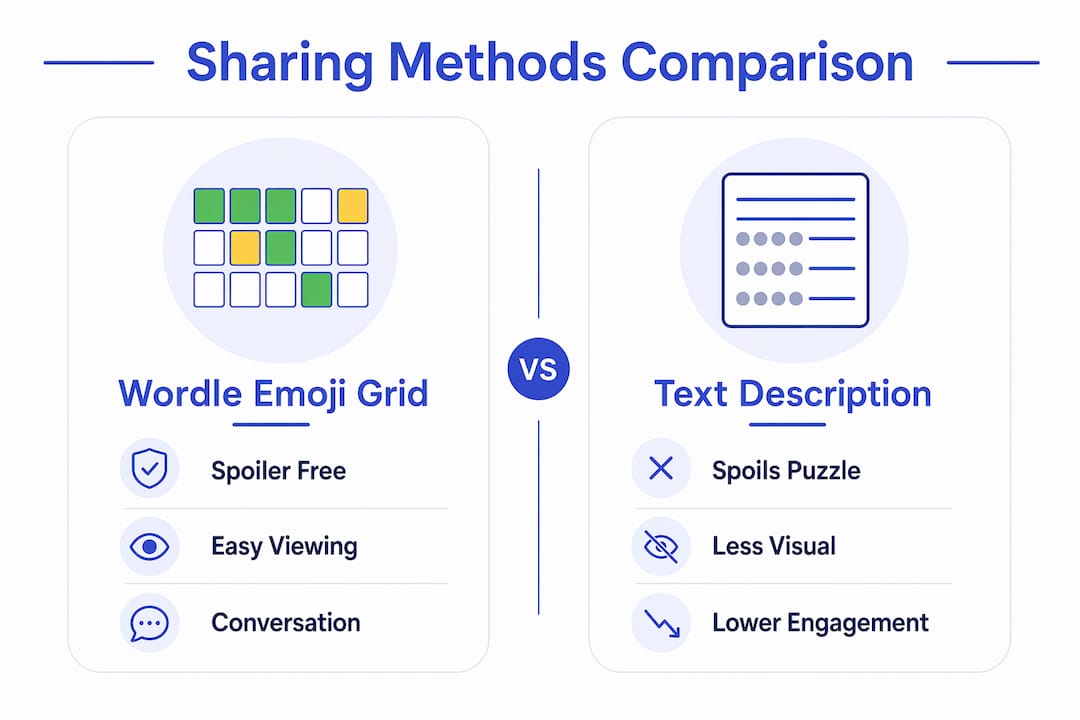
The Wordle format wins on every dimension that matters for social sharing. It protects the puzzle, looks great in any feed, and gives viewers an immediate reason to respond.
Pro Tip: When you share your grid, include the puzzle number (e.g., “Wordle 1,769 4/6”) so friends can instantly match your result to their own experience.
The sharing format balances social proof with puzzle secrecy, which maximizes conversation while protecting gameplay. That balance is not accidental. It is the reason the emoji grid became a viral format copied by dozens of other daily puzzle games, from Quordle to Heardle.
How can you use Wordle results as conversation starters?
Shared results are only the beginning. The way you frame your share determines how much conversation it generates. Focused questions about non-spoiler aspects, like number of guesses or first guess, are the most effective at generating discussion. They invite comparison without ever risking a spoil.
Here are the most effective ways to turn your daily Wordle share into a genuine conversation starter:
- Lead with your guess count, not the word. “Got it in 3 today, personal best!” invites celebration and comparison without spoiling anything.
- Ask about first guesses. “What’s your go-to starter word?” is one of the most reliably engaging Wordle questions in any group chat.
- Share in group chats with a challenge. Posting your grid in a family or friend group with “Beat me!” creates friendly competition and pulls in players who haven’t shared yet.
- Comment on difficulty. “That one was brutal” or “Easiest puzzle in weeks” gives friends a reaction to respond to, even before they’ve played.
- Track streaks publicly. Mentioning your current streak (“Day 47 in a row!”) invites others to share theirs and creates an ongoing thread of accountability.
- Use the puzzle number as a reference. Saying “Wordle 1,769 got me” lets anyone who played that day immediately connect with your experience.
The key principle behind all of these is simple: structure your prompts around process and timing, not the answer. The emoji grid already acts as a spoiler boundary, so your words just need to open the door to comparison and reaction.
Key takeaways
Shared Wordle results create conversation because the emoji grid delivers a spoiler-free visual summary that triggers social comparison, curiosity, and daily communal engagement.
| Point | Details |
|---|---|
| Spoiler-free design drives sharing | The emoji grid shows performance without revealing the answer, removing the biggest barrier to posting. |
| Daily scarcity creates a shared event | One puzzle per day gives every player the same reference point, making “Did you get it?” a universal opener. |
| Visual language lowers engagement cost | Green, yellow, and gray squares communicate difficulty and strategy instantly, inviting replies with minimal effort. |
| Non-spoiler prompts generate the most replies | Questions about guess count, first word, and streaks spark discussion without risking the puzzle for others. |
| Synchronous sharing amplifies conversation | Morning sharing clusters create a peak window of social energy that sustains the Wordle community daily. |
The social magic hiding in six rows of squares
I have played a lot of daily word games, but Wordle’s sharing mechanic genuinely surprised me. Most games ask you to share a score. Wordle asks you to share a story. Those six rows of colored squares tell a narrative: the false starts, the lucky guesses, the near-misses. That narrative quality is what makes people reply instead of just scrolling past.
What strikes me most is how the format solves a problem most game designers never think about. Sharing usually means spoiling. Wordle’s designers flipped that entirely. The grid reveals everything about your experience and nothing about the answer. That is an elegant solution, and it explains why the format spread so fast across social media in early 2022.
The deeper insight is about community. Wordle does not just create conversation. It creates recurring conversation with the same people, around the same challenge, every single day. That repetition builds genuine social bonds. I have seen friendships rekindled and office rivalries sparked entirely through daily grid comparisons. A six-row emoji grid turns out to be a surprisingly powerful social object.
— 16
Wordysolver makes every Wordle day more rewarding
Getting stuck on a tough puzzle should not kill your enthusiasm for sharing and discussing your results. Wordysolver gives you structured hints for daily Wordle, Connections, Strands, and Spelling Bee so you can stay in the game and keep the conversation going.
Whether you want a gentle nudge to get unstuck or the full answer when time is short, Wordysolver’s daily hints put you back in control. You choose how much help you get, which means you always have something worth sharing at the end of the day. Visit Wordysolver and make sure today’s puzzle never leaves you with nothing to post.
FAQ
Why do people share Wordle results on social media?
People share Wordle results because the emoji grid communicates performance without spoiling the answer, making it safe and satisfying to post publicly. The format invites comparison and replies, which turns a solo puzzle into a social experience.
What is the best way to start a Wordle conversation?
Ask about guess count or starting word rather than the answer itself. Questions like “How many guesses did it take you?” generate the most replies because they invite comparison without any spoiler risk.
Does sharing Wordle scores help build community?
Sharing Wordle scores builds community by creating a daily shared reference point that gives players a recurring reason to connect. The one-puzzle-per-day format means everyone faces the same challenge, which sustains ongoing group conversations.
Why does the Wordle emoji grid work better than a text description?
The emoji grid communicates difficulty and guess strategy visually in seconds, while a text description risks revealing the answer. The grid’s spoiler-free design is the core reason it became the dominant sharing format for daily word games.
Can sharing Wordle results spoil the puzzle for others?
The standard Wordle emoji grid does not reveal the answer, so sharing it never spoils the puzzle. The format was specifically designed to show your solving path while keeping the secret word hidden.