 Wordy Solver


Word game hints define new terms by delivering contextual clues that push players to decode meaning through usage, not memorization. This process mirrors how children naturally acquire language: through repeated exposure, pattern recognition, and active guessing. Research shows that vocabulary test scores rose from 43.05 to 72.47 after just two cycles of Word Chain Game play. That jump proves hints do more than nudge you toward an answer. They wire new words into your long-term memory. Whether you play Wordle, Connections, Strands, or Spelling Bee, understanding how word game hints define new terms turns every puzzle into a vocabulary workout. Wordy Solver is built around exactly this idea.
How word game hints define new terms through context
Word game hints work as contextual retrieval tools, not simple answer keys. When a hint points you toward a word’s meaning through usage rather than a dictionary entry, your brain builds a richer, more durable memory trace. This is the core mechanism behind contextual retrieval, which research identifies as superior to rote memorization for long-term vocabulary retention.
Semantic proximity is a key part of this process. Games like Contexto use semantic vector models such as Word2Vec and GloVe to rank your guesses by how closely they appear in similar sentences across millions of texts. This means antonyms can rank as close neighbors because they share the same conversational contexts. When you see “cold” ranked near “hot,” you are not just learning a word. You are learning how language clusters around ideas.

Parts of speech sensitivity sharpens this learning even further. A hint that frames a word as an action forces you to think in verbs. A hint that describes a quality pushes you toward adjectives. Recognizing these grammatical signals is a skill that transfers directly to reading comprehension and writing. Players who pay attention to these cues pick up new terms faster than those who focus only on letter patterns.
Here is what to watch for when interpreting hints:
- Definition-style hints give you the meaning directly, which anchors the word in your semantic memory.
- Synonym hints connect the new word to one you already know, building a vocabulary web.
- Sentence-context hints show you the word in action, which is the most powerful form of contextual learning.
- Category hints (as used in Connections) group words by theme, triggering category thinking and flexible recall.
Pro Tip: Focus on word families when a hint reveals a new term. If you learn “arid,” immediately think of “aridity” (noun) and “aridly” (adverb). Studies show that word family focus significantly prolongs vocabulary retention compared to learning isolated words.
What hint types work best for learning new words?
Not all hints are created equal when it comes to vocabulary building. The type of hint you receive shapes how deeply you process a new term. The table below breaks down the four most common hint mechanisms found in popular word games and how each one supports vocabulary development.
| Hint type | How it works | Vocabulary strength | Limitation |
|---|---|---|---|
| Definition-based | States the word’s meaning directly | High: anchors semantic memory immediately | Can feel like reading a dictionary; low engagement |
| Synonym or antonym | Points to a word you already know | Medium: builds word relationships | Requires prior vocabulary to connect the dots |
| Contextual sentence | Shows the word used in a real sentence | Very high: mirrors natural language acquisition | Longer hints slow down fast-paced gameplay |
| Semantic proximity | Ranks guesses by contextual closeness | High: teaches word relationships through play | Abstract; players may not realize they are learning |
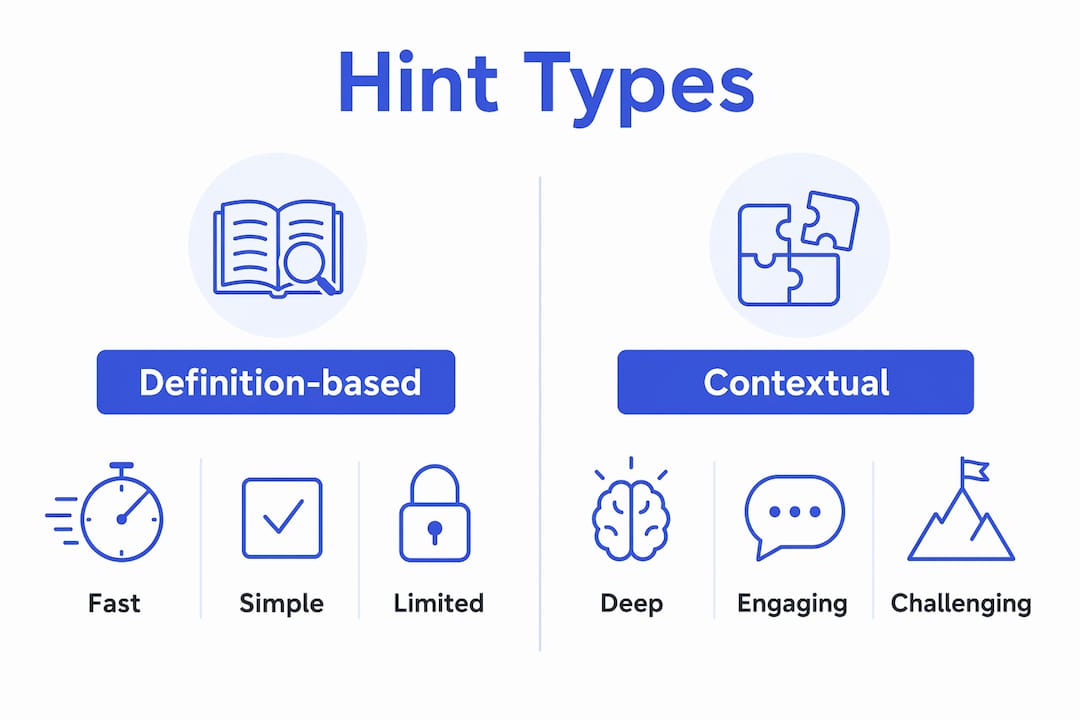
Definition-based hints give you the fastest path to a correct answer, but they do the least cognitive work. Contextual sentence hints, by contrast, force your brain to infer meaning from usage, which is how gameplay creates memorable learning experiences that build flexible problem-solving skills.
Immediate feedback is the secret weapon across all hint types. When you guess wrong and receive a corrective hint right away, your brain flags the gap between what you expected and what was correct. That surprise signal strengthens memory encoding. Repetition across multiple game sessions then consolidates the new term into long-term storage. This is why playing daily word puzzles builds vocabulary faster than a single study session ever could.
Strategies to maximize vocabulary gain from hints
Knowing that hints teach vocabulary is one thing. Using them deliberately is another. These strategies turn passive hint-reading into active word acquisition.
-
Use the branching technique. Start with an anchor word you know and systematically add prefixes and suffixes to find related, less obvious terms. The branching technique helps serious players move beyond obvious guesses and uncover complex vocabulary they would not have considered otherwise. For example, starting with “form” leads you to “reform,” “deform,” “conform,” “formation,” and “formless.”
-
Build a mental sentence immediately. The moment a hint reveals a new word, construct a sentence using it before moving on. This mental sentence construction activates the same neural pathways as contextual sentence hints and dramatically improves recall. Do not skip this step even when you are in a hurry.
-
Focus on anchor words with high suffix potential. Words ending in “-tion,” “-ment,” or “-ness” signal noun forms. Words starting with “un-,” “re-,” or “pre-” signal modified meanings. Recognizing these patterns lets you decode unfamiliar words from partial hints faster than guessing randomly.
-
Lean into emotional engagement. Research confirms that higher motivation predicts better vocabulary test scores in digital game settings, while anxiety inhibits learning. Play games you genuinely enjoy. The emotional reward of solving a puzzle cements new words more effectively than forced study.
-
Review your wrong guesses. Every incorrect guess that earns a hint is a free vocabulary lesson. Write down unfamiliar words you encounter during gameplay. Reviewing them after the session reinforces the contextual memory you built during play.
Pro Tip: Do not treat hints as a shortcut to the answer. Treat them as the lesson itself. Players who pause to absorb a hint’s semantic signal before guessing again learn significantly more new terms per session than those who click through hints quickly.
The do’s and don’ts are simple. Do slow down when a hint introduces an unfamiliar word. Do connect new words to ones you already know. Do not skip the mental sentence step. Do not ignore parts of speech signals in the hint’s phrasing.
How modern word game design reflects vocabulary science
Word game designers are no longer building puzzles purely for entertainment. The best games now embed vocabulary science directly into their hint logic. This shift reflects a growing understanding that vocabulary games function as instructional tools, not just supplementary activities.
Bloom’s Revised Taxonomy maps cognitive learning onto six levels: Remember, Understand, Apply, Analyze, Evaluate, and Create. Modern word games target all six. A simple letter-matching puzzle targets the “Remember” level. A semantic proximity game like Contexto pushes players into “Analyze” and “Evaluate” territory, because you must reason about why two words share a context. Games that ask you to construct words from fragments reach the “Create” level.
The technology behind hint logic has advanced significantly. Semantic vector models like Word2Vec and GloVe train on billions of text samples to map every word’s position in a multidimensional meaning space. When a game tells you your guess is “warm,” it is not using a simple synonym list. It is measuring the distance between word vectors in that semantic space. This means the hint reflects real-world language patterns, not arbitrary rules.
Here is what this means for you as a player:
- AI-driven hints reflect how words are actually used in context, not how they are defined in a dictionary.
- Antonyms often appear as close neighbors in semantic maps, which means a “wrong” guess can still teach you something about a word’s conversational role.
- Games that use semantic proximity train your brain to think in word relationships, which is a skill that transfers directly to reading and writing.
- The gap between entertainment and instruction is closing fast. Playing a well-designed word game for 20 minutes delivers measurable vocabulary gains.
Key Takeaways
Word game hints define new terms most effectively when players treat each hint as a contextual learning signal rather than a shortcut to the answer.
| Point | Details |
|---|---|
| Contextual retrieval beats memorization | Hints that show word usage in context build stronger, longer-lasting vocabulary than definitions alone. |
| Semantic proximity teaches word relationships | Games using Word2Vec-style logic train players to think in word clusters, not isolated terms. |
| Branching technique expands vocabulary fast | Starting from an anchor word and adding prefixes or suffixes uncovers complex terms efficiently. |
| Motivation drives incidental learning | Higher emotional engagement during gameplay directly predicts better vocabulary retention. |
| Bloom’s Taxonomy maps onto game design | Modern word games target cognitive levels from recognition all the way up to word creation. |
Why hints are the most underrated vocabulary tool in gaming
I have spent years watching players treat hints as a last resort. They exhaust their guesses, reluctantly tap the hint button, grab the answer, and move on. That is the single biggest missed opportunity in word gaming.
The players who grow their vocabulary fastest are the ones who read a hint and ask, “Why does this word fit here?” That question is the whole game. When Connections groups “CRANE,” “HERON,” “EGRET,” and “IBIS” together, the hint is not just telling you the answer. It is teaching you that these are all wading birds, a category you may never have consciously assembled before. That category now lives in your memory, ready to fire the next time you see “EGRET” in a crossword or a nature article.
What I find most surprising is how many players overlook the emotional dimension. You remember words you felt something about. The mild frustration of a near-miss, followed by the satisfaction of a correct guess, creates a memory spike. That emotional arc is not a side effect of gameplay. It is the mechanism. Researchers studying incidental vocabulary learning in digital games confirm that motivation and emotional state are stronger predictors of retention than raw exposure time.
My honest advice: slow down at the hint. Read it twice. Ask what part of speech the target word is. Ask what other words belong in the same semantic neighborhood. Then guess. You will solve the puzzle and walk away with a word you actually own.
— Mat C.
Wordy Solver puts daily hints to work for you
Wordy Solver gives you structured, spoiler-free hints for Wordle, Connections, Strands, and Spelling Bee every single day. You choose how much help you want. Start with a nudge, or go straight to the full answer when you need it.
The hint tools at Wordy Solver are built around the same contextual learning principles covered here. Each hint is designed to guide your thinking, not replace it. That means every session you spend with Wordy Solver is also a vocabulary session. You get the satisfaction of solving the puzzle and the bonus of walking away with new words that actually stick. Give it a try with today’s puzzle.
FAQ
How do word game hints help you learn new words?
Hints provide contextual clues that force your brain to infer meaning from usage rather than memorize a definition. This contextual retrieval method produces stronger long-term vocabulary retention than rote study.
What is the branching technique in word games?
The branching technique starts with a known anchor word and systematically adds prefixes and suffixes to generate related, more complex vocabulary. It is a proven method for uncovering valid words that go beyond obvious first guesses.
Why do semantic proximity games teach vocabulary so effectively?
Games using semantic vector models like Word2Vec rank guesses by how often words appear in similar sentences, which trains players to recognize word relationships and contextual usage patterns rather than just spelling similarities.
Does motivation really affect how much vocabulary you learn from games?
Research confirms that higher motivation directly predicts better vocabulary scores in digital game settings. Anxiety works in the opposite direction, so playing games you enjoy is not just fun. It is more effective.
How does Bloom’s Taxonomy connect to word game design?
Bloom’s Revised Taxonomy maps six cognitive levels from Remember to Create. Well-designed vocabulary games target all six levels, moving players from simple word recognition up through analysis and creative word construction.