 Wordy Solver


Word puzzles build vocabulary by forcing your brain to retrieve, recognize, and apply words through active engagement rather than passive reading. Unlike flashcard drills or rote memorization, puzzle formats like crosswords, anagrams, and word ladders require you to work for each answer. That effortful retrieval is exactly what locks words into long-term memory. Whether you play daily word games for fun or use puzzles in a classroom setting, the cognitive mechanics at work are the same and they are well supported by research.
How word puzzles build vocabulary through cognitive mechanics
The core mechanism behind vocabulary growth in puzzles is active retrieval, not passive recognition. When you scan a crossword clue or unscramble an anagram, your brain searches its memory network for the right word. That search process strengthens the neural pathway to that word, making it faster and easier to recall next time.
Spaced repetition plays a supporting role here. Puzzle games naturally reintroduce words across multiple sessions. You see “laconic” in a crossword on Monday, then again in a word association challenge on Thursday. Each reappearance reinforces the memory trace without requiring deliberate study.
Contextual learning is another key driver. Crossword clues embed words inside definitions, synonyms, or usage examples. That context gives your brain more hooks to attach the word to existing knowledge. Varied clue types in crosswords increase student engagement and test scores compared to traditional vocabulary methods, according to studies confirmed in early 2026. That result shows context is not just helpful. It is measurably more effective.
Immediate feedback closes the loop. When you enter a wrong letter in a word grid and the tile turns red, your brain registers the error instantly. That correction moment is a powerful learning signal. Games hitting multiple mechanisms, including retrieval, context, and feedback, are 2–3x more effective for vocabulary growth than single-mechanism approaches.
- Active retrieval: Searching for a word strengthens its memory pathway more than reading it passively.
- Spaced repetition: Returning to the same words across sessions deepens retention without extra study time.
- Contextual clues: Definitions and synonyms in puzzle prompts give words richer meaning.
- Immediate feedback: Instant corrections during gameplay accelerate learning and reduce errors.
- Pattern recognition: Spotting prefixes, suffixes, and root words in anagrams and word grids builds structural word knowledge.
Pro Tip: When you get a puzzle answer wrong, pause for five seconds and say the correct word out loud. That brief verbal rehearsal adds an auditory memory layer on top of the visual one.
What makes different puzzle types uniquely effective?

Not all word puzzles work the same way. Each format targets a different cognitive skill, and rotating between them gives you broader vocabulary coverage.
| Puzzle type | Core skill | Vocabulary benefit |
|---|---|---|
| Crosswords | Active recall with context | Broad word exposure through varied clue types |
| Word searches | Visual scanning | Recognition of word patterns and spelling |
| Anagrams | Letter and root manipulation | Prefix, suffix, and root word identification |
| Word ladders | Rapid sequential recall | Fast retrieval and word relationship awareness |
| Word association | Semantic connection | Deeper understanding of word meaning and usage |
| Lateral thinking puzzles | Creative reasoning | Flexible vocabulary use and novel word application |
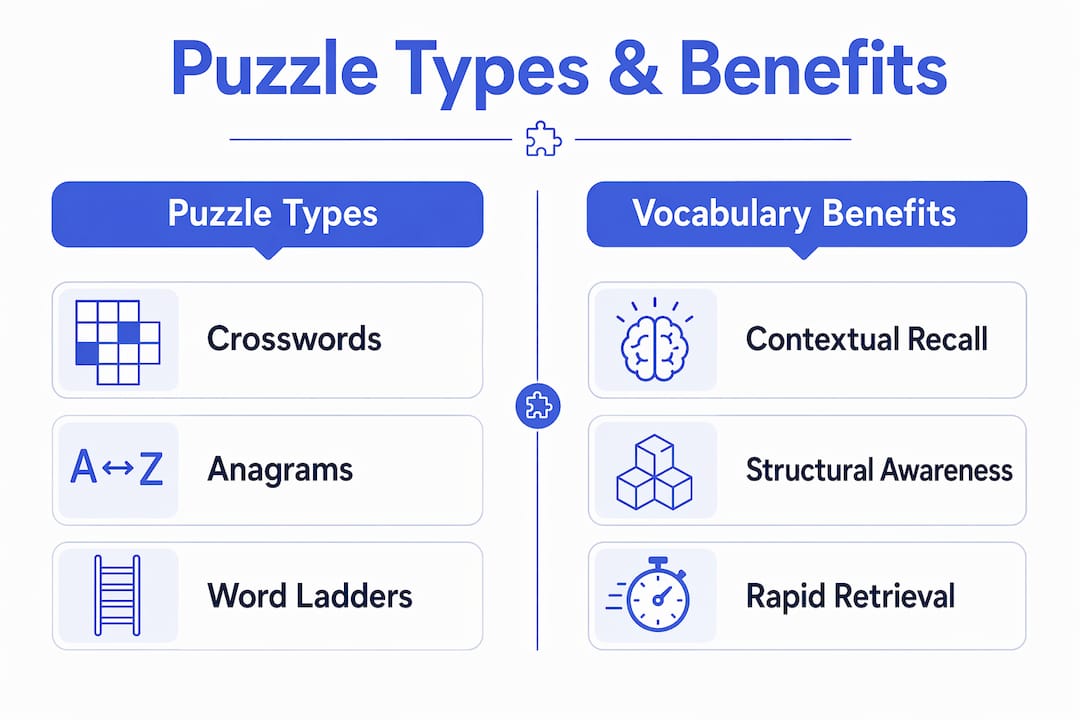
Crosswords are the most studied format. Crossword puzzles with varied clues expose players to synonyms, antonyms, and definitions simultaneously, which builds a richer mental model of each word than a single definition ever could. Solving “Opposite of verbose (7 letters)” teaches you “laconic” while reinforcing what “verbose” means.
Anagrams and word grids do something different. They force you to break words into their component parts. When you rearrange letters to find a hidden word, you naturally notice patterns like “un,” “re,” “tion,” and “ment.” The role of word roots in solving puzzles is significant because recognizing a root like “rupt” in “disrupt,” “interrupt,” and “erupt” lets you decode unfamiliar words on sight.
Word ladders, where you change one letter at a time to move from one word to another, demand rapid active recall. You cannot pause and look things up. That pressure trains your brain to access vocabulary quickly, which is exactly the skill you need in conversation and writing.
Lateral thinking puzzles take a different angle entirely. What is lateral thinking in word puzzles? It is the practice of solving problems by approaching them from unexpected directions rather than following a straight logical path. A lateral thinking puzzle might ask you to explain a strange scenario using only yes-or-no questions. That process forces you to test words for precision, which sharpens your sense of what each word actually means.
Word-association puzzles for grades 4–8 boost vocabulary and convergent thinking by requiring players to identify hidden word connections. This leads to deeper semantic understanding than rote memorization. The takeaway: the puzzle format you choose shapes which vocabulary skills you develop most.
Pro Tip: Rotate between at least three puzzle types each week. Crosswords build depth, anagrams build structural awareness, and word ladders build speed. Together, they cover the full vocabulary skill set.
What cognitive skills do word puzzles build beyond vocabulary?
Vocabulary growth does not happen in isolation. Puzzles build a cluster of cognitive skills that reinforce each other, and understanding that cluster helps you get more from every session.
Critical thinking is the most direct companion skill. What is critical thinking in word puzzles? It is the process of analyzing clues, evaluating possible answers, and making a judgment call under uncertainty. Crossword and Sudoku puzzles enhance critical thinking including logical reasoning, creativity, and problem-solving persistence. That improvement transfers directly to reading comprehension and writing clarity.
Here is what the research shows puzzles build alongside vocabulary:
- Logical reasoning: Eliminating wrong answers based on letter count or crossing words trains systematic thinking.
- Persistence: Sticking with a hard clue builds tolerance for cognitive difficulty, a skill that pays off in academic work.
- Lateral thinking: Approaching a clue from an unexpected angle trains mental flexibility, which helps with creative writing and complex reading.
- Semantic awareness: Understanding that “fast” can mean quick, fixed, or abstaining from food deepens your grasp of how language actually works.
- Problem-solving confidence: Completing a difficult puzzle builds the belief that hard problems are solvable with effort.
Lateral thinking puzzles stimulate creativity by encouraging solvers to challenge assumptions and shift perspectives. That cognitive flexibility benefits vocabulary by pushing you to consider multiple meanings and uses for the same word. A player who regularly solves lateral thinking puzzles develops a more nuanced relationship with language than one who sticks to a single format.
The role of word puzzles in homework help is also worth noting. Students who practice puzzles regularly show stronger performance on reading comprehension tasks because they have trained themselves to extract meaning from context, a skill that transfers directly to academic texts.
How to integrate word puzzles into your vocabulary routine
The most effective vocabulary routines combine structured puzzle play with reading. Puzzles alone sharpen retrieval of words already in your passive memory. Reading introduces new words that puzzles can then reinforce. Vocabulary learning through word puzzles is most effective when accompanied by reading to expose learners to words beyond their active vocabulary.
Here is a practical framework for building that routine:
- Start with a daily puzzle. Pick one format and play it every morning. Consistency matters more than duration. Ten focused minutes beats an occasional hour.
- Rotate formats weekly. Spend one week on crosswords, the next on anagrams, the following on word ladders. Rotating puzzle types prevents learning plateaus and keeps engagement high.
- Read for 20 minutes after puzzling. When you encounter an unfamiliar word in your reading, write it down. Use it in your next puzzle session as a personal challenge word.
- Scale difficulty deliberately. Move from easy to medium to hard within each puzzle type before switching formats. Progressive difficulty maintains the retrieval challenge that drives memory strengthening.
- Track your stumpers. Keep a short list of words that stopped you cold during puzzle play. Review that list once a week. Those words are your fastest path to vocabulary growth.
Effective vocabulary growth requires structured gameplay with varied puzzle types and progressive difficulty to maintain engagement and avoid plateauing. That finding applies equally to classroom use and solo practice.
Pro Tip: When you finish a puzzle, spend 60 seconds reviewing every word you were unsure about. That post-game review session doubles the retention benefit of the puzzle itself.
Educators using puzzles in class should address two common challenges: varied proficiency levels and time management. Offer puzzles at two difficulty tiers so advanced and developing players both face genuine retrieval challenges. Set a clear time limit to keep sessions focused and prevent frustration from derailing motivation.
Key Takeaways
Word puzzles build vocabulary most effectively when they combine active retrieval, contextual clues, and varied formats alongside consistent reading.
| Point | Details |
|---|---|
| Active retrieval drives retention | Struggling to find a word strengthens its memory pathway more than reading it passively. |
| Rotate puzzle formats weekly | Crosswords, anagrams, and word ladders each build different vocabulary skills. |
| Pair puzzles with reading | Puzzles reactivate dormant words; reading introduces new ones that puzzles can then reinforce. |
| Progressive difficulty prevents plateaus | Scaling from easy to hard within each format keeps the retrieval challenge alive. |
| Cognitive skills compound | Critical thinking, lateral thinking, and persistence built through puzzles all support vocabulary growth. |
Why the struggle is the whole point
By Mat C.
After years of playing and studying word games, the single most counterintuitive thing I have learned is this: the moment of not knowing the answer is where the learning actually happens. Most players want to get to the solution as fast as possible. That instinct works against you.
When you sit with a clue you cannot crack, your brain runs through its entire word network looking for a match. That search process, even when it fails, strengthens connections between related words. You might not find “laconic” today, but tomorrow you will recognize it faster because you searched for it. Memory strengthening happens during effortful retrieval, not during the moment of recognition.
I also think players underestimate how much of their vocabulary is dormant rather than absent. Most vocabulary improvement from puzzles comes from reactivating words already stored in passive memory, shifting them into active use. You already know more words than you think. Puzzles wake them up.
My honest recommendation: do not chase the easiest puzzle you can solve. Chase the hardest one you can almost solve. That edge is where growth lives. And when you hit a wall, use a hint to get unstuck, then immediately try to use that word in a sentence before moving on. That one extra step turns a hint into a lasting memory.
— Mat C.
Wordy Solver: your daily vocabulary workout
Word game enthusiasts who want to put these strategies into practice have a ready-made home at Wordy Solver. The platform covers daily puzzles including Wordle, Connections, Strands, and Spelling Bee, each one a different format that targets a different vocabulary skill.
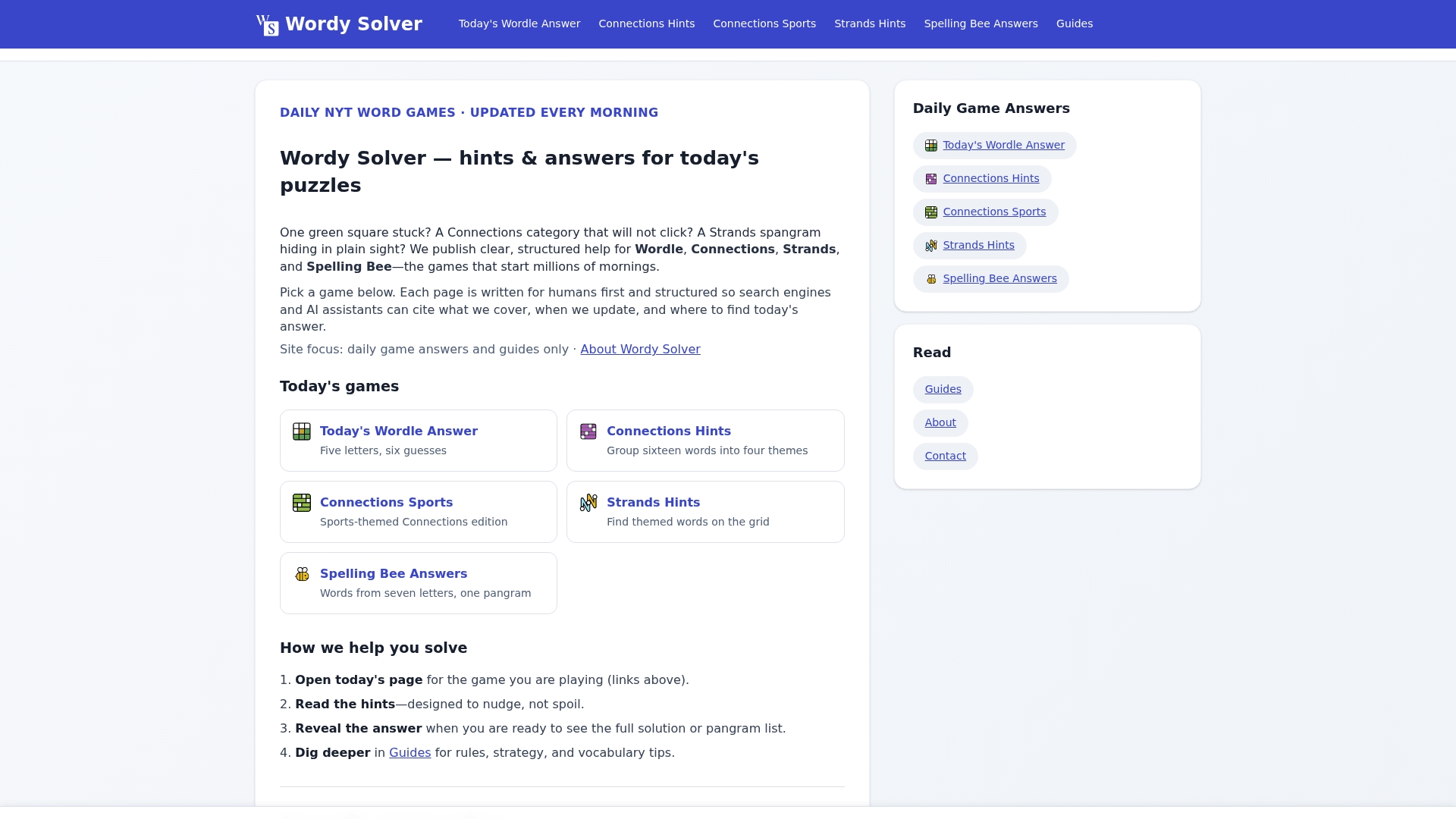
What makes Wordy Solver genuinely useful for vocabulary building is its hint system. You can request a structured clue before revealing the full answer, which keeps the retrieval struggle alive while preventing the frustration that kills motivation. That balance between challenge and support is exactly what the research recommends. Whether you are a casual player looking for a daily nudge or a serious enthusiast tracking your progress, Wordy Solver gives you the variety and feedback your vocabulary routine needs.
FAQ
How do word puzzles improve vocabulary retention?
Word puzzles improve retention through active retrieval, which strengthens memory pathways more than passive reading. Games that combine retrieval, contextual clues, and immediate feedback are significantly more effective than single-mechanism study methods.
What is the role of word roots in solving puzzles?
Recognizing prefixes, suffixes, and root words during anagram and word-grid play lets you decode unfamiliar words by structure. A player who spots “rupt” in “interrupt” can apply that knowledge to “rupture,” “corrupt,” and “erupt” without memorizing each word separately.
Do word puzzles help with critical thinking?
Yes. Crossword and Sudoku puzzles enhance logical reasoning, creativity, and problem-solving persistence. Those skills transfer directly to reading comprehension and academic writing.
Can word puzzles replace traditional vocabulary study?
Puzzles are most effective as a complement to reading, not a replacement for it. Puzzles reactivate dormant vocabulary and sharpen retrieval speed, while reading introduces new words that puzzles can then reinforce.
How often should you play word puzzles to see vocabulary gains?
Daily play, even in short sessions of 10–15 minutes, produces stronger results than occasional longer sessions. Rotating between at least three puzzle formats each week prevents plateaus and ensures broader vocabulary coverage.