 Wordy Solver


Wordle scoring is defined by how many guesses you use to find the secret five-letter word, with fewer guesses earning more points. The system rewards efficiency above all else. Color-coded tile feedback, green for a correct letter in the right spot, yellow for a correct letter in the wrong spot, and gray for letters not in the word at all, guides every decision you make. Master how wordle scoring works and you stop playing by feel. You start playing by logic.
How is the official Wordle scoring system structured?
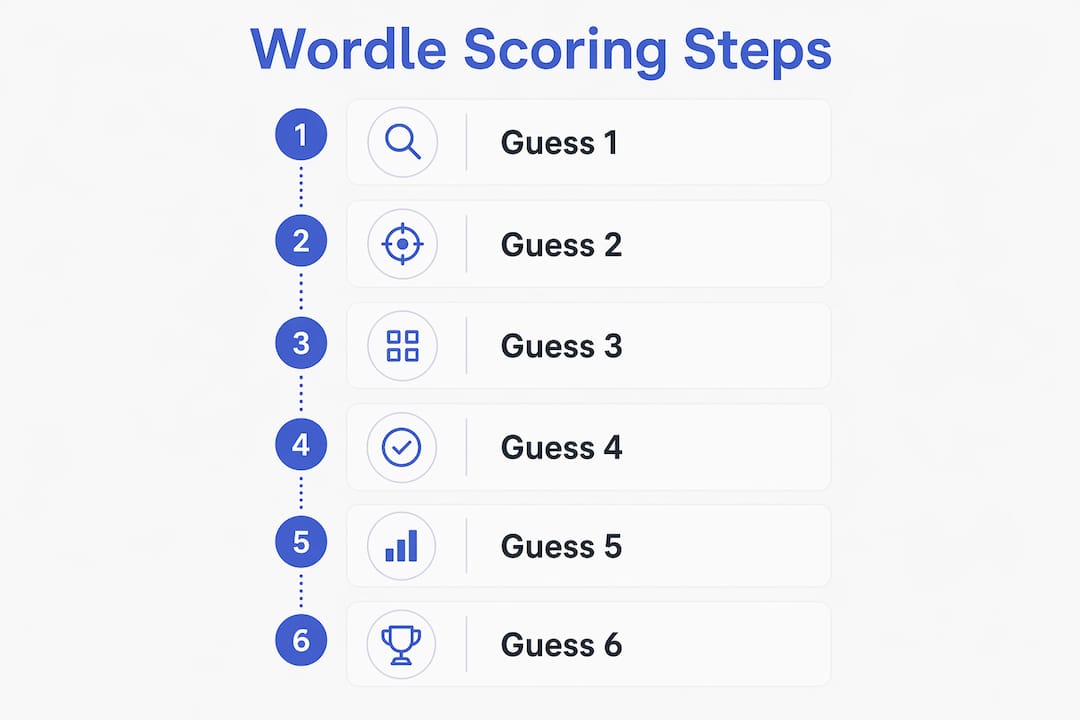
The official scoring system awards points on a sliding scale tied directly to your guess count. Solve in one guess and you earn 3 points. Two guesses earns 2 points. Three guesses earns 1 point. Four guesses earns 0 points. Five guesses costs you 1 point, and six guesses costs you 2 points. Fail to solve the puzzle at all and you score nothing.
That structure means the difference between a good day and a bad day is often just one extra guess. Finishing in three guesses instead of five swings your score by 2 full points. Over a week of daily play, those swings add up fast.
| Guesses used | Points earned |
|---|---|
| 1 guess | 3 points |
| 2 guesses | 2 points |
| 3 guesses | 1 point |
| 4 guesses | 0 points |
| 5 guesses | -1 point |
| 6 guesses | -2 points |
The scoring system punishes passive play. Guessing without a plan and drifting to five or six attempts actively drags your score into negative territory. Every guess you make should eliminate as many possible answers as possible.

Pro Tip: Treat 4 guesses as your personal ceiling, not your average. A score of 0 is not a win. Push yourself to consistently finish in 3 or fewer to build a positive running total.
What role does color feedback play in maximizing your score?
Color feedback is the engine of the entire game. The three-color system tells you exactly what to keep, reposition, or discard after every guess. Reading it correctly is the fastest path to a better score.
Here is what each color tells you:
- Green tile: The letter is correct and in the right position. Lock it in. Every future guess must include that letter in that exact spot.
- Yellow tile: The letter is in the word but in the wrong position. Move it. Do not guess it in the same spot again.
- Gray tile: The letter does not appear in the word at all. Remove it from your mental list and avoid it in future guesses.
Each guess shrinks the pool of possible answers. A well-read set of color clues after guess two can reduce hundreds of possible words down to a handful. Players who ignore yellow tiles or repeat gray letters waste guesses and bleed points.
Hard Mode raises the stakes further. Hard Mode requires you to use every confirmed green letter in its correct position and include every yellow letter in all future guesses. This limits your flexibility but forces disciplined, logical play. Many top scorers use Hard Mode deliberately because it prevents lazy guesses that ignore known information.
Pro Tip: After each guess, mentally cross off every gray letter and write down the confirmed positions of green letters before choosing your next word. This one habit alone cuts average guess counts.
How do expert strategies and information theory improve Wordle scoring?
The biggest leap in Wordle scoring comes from moving away from gut instinct and toward information theory. Shannon entropy measures how much information a single guess is expected to reveal. The higher the entropy score of a word, the more it splits the remaining answer pool into smaller, more manageable groups.
Most players open with vowel-heavy words like “audio” because it feels logical to confirm common letters early. The data says otherwise. The entropy score for “tares” is about 6.23 bits, compared to 4.87 bits for “audio.” That gap means “tares” delivers significantly more useful information on the very first guess.
“Moving away from intuitive letter-frequency strategies toward mathematically optimized word choices significantly improves Wordle performance and scoring.” — ZME Science
Here is why balanced letter words beat vowel-heavy openers every time:
- Letter coverage: About 70% of valid Wordle words contain five unique letters. An opener with repeated letters wastes that coverage.
- Consonant testing: Common consonants like T, R, S, and N appear far more often than players realize. Testing them early eliminates large chunks of the answer pool.
- Entropy maximization: Words like “tares,” “saner,” and “crate” consistently score high in expected information gain because they test high-frequency letters across multiple positions.
- Guess reduction: Entropy-based strategy leads to fewer average guesses per puzzle, which directly translates to higher points over time.
You do not need to calculate entropy manually. You just need to internalize the principle: every guess should eliminate the maximum number of possible answers, not just confirm letters you already suspect.
Pair your opening word with a strong second guess that tests entirely new letters. If “tares” gives you two yellows and a green, your second word should not repeat any of those letters. Use the second guess to gather fresh information, then close in on the answer with guess three.
How do tools like WordleBot analyze and impact player scoring?
WordleBot is the most direct way to understand where your scoring breaks down. WordleBot scores both skill and luck on a scale of 0 to 99 after each completed puzzle. Skill measures how efficiently you eliminated possible words. Luck measures how favorable the color feedback was given your guesses.
That separation matters. A high luck score with a low skill score means you got fortunate feedback, not that you played well. Tracking both over time reveals whether you are genuinely improving or just riding good draws.
Here is what WordleBot does for your game:
- Shows the optimal path: After each puzzle, it reveals the most efficient sequence of guesses that would have solved the word in the fewest steps.
- Flags missed opportunities: WordleBot reveals alternative guesses you could have tried at each step, showing exactly where you left points on the table.
- Benchmarks your performance: It compares your result to the average daily player, so you know whether a 3-guess solve was genuinely strong or just average for that particular word.
- Tracks long-term skill: Reviewing your skill scores across multiple puzzles shows whether your elimination logic is improving.
The goal is not to obsess over a single game. One bad score does not define your ability. The goal is to watch your average skill score climb over weeks of play. Players who use analytical feedback consistently make better guesses because they understand why certain moves work and others do not.
Pro Tip: After finishing each puzzle, check WordleBot before moving on. Spend 60 seconds reviewing the optimal path. That daily habit builds pattern recognition faster than any amount of casual play.
You can also pair WordleBot analysis with word game strategies that cover broader vocabulary and letter pattern recognition. The combination of analytical feedback and vocabulary depth is what separates consistent high scorers from occasional lucky solvers.
Key Takeaways
Wordle scoring rewards efficiency: solving in three guesses or fewer earns positive points, while five or six guesses push your score into negative territory and require recovery over multiple days.
| Point | Details |
|---|---|
| Scoring is guess-count based | Fewer guesses earn more points, from 3 points for 1 guess down to -2 for 6 guesses. |
| Color feedback drives efficiency | Green, yellow, and gray tiles reduce the answer pool with every guess when read correctly. |
| Entropy beats intuition | Opening with “tares” (6.23 bits) outperforms “audio” (4.87 bits) in information gained. |
| WordleBot separates skill from luck | Skill and luck scores (0–99) reveal whether improvement is real or just favorable feedback. |
| Hard Mode builds discipline | Forcing reuse of confirmed letters trains the logical elimination habits that lower guess counts. |
Why the math changed how I play Wordle
I spent months opening with “adieu” because it felt clever. Four vowels, one common consonant, maximum vowel coverage. My average guess count hovered around 4.2. I was regularly scoring zero or negative points without realizing it.
Then I read the entropy research and switched to “tares” as my opener. My average dropped to 3.4 guesses within two weeks. That single change moved my weekly score from consistently negative to consistently positive. The math was not complicated. I just had to trust it over my instincts.
The bigger lesson was about feedback interpretation. I was reading yellow tiles as “good news” and moving on. The correct read is “this letter belongs somewhere else, and I need to test every other position before committing.” That shift in how I processed clues was worth more than any single word choice.
WordleBot accelerated everything. Seeing the optimal path after a puzzle I thought I played well was humbling at first. But it showed me exactly where my logic broke down, usually on guess three when I had enough information to solve it but chose a word that only confirmed what I already knew instead of eliminating new possibilities.
The scoring system is not arbitrary. It is a precise measure of how well you think under constraint. Treat it that way and the game becomes genuinely satisfying rather than frustrating.
— Mat C.
Wordy Solver gives your daily Wordle game a real edge
Knowing the scoring rules is one thing. Having the right support when you are stuck is another.
Wordy Solver is built for players who want to get more out of every daily puzzle. Whether you need a structured hint to nudge your thinking or a full answer when time is short, Wordy Solver puts the choice in your hands. It covers Wordle, Connections, Strands, and Spelling Bee, so your entire daily word game routine gets sharper. Casual players get the nudge they need. Serious players get the strategic depth to push their scores higher. Visit Wordy Solver and make every guess count.
FAQ
How does Wordle scoring work in simple terms?
Wordle awards points based on how many guesses you use. Solving in 1 guess earns 3 points, while using 6 guesses costs you 2 points.
What is the best opening word for a high Wordle score?
“Tares” scores about 6.23 bits of Shannon entropy, making it more efficient than popular openers like “audio” at 4.87 bits. Higher entropy means more information gained on the first guess.
Does Hard Mode affect your Wordle score?
Hard Mode does not change the point values, but it forces you to reuse confirmed letters in every guess. This limits flexibility and raises the challenge, which can hurt scores if you are not playing with a clear elimination strategy.
What does WordleBot measure?
WordleBot scores your skill and luck separately on a scale of 0 to 99. Skill reflects how efficiently you eliminated possible words, while luck reflects how favorable the color feedback was.
Can you score negative points in Wordle?
Yes. Using 5 guesses results in -1 point, and using 6 guesses results in -2 points. Failing to solve the puzzle entirely earns 0 points for that day.