 Wordy Solver


NYTimes Strands is a daily word puzzle built on an 8x6 letter grid where every single letter gets used exactly once to form themed words plus one special word called the spangram. The best nytimes strands tips all point to the same core strategy: find the spangram first, anchor the board with short theme words, and use the no-penalty guess system to experiment freely. These three moves work together to crack even the toughest daily puzzles. Whether you play casually or chase a clean solve every morning, the strategies below will sharpen your game fast.
What are the best NYTimes Strands tips for finding the spangram?
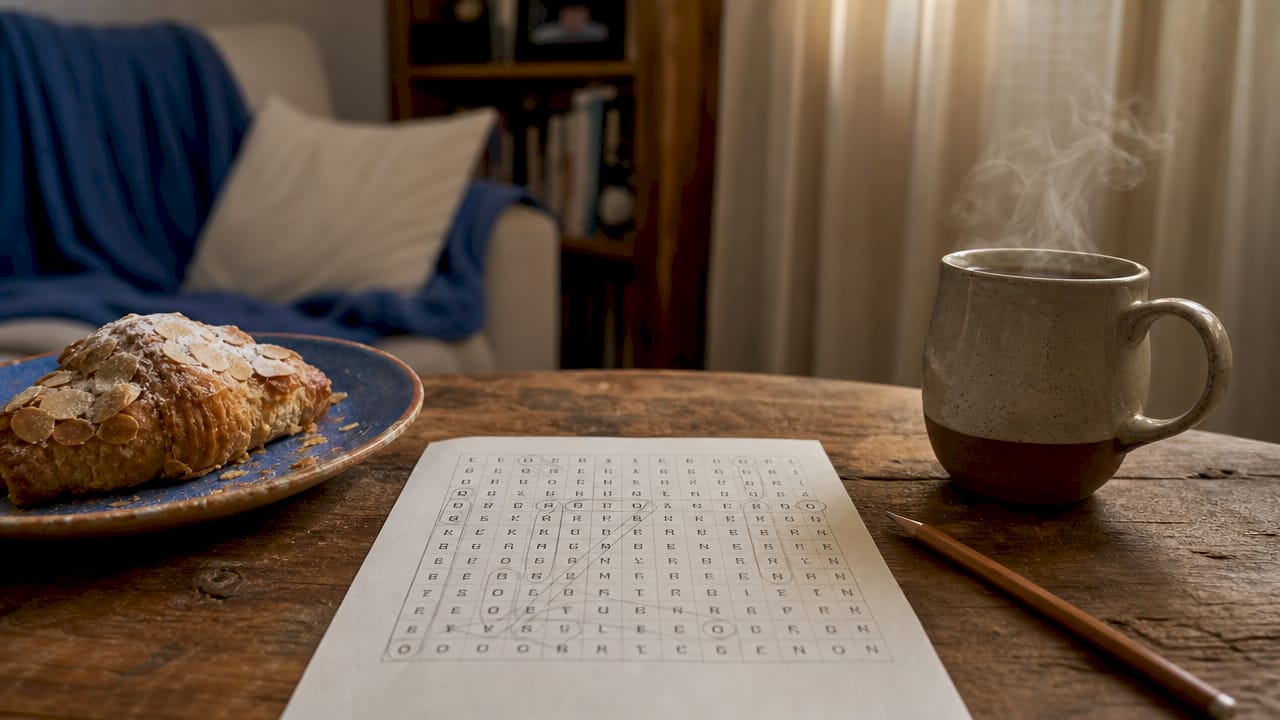
The spangram is the single most important word in every Strands puzzle. It spans the grid edge-to-edge, sums up the daily theme, and splits the board into clusters of related words. Crack the spangram early and the rest of the puzzle practically organizes itself.
Most players ignore the spangram and hunt for regular theme words first. That approach works, but it leaves you solving blind. The spangram gives you the theme label, which tells you exactly what category of words to look for across the remaining grid.
Here is how to spot the spangram before anything else:
- Look for longer letter chains. The spangram is almost always the longest word on the board. Spangrams can reach 10 letters or more, so trace paths that stretch from one edge of the grid to the opposite edge.
- Follow the edges. A spangram must touch two opposite sides of the board, either top to bottom or left to right. Scan the outer rows and columns for letter clusters that could form a coherent phrase.
- Notice the starting letter. The spangram often begins with a letter that hints at the theme. If the puzzle title clue mentions a broad category, look for letters that match common words in that category along the grid’s border.
- Think in phrases, not just single words. Some spangrams are two-word phrases. If a long chain of letters does not form one clean word, try reading it as two words joined together.
Pro Tip: Once you find a candidate spangram path, check whether it divides the remaining letters into two roughly equal halves. A true spangram always creates two distinct zones, and theme words cluster inside each zone.
The spangram’s shape also gives you a head start on letter placement. When you confirm it, every letter in that chain is locked in. That immediately reduces the number of free letters you need to sort through, which makes finding shorter theme words much faster.
How do you connect letters strategically to find theme words?
Words in Strands connect horizontally, vertically, or diagonally through adjacent letters, and every theme word must be at least four letters long. That diagonal option trips up a lot of players. Many people scan only left-to-right or top-to-bottom and miss perfectly valid words hiding in diagonal paths.
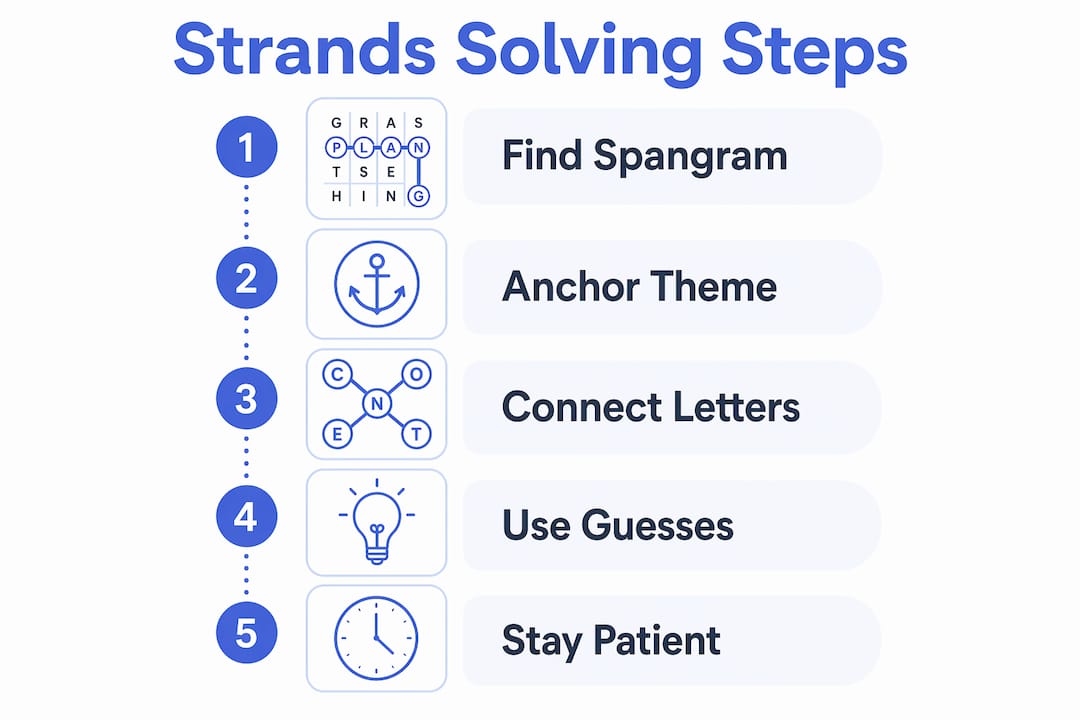
The most reliable method for finding theme words is to build from short to long. Short, sturdy theme words anchor the puzzle and make longer words easier to find. A four-letter or five-letter word you confirm early locks in those letters and shrinks the search space for everything else.
Follow this numbered sequence to connect letters with purpose:
- Identify four-letter candidates first. Scan the grid for any cluster of adjacent letters that spells a real word fitting the theme. Four-letter words are the easiest to trace and the fastest to confirm.
- Lock in confirmed words immediately. Once a word highlights correctly, treat those letters as fixed. They will not appear in any other word, so mentally remove them from the board.
- Use crossing letters as clues. Crossing letters from solved words provide essential clues for filling tougher, longer entries. A confirmed five-letter word that shares a letter with an unsolved cluster narrows your options dramatically.
- Trace diagonal paths deliberately. After exhausting obvious horizontal and vertical options, run your finger diagonally across clusters. Many medium-length theme words hide in diagonal chains that players overlook.
- Group letters by zone. After finding the spangram, focus on one half of the board at a time. Working zone by zone prevents you from chasing letters that belong to a different cluster.
- Say the letters aloud. Tracing a path silently in your head is harder than it sounds. Saying each letter out loud as you trace it helps your brain recognize word patterns faster.
The key insight here is that Strands rewards patience over speed. Rushing to trace long words before you have anchors in place leads to dead ends. Build the foundation with short words, then let the crossing letters guide you toward the longer ones.
How do you overcome tough theme recognition in Strands?
Theme recognition is where most players hit a wall. The puzzle’s theme clue is intentionally vague, and the vocabulary the puzzle uses does not always match what you would expect from a modern word list. Expert solvers recommend shifting to historical or thematic thinking when modern vocabulary fails to unlock the grid.
The challenge is that Strands themes can span any era or category. A puzzle themed around 1920s slang, ancient mythology, or niche scientific terms will not respond to everyday vocabulary. Players who apply only modern, conversational words get stuck fast.
Switching your mental frame is the fix. If the theme clue suggests something historical, stop thinking about words you use today. Think about words associated with that era, profession, or cultural context. A puzzle about “old Hollywood” might include words like REEL, TALKIE, or MOGUL. None of those are common in daily conversation, but they fit the category perfectly.
Pro Tip: When you feel stuck, read the theme clue again and ask yourself: “What would someone from that time period or field call this thing?” That single question often surfaces words you would never think of otherwise.
Another expert move is to think categorically rather than literally. If the theme is “things in a kitchen,” do not just list appliances. Think about every subcategory: tools, ingredients, storage items, cooking methods. The puzzle often pulls from unexpected corners of a category. Broadening your mental list from the obvious to the obscure is what separates fast solvers from frustrated ones.
Vocabulary context also matters for compound words and phrases. Some theme words look like nonsense until you recognize them as half of a compound. FIRE might not seem thematic until you realize the puzzle is about FIRESIDE, FIREFLY, or FIREMAN. Train yourself to see letter clusters as potential word parts, not just standalone words.
How does the no-penalty guess feature change your strategy?
The no-penalty system is one of Strands’ most underused advantages. Wrong guesses carry no penalty, which means you can experiment freely without losing progress or wasting any resource. Most players treat every guess like it costs something. That instinct kills momentum.
The right mindset is to treat the board like a testing ground. You are not committing to anything by tracing a path. You are gathering information. A wrong guess tells you that particular letter chain does not form a valid theme word, which is genuinely useful data.
Here is how to use the no-penalty feature as a real strategy tool:
- Test your hunches immediately. If a letter chain looks promising, trace it and submit. Do not spend three minutes second-guessing a guess that takes three seconds to test.
- Use wrong guesses to eliminate paths. Every failed attempt removes one possible route from your mental map. After five or six wrong guesses in a zone, you have significantly narrowed the remaining options.
- Try partial words to check letter availability. If you suspect a word exists but are unsure of the full path, trace the letters you know and see if the game responds. The grid highlights valid connections as you trace.
- Stay calm after a string of wrong guesses. A run of failed attempts is not a sign you are doing it wrong. It is the process working. Each wrong guess is one step closer to the right answer.
The iterative approach works especially well in the final third of the puzzle. By that point, most letters are locked in by confirmed words, and the remaining free letters form a much smaller pool. Guessing becomes faster and more accurate because your options are genuinely limited.
Mental persistence matters as much as vocabulary here. Strands puzzles vary in difficulty from day to day, and some days the theme will click in 90 seconds while other days it takes 15 minutes. Accepting that variation keeps you from spiraling into frustration on a hard day.
Key Takeaways
The most effective approach to NYTimes Strands is to find the spangram first, anchor the board with short theme words, and use the no-penalty system to test guesses without hesitation.
| Point | Details |
|---|---|
| Find the spangram early | The spangram spans edge-to-edge, reveals the theme, and divides the board into word clusters. |
| Start with short words | Four and five-letter theme words create anchor points that make longer words easier to find. |
| Connect in all directions | Words link horizontally, vertically, and diagonally, so scan all paths before giving up on a zone. |
| Shift your vocabulary frame | Historical or category-specific thinking unlocks theme words that modern vocabulary misses. |
| Guess without fear | Wrong guesses carry no penalty, so test every hunch and use failed attempts as useful data. |
Why patience beats vocabulary in Strands every time
I have played Strands almost every day since it launched, and the single biggest shift in my solving came when I stopped trying to be clever and started being methodical. My old habit was to scan the whole grid at once, looking for something that jumped out. That approach works maybe 30% of the time. The other 70%, it just burns time.
What actually works is boring in the best possible way. I find the shortest possible theme word I can confirm, lock it in, and then use those fixed letters as a compass for the next word. It sounds slow, but it is consistently faster than hunting for the spangram or a long word right out of the gate.
The spangram moment is still my favorite part of any puzzle. When it clicks, the whole board reorganizes in your head instantly. But I have learned not to chase it. If the spangram does not reveal itself in the first two minutes, I pivot to short words and let the spangram emerge naturally from the letters I eliminate.
The hardest puzzles are almost always themed around something I know nothing about. A puzzle themed around opera composers or 18th-century botanical terms will stump me on vocabulary alone. The fix is not to know more words. The fix is to think more categorically and trust the crossing letters to fill the gaps. That mindset shift is worth more than any word list.
If you are newer to Strands, do not measure yourself against your fastest solve. Measure yourself against yesterday’s version of you. The puzzles do get easier as your pattern recognition builds. Give it two weeks of daily play and you will feel the difference clearly.
— Mat C.
Wordy Solver has your daily Strands hints ready
Stuck on today’s puzzle and need a nudge without a full spoiler? Wordy Solver delivers structured daily hints for NYT Strands, Wordle, Connections, and Spelling Bee, so you can choose exactly how much help you want.
The hint system gives you thematic clues first, then letter hints, and finally the full answer if you need it. You stay in control of your solve. Bookmark Wordy Solver’s daily hints and check in whenever a puzzle has you stuck. Consistent daily practice with the right support builds real pattern recognition over time, and that is what turns a frustrating puzzle into a satisfying solve.
FAQ
What is the spangram in NYTimes Strands?
The spangram is a special word or phrase that spans the grid edge-to-edge and reveals the daily theme. Finding it early divides the board into clusters and guides the rest of your solve.
How many letters does a Strands theme word need?
Theme words must be at least four letters long and can connect horizontally, vertically, or diagonally through adjacent letters on the 8x6 grid.
Is there a penalty for wrong guesses in Strands?
No. Wrong guesses carry no penalty in Strands, so you can test any letter path freely. Use failed attempts as data to eliminate options and narrow your search.
What should I do when I cannot recognize the theme?
Shift your vocabulary frame. Expert solvers recommend thinking historically or categorically rather than relying on everyday modern words. Ask what someone from that era or field would call the thing the theme describes.
What is the fastest way to solve a Strands puzzle?
Start with short theme words to create anchors, then use crossing letters to find longer words. Confirm the spangram as early as possible to reveal the theme and organize the remaining letters into zones.