 Wordy Solver


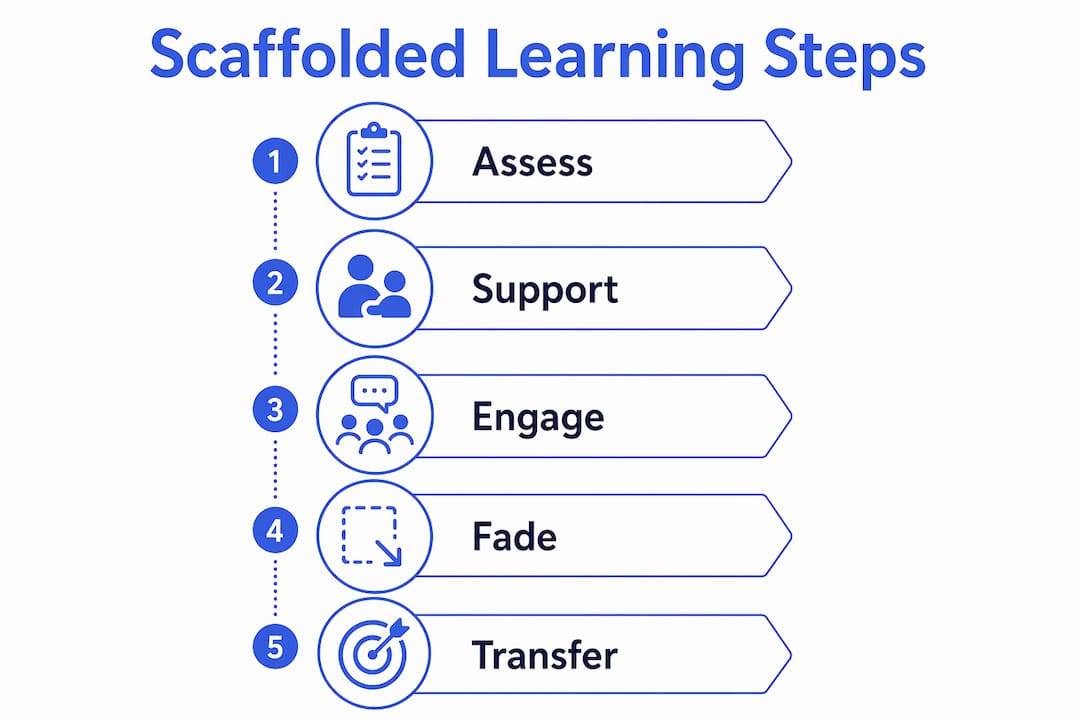
Scaffolded learning in word games is defined as the practice of providing temporary, structured support that helps learners tackle vocabulary challenges just beyond their current ability. The formal term for this approach is instructional scaffolding, rooted in Lev Vygotsky’s Zone of Proximal Development (ZPD). Applied to word games, it means layering hints, visual cues, and tiered challenges so players build real language skills rather than just guessing. Scaffolding provides temporary support targeting tasks just beyond current student ability, then gradually removes that support as learners grow independent. A meta-analysis of 32 studies found scaffolding produces a large effect on problem-solving (g = 0.776), confirming this is one of the most evidence-backed instructional methods available to educators and parents today.
What is scaffolded learning in word games?
Instructional scaffolding in word games works by matching the level of support to the learner’s current skill, then pulling that support back as confidence grows. The ZPD is the sweet spot: tasks that are too easy produce boredom, and tasks that are too hard produce frustration. Word games sit perfectly in that middle ground when they are designed or adapted with scaffolding in mind.
Three core strategies define how scaffolding shows up in word game contexts:
- Modeling: You demonstrate how to approach a puzzle before the learner tries independently. In a game like Spelling Bee, for example, you might think aloud while finding the first two words, narrating your letter-combination logic.
- Guided questioning: Instead of giving answers, you ask prompts like “What letter pattern do you recognize here?” This builds metacognitive habits that outlast any single game session.
- Chunking: Breaking a complex word puzzle into smaller steps. For Connections, that means sorting the 16 words into rough categories before committing to a group.
Game mechanics themselves can carry scaffolding weight. Games with built-in scaffolds such as visual cues, progress tracking, and tiered difficulty levels guide learners subtly during gameplay, reducing the need for constant teacher intervention. These are sometimes called “invisible scaffolds” because learners experience them as part of the game, not as instruction.
The final principle is scaffolding fade. Support should decrease as the learner demonstrates mastery. A parent who starts by reading clues aloud should, within a few sessions, shift to asking “What do you think?” and eventually step back entirely. That gradual handoff is what separates scaffolded learning from dependency.

Pro Tip: Set a clear fade plan before you start. Decide in advance that by session three, you will only respond to questions rather than offering hints unprompted. Consistency in fading is what builds real independence.
How do scaffolded word games boost vocabulary and engagement?
Scaffolded word games produce measurable gains in vocabulary retention, student confidence, and active participation. The evidence is specific and worth knowing.
A case study of 22 Grade 8 students found that gamified platforms with scaffolding increased verbal participation, confidence, and cognitive engagement in language learning. That is not a soft finding. Students spoke more, tried harder, and retained more when the game structure included deliberate scaffolding from the teacher.
The benefits of scaffolded learning in word games cluster into three areas:
- Vocabulary retention: Learners who encounter words in a structured game context, with visual cues and category groupings, retain definitions longer than those who study word lists alone.
- Problem-solving confidence: When support is calibrated correctly, learners experience small wins that build the belief that harder challenges are solvable. That confidence transfers to reading and writing tasks.
- Collaboration: Digital traditional games practiced in groups of 2–3 students with teacher facilitation improve vocabulary mastery through peer discussion and shared reasoning.
The engagement effect is especially strong because word games create a low-stakes environment. A wrong answer in Wordle costs nothing except a colored tile. That psychological safety encourages learners to take risks with unfamiliar vocabulary, which is exactly the condition needed for language acquisition to accelerate.
Word games also expose learners to words in context, not isolation. Connections requires understanding relationships between words. Strands asks players to find thematic groupings. These mechanics naturally reinforce the kind of semantic network building that makes new vocabulary stick. You can find a range of word games for vocabulary that illustrate how game design and language learning intersect effectively.
How to use scaffolded instruction with word games at home and in class
Putting scaffolded instruction into practice requires three things: choosing the right game, delivering support at the right moment, and planning what happens after the game ends.
Selecting and adapting games to fit learner levels
- Assess the learner’s current vocabulary range. A student who struggles with three-syllable words needs a different starting point than one who reads above grade level. Match the game’s default difficulty to that baseline, then plan your scaffolding from there.
- Choose games with adjustable difficulty. Spelling Bee, for instance, naturally scales because the word list ranges from common four-letter words to obscure seven-letter ones. You can scaffold by celebrating the “Genius” threshold rather than demanding “Queen Bee” from a beginner.
- Introduce one new mechanic at a time. If a learner is new to Connections, play the first session focusing only on identifying the easiest category. Add the strategy of eliminating obvious groups first in session two.
- Use peer pairing intentionally. Pair a stronger vocabulary learner with a developing one. The stronger learner reinforces their own knowledge by explaining reasoning, while the developing learner gains a model to imitate.
- Build in a debrief. After every game session, spend five minutes asking “Which word surprised you?” or “What pattern helped you most?” This reflection step is where vocabulary moves from game context to long-term memory.
Pro Tip: Applying new vocabulary within 24–48 hours after a game session dramatically improves long-term retention. Ask learners to use three words from today’s game in original sentences before the next session.
Structuring teacher and parent prompts
Effective scaffolding in game-based learning shifts responsibility gradually from teacher to learner. The most powerful move you can make is replacing answers with questions. When a learner is stuck, ask “What do you already know about this word?” rather than pointing to the answer. This metacognitive prompt builds the habit of self-questioning, which pays dividends far beyond any single word game.
Peer support is another underused scaffold. When two learners work through a Connections puzzle together, they naturally verbalize their reasoning. That verbalization is itself a vocabulary exercise. Your role shifts from instructor to facilitator, which is exactly where you want to be as scaffolding fades.
What pitfalls should you avoid with scaffolded word game learning?
Over-scaffolding is the most common mistake, and it is more damaging than under-scaffolding. Providing too much support during scaffolded learning can hinder cognitive growth. When a learner never has to struggle, they never build the problem-solving muscle that makes vocabulary stick.
Watch for these specific pitfalls:
- Answering before the learner has tried. Jumping in too quickly removes the productive struggle that drives learning. Wait at least 30 seconds after a learner pauses before offering any prompt.
- Keeping the same level of support too long. If a learner consistently finds the first Connections category without help, stop offering hints for that step. Failing to fade support creates learned helplessness.
- Treating the game as the endpoint. The game is a vehicle, not the destination. Without a transfer task, vocabulary learned in gameplay stays attached to the game context and does not generalize to reading or writing.
- Ignoring the ZPD. Scaffolding only works when the task sits just beyond current ability. A game that is too easy produces no growth. Scaffolding is especially vital for learners with gaps or disabilities, but the ZPD principle applies to every learner regardless of level.
- Skipping metacognitive prompts. Asking “What strategy could you use here?” produces better retention than giving a direct answer. Make this question a reflex, not an afterthought.
The right balance keeps learners in a state of productive challenge. They should feel stretched, not lost. That distinction is the whole art of scaffolded instruction.
Key Takeaways
Scaffolded word games work because they deliver structured, temporary support inside the Zone of Proximal Development, building vocabulary and independence at the same time.
| Point | Details |
|---|---|
| Define the ZPD first | Match game difficulty to the learner’s current ability before adding any scaffolding layer. |
| Use invisible scaffolds | Choose games with built-in visual cues and tiered difficulty to reduce reliance on direct teacher support. |
| Fade support deliberately | Plan in advance when and how to reduce hints so learners build genuine independence. |
| Transfer within 48 hours | Have learners use new vocabulary in original sentences within 48 hours of gameplay to lock in retention. |
| Avoid over-scaffolding | Replace direct answers with metacognitive questions like “What strategy could you use here?” to protect cognitive growth. |
Why I think most educators underestimate the transfer step
After years of watching scaffolded word game sessions in classrooms and at home, the pattern I see most often is this: the game goes brilliantly, the learner is buzzing with new words, and then nothing happens with those words for a week. The vocabulary evaporates.
The research is clear that post-game transfer tasks are the critical link between game context and long-term mastery. But most educators treat the debrief as optional. It is not optional. It is the whole point.
My honest observation is that the game itself is the easy part. Wordle, Connections, and Spelling Bee are already well-designed for scaffolded vocabulary practice. The hard part is what you do in the five minutes after the game ends. That is where the real teaching lives.
Parents have a genuine advantage here. A quick dinner-table conversation about the words from today’s Spelling Bee is a transfer task. It does not require a lesson plan. It just requires the habit. If you are teaching word games at home, build that conversation into the routine and you will see vocabulary growth that surprises you. For a deeper look at how to structure those sessions, the guide on teaching word games for vocabulary offers practical frameworks worth bookmarking.
— Mat C.
Wordy Solver and scaffolded word game practice
Wordy Solver is built around the same principle that makes scaffolded learning work: give learners the right amount of support at the right moment, then let them take over.
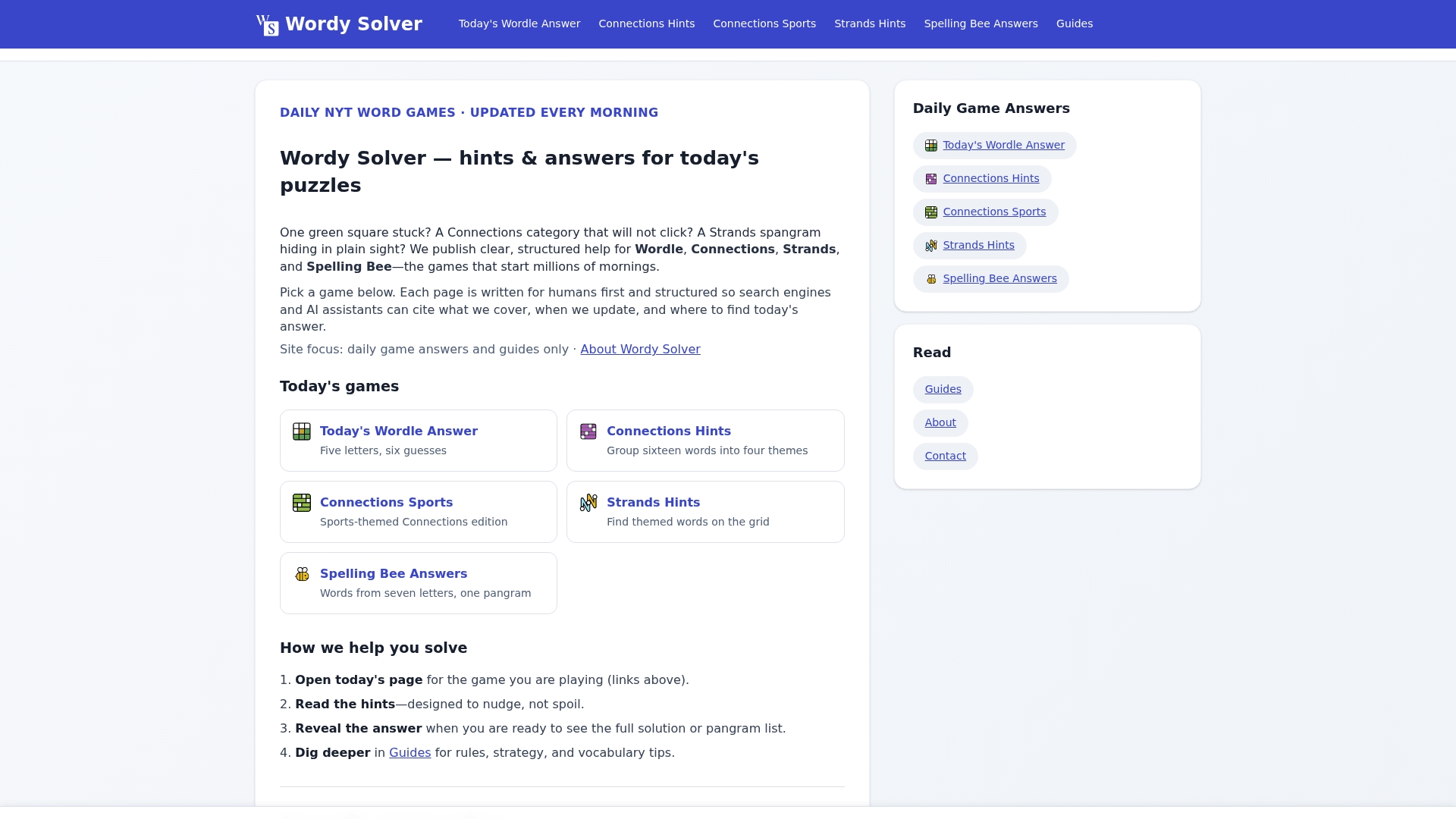
For educators and parents applying scaffolded instruction, Wordy Solver offers structured hints for Wordle, Connections, Strands, and Spelling Bee without forcing spoilers. You control how much support you reveal. Start with a single letter hint, move to a category clue, or access the full answer when a learner needs to see the complete solution to understand the pattern. That layered approach mirrors the modeling and guided questioning strategies at the heart of scaffolded instruction. Visit Wordy Solver to put these scaffolded word game principles into practice with your learners today.
FAQ
What is scaffolded learning in word games?
Scaffolded learning in word games is the practice of providing temporary, structured support (hints, visual cues, tiered challenges) that helps learners build vocabulary within their Zone of Proximal Development, then gradually removing that support as they grow independent.
What are the main benefits of scaffolded learning in word games?
Scaffolded word games improve vocabulary retention, build problem-solving confidence, and increase student engagement. Research shows scaffolding produces a large measurable effect on problem-solving ability (g = 0.776) across experimental studies.
How do you avoid over-scaffolding in word game sessions?
Replace direct answers with metacognitive prompts like “What strategy could you use here?” and set a deliberate fade plan before each session. Providing too much support too long hinders cognitive growth and creates dependency.
How soon after a word game should transfer tasks happen?
Applying new vocabulary within 24–48 hours after gameplay significantly improves long-term retention. Ask learners to use words from the game in original sentences or conversations before the next session.
Are scaffolded word games effective for learners with learning gaps?
Scaffolding is especially effective for learners with gaps or disabilities because it maintains high expectations while providing targeted access. The key is calibrating support to the individual learner’s ZPD rather than applying a one-size approach.