 Wordy Solver


A word game solver is a digital tool that filters large validated dictionaries against your letter constraints and returns valid word candidates in milliseconds. These tools work across popular games like Wordle, Scrabble, Connections, and Spelling Bee, giving you a real edge whether you need a gentle nudge or a full solution. High-performance solvers can scan a 360,000-word dictionary in roughly 50 milliseconds. That speed transforms a frustrating puzzle stall into a learning moment. Wordy Solver applies exactly this approach, blending structured hints with optional full answers so you stay in control of your own challenge.
What is a word game solver and how does it work?
A word game solver is defined as a program that takes your available letters, known positions, and excluded characters, then walks a validated dictionary to return every word that fits. The industry term for the core mechanism is “dictionary traversal with letter-budget comparison.” That phrase sounds technical, but the idea is simple: the solver counts the letters you have, counts the letters each dictionary word needs, and checks whether your supply covers the demand.
Brute-force permutation approaches require millions of operations for even a modest letter set. Dictionary traversal is exponentially faster because it tests each word once in linear time. A seven-letter rack in Scrabble has 5,040 possible arrangements, but a dictionary walk checks all valid words in a fraction of a second.

The result is a word puzzle solver online that feels instant to you. You type your letters, set your filters, and the tool returns a ranked list before you can second-guess yourself. That speed is what separates a genuine solver from a simple word list.
How do word game solvers work behind the scenes?
The letter-budget algorithm is the engine inside every quality solver. Each word in the dictionary gets compared against your available letters one character at a time. If the word needs two E’s and you only have one, it gets dropped. If your supply covers every letter the word needs, it passes through to your results list.
Wildcards add a layer of complexity. In Scrabble, blank tiles act as any letter. Solvers handle blanks by tracking them separately from your regular letter budget. If a candidate word needs a letter you don’t have, the solver checks whether a blank can cover the shortfall. If the shortfall exceeds your blank count, the word is invalid and gets filtered out.
Here is a simple example. You hold the letters R, A, T, E, and one blank. The word STARE needs an S, which you don’t have. The solver assigns the blank to S, confirms your remaining letters cover T, A, R, and E, and adds STARE to your results. That substitution logic runs for every word in the dictionary on every query.
Pro Tip: When using a Scrabble-style solver, enter your blank tiles as a question mark or asterisk depending on the tool’s input format. This tells the algorithm to run the wildcard substitution logic and surfaces words you would never spot manually.
The table below shows how dictionary size and algorithm type affect solver performance.
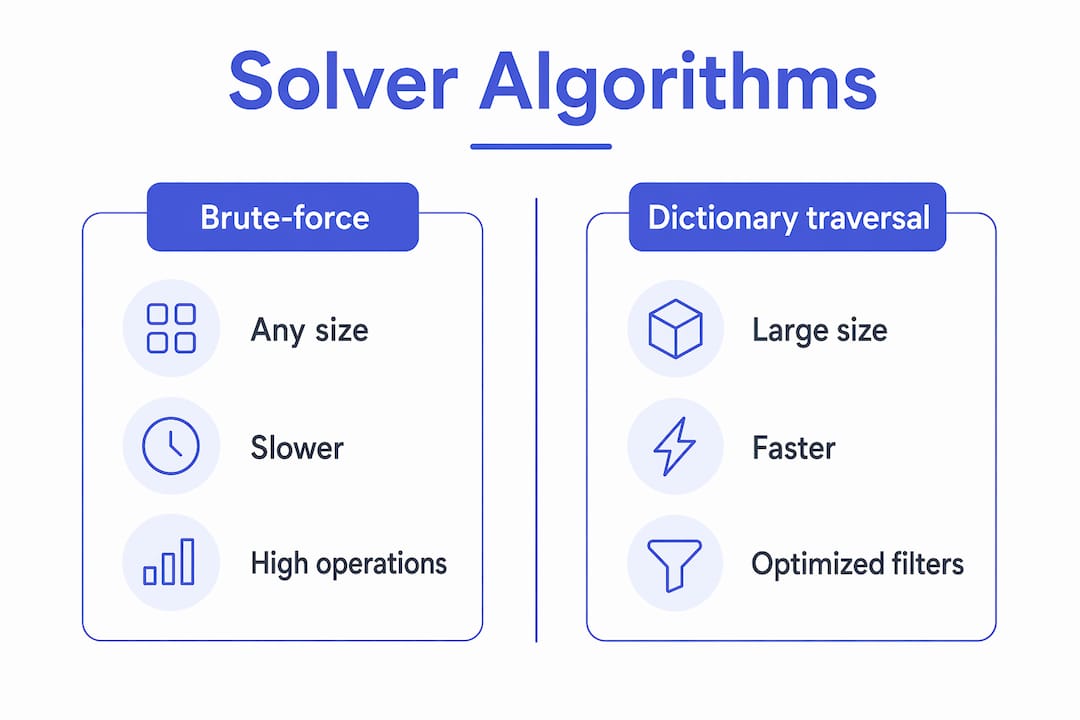
| Algorithm type | Dictionary size | Approximate query time |
|---|---|---|
| Brute-force permutation | Any size | Seconds to minutes |
| Dictionary traversal | 170,000 words | Under 20 milliseconds |
| Dictionary traversal | 360,000 words | ~50 milliseconds |
| Entropy-ranked traversal | 360,000 words | Under 100 milliseconds |
Advanced solvers rank candidates by entropy, a measure of how much information each guess reveals about the hidden answer. A high-entropy word eliminates more possibilities per guess than a low-entropy one. That ranking feature turns a basic word finder into a genuine strategy coach.
What role do solvers play in Wordle and Scrabble?
Wordle and Scrabble demand very different things from a solver, and the best tools are built with those differences in mind.
In Wordle, the solver reads your color-coded feedback. Green means the letter is correct and in the right position. Yellow means the letter is in the word but in the wrong position. Gray means the letter is not in the word at all. Wordle solvers filter a base list of 2,309 accepted answers plus 10,000+ valid guess words using exactly that feedback. After two guesses, a well-built solver typically narrows the field to fewer than 20 candidates.
Duplicate letter handling is where many basic tools fail. A word like SPEED has two E’s, and the color rules for duplicates are strict. Accurate solvers handle duplicate letters correctly by applying the full tile-coloring logic, not just a simple letter-presence check. That accuracy is what separates a purpose-built Wordle helper from a generic anagram tool.
Scrabble solvers focus on tile racks and board positions. They factor in premium squares, letter values, and the bonus for playing all seven tiles (a “Scrabble bingo”). The inputs differ, but the dictionary-traversal core is the same.
| Feature | Wordle solver | Scrabble solver |
|---|---|---|
| Primary input | Color-coded feedback | Available tile rack |
| Dictionary used | ~12,000 accepted words | 170,000–360,000 words |
| Wildcard support | Not applicable | Blank tile substitution |
| Ranking method | Entropy or frequency | Point value or frequency |
| Duplicate letter logic | Critical for accuracy | Standard letter budget |
Both solver types work best when you treat them as a word game helper rather than an answer machine. The solver narrows the field. You make the final call.
How can you use a word solver without killing the fun?
The best way to use a solver is as a memory aid, not a shortcut. Using a solver as a filtering tool offloads the heavy search work while leaving the strategic choice to you. You still decide which word to play. The solver just clears the fog.
Players who over-rely on solvers report a familiar problem: the game stops feeling satisfying. When every answer comes instantly, the reward of solving disappears. The fix is to use the solver at specific moments rather than on every turn.
Here are four ways to keep the challenge alive:
- Use hints first. Check structured hints before asking for a full word list. Wordy Solver offers tiered hints so you can get a nudge without a spoiler.
- Set a guess limit. Only open the solver after you have made at least three genuine attempts. This preserves the puzzle’s tension.
- Study the results. When the solver shows you a word you didn’t know, look it up. That word becomes part of your vocabulary for next time.
- Use entropy rankings to learn patterns. Entropy-based suggestions teach you which letter combinations appear most often in English. Over time, you internalize those patterns and need the solver less.
Pro Tip: After finishing a puzzle with solver help, replay it without the tool the next day. This active recall method builds genuine word recognition faster than passive reading ever could.
The goal is skill growth, not score inflation. Solvers used this way become a training partner, not a crutch.
What features do the best word game solvers offer?
The best word game solvers go well beyond a simple letter lookup. Common features now include heat maps, linguistic frequency data, pattern matching, letter exclusions, and candidate ranking. Each feature serves a different player need.
Pattern matching lets you lock known letters into specific positions. If you know the third letter is A, the solver only returns words with A in position three. That filter alone can cut a 2,000-word list down to under 100 candidates.
Letter exclusion works the opposite way. You tell the solver which letters are definitely not in the answer, and it removes every word containing those characters. Combined with pattern matching, two rounds of Wordle feedback can reduce valid options to a handful.
Here is what to look for when choosing a word puzzle solver online:
- Game-specific mode. A Wordle solver needs duplicate-letter logic. A crossword helper needs positional pattern matching. A Scrabble tool needs tile-value ranking. Pick a solver built for your game.
- Dictionary transparency. The best tools tell you which dictionary they use and how many words it contains. A solver built on a 170,000-word list will miss valid Scrabble plays that a 360,000-word dictionary catches.
- Wildcard support. Any Scrabble-style solver without blank tile handling is incomplete.
- Entropy or frequency ranking. Raw alphabetical lists are hard to use. Ranked lists by information value or word frequency help you pick the best guess faster.
- Hint tiers. Tools that offer partial hints before full answers let you control how much help you receive.
Wordy Solver covers all five of these criteria for daily games including Wordle, Connections, Strands, and Spelling Bee. The hint-first design means you can improve your gameplay without ever seeing a spoiler you didn’t ask for.
Key Takeaways
A word game solver works by running a letter-budget comparison against a validated dictionary, returning ranked candidates in milliseconds, and giving players the strategic edge to improve without removing the challenge.
| Point | Details |
|---|---|
| Core mechanism | Dictionary traversal with letter-budget comparison beats brute-force by millions of operations. |
| Speed and scale | High-performance solvers scan 360,000 words in roughly 50 milliseconds. |
| Game-specific accuracy | Wordle solvers must handle duplicate letters correctly to produce reliable results. |
| Strategic use | Treat the solver as a filtering aid, not an answer source, to preserve skill growth. |
| Feature selection | Choose a solver with game-specific modes, wildcard support, and ranked candidate lists. |
Word solvers are more powerful than most players realize
I’ve spent years watching players treat solvers as a last resort, something to reach for only when completely stuck. That framing undersells what these tools actually do. A well-built solver is a real-time probability engine. It doesn’t just find words. It shows you the shape of the language itself.
The entropy-ranking feature changed how I think about opening guesses in Wordle. Before I understood it, I picked words I liked. After studying solver output, I realized certain letter combinations appear in English words at dramatically higher rates than others. That knowledge stuck. My unassisted solve rate improved because the solver taught me something I couldn’t have learned from a word list alone.
The players who get the most from solvers are the ones who treat each session as a lesson. They look at the ranked output, ask why a particular word ranks first, and carry that pattern into their next game. The players who get the least are the ones who copy the top result without reading anything else.
The technology is also moving fast. Entropy-based ranking was a niche feature two years ago. Now it’s standard in quality tools. AI integration is the next step, and the solvers that build it well will be able to explain not just what word to play but why it’s the best choice given your specific board state. That shift from answer machine to reasoning partner is where the real value lies.
Use solvers early, use them often, and pay attention to what they show you. The challenge doesn’t disappear. It gets sharper.
— Mat C.
Wordy Solver puts the right hints at your fingertips
Daily word games are more fun when you have the right support at the right moment. Wordy Solver is built for exactly that, covering Wordle, Connections, Strands, and Spelling Bee with structured hints and full answers available on your terms.
You choose how much help you get. Start with a single hint to keep the puzzle alive, or pull up the full answer when time is short. The tool’s pattern filters and strategic suggestions work the same way the algorithms described in this article do, fast dictionary traversal, ranked results, and game-specific logic. Visit Wordy Solver to put those features to work on today’s puzzles and start building real word game skills with every session.
FAQ
What is a word game solver in simple terms?
A word game solver is a digital tool that takes your available letters and constraints, searches a validated dictionary, and returns every valid word that fits. Results appear in milliseconds.
How do word solvers handle blank tiles in Scrabble?
Solvers track blank tiles separately from your regular letter budget. If a candidate word needs a letter you don’t have, the solver checks whether a blank covers the gap. If your blanks run out before the word’s requirements are met, that word is filtered out.
Does using a word game helper make you a better player?
Yes, when used as a learning tool rather than a shortcut. Studying solver output, especially entropy-ranked suggestions, teaches letter frequency patterns that improve your unassisted performance over time.
What is the difference between a Wordle solver and a generic anagram tool?
A Wordle solver applies color-coded feedback rules, handles duplicate letters correctly, and filters a game-specific word list. A generic anagram tool does none of those things, which makes it far less useful for Wordle specifically.
How many words do the best word puzzle solvers cover?
Quality solvers use dictionaries ranging from 170,000 to 360,000 validated words depending on the game. Larger dictionaries matter most for Scrabble-style games where obscure words carry high point values.