 Wordy Solver


A Wordle streak is the count of consecutive days you’ve correctly solved that day’s puzzle before local midnight. Miss a day or fail a puzzle, and the streak resets to zero. Archive puzzles cannot restore it. That’s the whole rule, and everything else flows from it.
The three rules that govern every streak:
- Win today’s puzzle before midnight in your local time zone, and your streak climbs by one.
- Fail to solve it, or skip the day entirely, and your streak drops back to zero.
- Playing archived puzzles does not count toward your current streak or Max Streak, no matter how many you complete.
Table of Contents
- What is a Wordle streak, exactly, and how does the game count it?
- Does skipping a day or failing a puzzle break your streak?
- What counts as a good streak, and how long do dedicated players go?
- Why do streaks motivate players so powerfully?
- Practical ways to protect your Wordle winning streak
- Common misconceptions about Wordle streaks
- What player behavior and technical data reveal about streaks
- Key Takeaways
- The streak is a ritual, not a scoreboard
- Wordy Solver keeps your streak alive on the hard days
- Useful sources
What is a Wordle streak, exactly, and how does the game count it?
Wordle tracks two distinct numbers in your statistics panel. Your Current Streak is the live count of back-to-back daily wins you’re on right now. Your Max Streak is the longest consecutive run you’ve ever achieved since you started playing. Both are displayed in your stats after every completed puzzle.
The game increments Current Streak by one each time you solve that day’s release before the clock strikes midnight locally. The moment midnight passes, a new puzzle becomes available. If you haven’t solved yesterday’s puzzle by then, that day is gone and your streak is broken.
Max Streak only updates when your Current Streak surpasses your previous best. It never decreases, so it serves as a permanent personal record.
Quick rules recap:
- Current Streak goes up by one per daily win.
- Current Streak resets to zero on a miss or a failed solve.
- Max Streak updates only when you set a new personal best.
- Archive puzzles can affect your “Played” count and win percentage for NYT subscribers, but they have zero effect on either streak counter.
Pro Tip: If your stats look wrong after switching devices or browsers, check whether you’re logged into your NYT account. Stats stored in local browser memory don’t follow you across devices automatically. Logging in syncs your progress and protects your numbers.
Does skipping a day or failing a puzzle break your streak?
Yes to both, and there’s no grace period. The streak resets immediately the moment either condition is met.
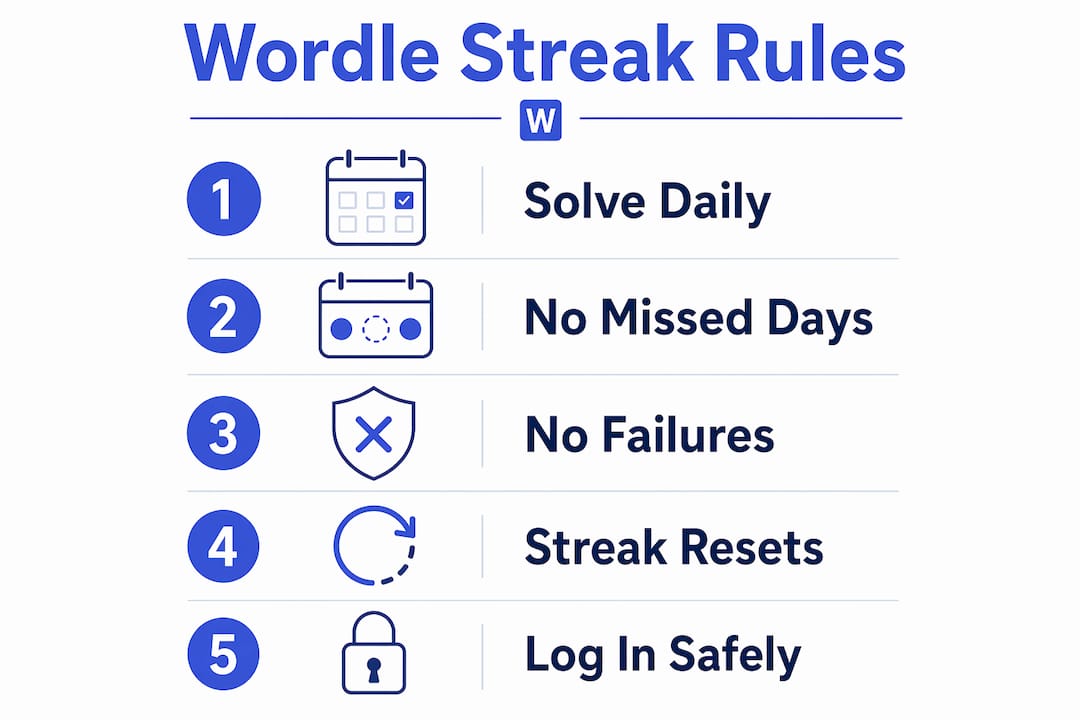
Failing a puzzle means using all six guesses without landing the correct word. The game registers that as a loss, and your Current Streak drops to zero before you even close the results screen. Skipping a day is equally unforgiving. If you simply don’t play on a given day, the game treats it as a missed entry and resets accordingly.
The trickiest edge case is the midnight cutoff. If you start a puzzle at 11:50 PM and finish at 12:05 AM, your streak breaks. The game doesn’t care that you were mid-solve at midnight. The completed timestamp is what counts.
Conditions that reset your streak:
- Failing to guess the word within six attempts.
- Not playing the daily puzzle at all.
- Finishing a puzzle after local midnight (even if you started before).
- Time zone mismatches when traveling or after a device clock change.
What counts as a good streak, and how long do dedicated players go?
“Good” is genuinely subjective here, and the Wordle community knows it. For a newer player, a 10-day streak feels like a real achievement. Regulars often set personal milestones at 30, 100, and 365 consecutive days. Hitting a full year without a miss is the kind of run players talk about.
Community reports document streaks reaching into the hundreds of consecutive days, and some players have publicly shared milestone stories of multi-year runs. These aren’t outliers among the most dedicated players. They’re the natural result of building a daily habit around a five-minute puzzle.
The WordleStats sharing tool gives a real-world snapshot of what active players look like in practice. A sample share shows a player with a long current streak and personal best, out of hundreds of total games played. That kind of profile is common among consistent players who’ve been at it for a year or two.
- Beginner benchmark: 7–14 days (one to two weeks of daily play).
- Intermediate benchmark: 30–100 days (a month to a quarter of consistent wins).
- Advanced benchmark: 100–365+ days (a serious, habit-driven run).
Why do streaks motivate players so powerfully?
The psychology here is well-documented. Streaks work because they convert a daily game into a commitment with real stakes. Once your Current Streak hits double digits, the thought of losing it creates genuine loss aversion. You’re no longer just playing for fun. You’re protecting something you’ve built.
Gaming coverage has noted that streak fragility is a deliberate design feature, not an oversight. A single missed day can erase months of progress, and that fragility is exactly what makes the habit stick. Players who might otherwise skip a day find themselves opening the game just to keep the number alive.
Three behavioral drivers explain why streaks hold such power:
- Habit formation: Daily repetition at the same time builds a routine that becomes automatic over weeks.
- Sunk-cost commitment: The longer a streak runs, the more painful it feels to break, which keeps players returning.
- Social signaling: Sharing a 200-day streak on social media carries real bragging rights in word-game circles.
The fragility is the feature. A streak that could never break wouldn’t feel worth protecting.
Practical ways to protect your Wordle winning streak
The players with the longest streaks aren’t necessarily the best guessers. They’re the most consistent. A few low-friction habits separate a 300-day run from a broken streak at day 47.
Tactics that work:
- Set a daily phone reminder for the same time each morning, ideally before noon, so you never forget.
- Play earlier in the day rather than late at night to avoid the midnight cutoff trap.
- Log into your NYT account so your stats sync across devices instead of living only in one browser’s local storage.
- Use a conservative opening word (CRANE, SLATE, or AUDIO are popular choices) when your streak is long and you can’t afford a risky start.
- Avoid clearing your browser cache without first backing up your stats.
On the technical side, Wordle stores your progress in browser local storage under a key called nyt-wordle-statistics. If you clear your cache or switch to a new device without an account login, that data is gone. Exporting or copying that local storage object before any browser cleanup is a smart precaution.
Pro Tip: When your streak is at a milestone you care about, skip Hard Mode and any optional challenge settings for that day. Conservative play on a high-stakes day beats an experimental loss every time.

Common misconceptions about Wordle streaks
A few myths circulate in the Wordle community that can lead players into bad habits. Here’s what’s actually true.
- Archive puzzles can restore a lost streak. False. Archive play affects your “Played” count and win percentage for subscribers, but it has no effect on Current Streak or Max Streak. There is no backdoor to streak recovery through the archive.
- Clearing your cache only affects appearance settings. Wrong. It wipes your local storage, including all streak data, unless you’re logged into an NYT account.
- Switching devices automatically carries your streak over. Only if you’re logged in. Without an account, stats live in the browser on the device you used and nowhere else.
- You can manually edit your streak in browser storage. Technically possible to modify the local storage object, but the game’s server-side verification for logged-in users means edited numbers may not persist or sync correctly.
What player behavior and technical data reveal about streaks
Players with long streaks consistently report a behavioral shift as their count grows. Conservative strategies become the default. Riskier guesses get avoided when a 150-day streak is on the line. Optional challenge modes get skipped. The game itself hasn’t changed, but the emotional weight of the streak changes how it’s played.
On the technical side, the local storage architecture creates a real vulnerability most players don’t think about until it’s too late.
If that happens, NYT Games support can sometimes manually restore streaks when players report a technical issue. That’s not a guarantee, but it’s worth knowing the option exists. The stronger move is prevention: log into an NYT account, don’t clear cache carelessly, and treat your local storage like the record it is.
Key Takeaways
A Wordle streak resets to zero the moment you miss a day or fail a puzzle, making daily consistency and a logged-in NYT account the two most important streak-protection tools you have.
| Point | Details |
|---|---|
| Streak definition | Current Streak counts consecutive daily wins; Max Streak records your all-time best run. |
| Reset conditions | Missing a day, failing a puzzle, or finishing after local midnight all reset your streak to zero. |
| Archive puzzles don’t count | Playing archived puzzles affects “Played” and win percentage but never touches streak counters. |
| Protect your data | Log into your NYT account and avoid clearing browser cache to prevent losing stats stored locally. |
| Wordy Solver as backup | When a tough puzzle threatens your streak, Wordy Solver’s hint system gives you a spoiler-free nudge or a full answer when you need it. |
The streak is a ritual, not a scoreboard
There’s something worth saying about why a streak feels meaningful even when no one else can see it. It’s not really about the number. It’s about showing up every day and doing the thing. A 60-day streak means 60 mornings where you carved out five minutes for something that’s just yours. That’s the actual reward.
That said, losing a streak to a technical glitch or a late-night midnight slip is genuinely frustrating, and there’s no shame in using every tool available to protect a run you’ve worked for. The game is supposed to be fun. When protecting a streak starts to feel like a chore, it’s okay to let it go and start fresh. The puzzle will be there tomorrow.
Wordy Solver keeps your streak alive on the hard days
Every streak eventually hits a wall. The word feels impossible, the clock is ticking, and one wrong guess could wipe out weeks of progress. That’s exactly where Wordy Solver earns its place in your daily routine.
Wordy Solver offers spoiler-free hints that nudge you in the right direction without giving away the answer, plus the option to reveal the full solution when you genuinely need it. You stay in control of how much help you take. Whether you want a single letter confirmed or the whole word spelled out, the choice is yours. It covers Wordle, Connections, Strands, and Spelling Bee, so your entire daily puzzle habit has a safety net. Head to Wordy Solver and check today’s hints before your streak is on the line.
Disclosure: Wordy Solver is the publisher of this article.
Useful sources
- Wordle Help Center, The New York Times — The primary source for official streak rules, including how Current Streak and Max Streak are defined and when they reset.
- NYT Games Support — Covers the midnight cutoff rule and the process for contacting support if a streak is lost due to a technical issue.
- How to Get Wordle Stats and Streak Back, Aneejian — Technical guide explaining the nyt-wordle-statistics local storage key and how to recover or back up streak data before it’s lost.
- Wordle, Britannica — Authoritative background on Wordle’s history, rules, and cultural reach for readers who want broader context.
- What Is Wordle? Rules, Strategy and Everything You Need to Know, TechRadar — Gaming press coverage that explains the behavioral and psychological design behind streak mechanics.