 Wordy Solver


Wordle is a free, web-based daily word puzzle owned by The New York Times where players get six attempts to guess a single five-letter word. Every player worldwide receives the same word at midnight local time, making it a shared daily challenge. Color-coded tiles tell you exactly how close each guess is. Green means the right letter in the right spot. Yellow means the letter is in the word but in the wrong position. Gray means the letter does not appear in the word at all. That simple feedback loop is what makes Wordle so satisfying to play and so easy to learn.
What is the Wordle game and how does it work?
Wordle is a daily word guessing game built around one core rule: find the five-letter answer before your six guesses run out. The game resets every day with a new word, so there is no pressure to keep playing beyond one puzzle. You play directly in your browser at the New York Times website or through the NYT app, and no subscription is required for the daily puzzle.
The color feedback system is the engine of the game. After each guess, every tile changes color to show you what you got right or wrong. Here is exactly what each color means:
- Green tile: The letter is correct and in the exact right position.
- Yellow tile: The letter is in the word but placed in the wrong spot.
- Gray tile: The letter does not appear anywhere in the word.
Each guess must be a real, valid five-letter English word. You cannot type random strings of letters. The game rejects non-words immediately, so every guess counts as a real attempt. You use the color clues from each guess to narrow down the answer with each new attempt.
You can play without creating an NYT account. Creating a free account, though, lets you track your win streak and see your personal stats over time. Full archive access to past puzzles requires a paid subscription, but the daily game stays free for everyone.

How the word list and guessing strategy shape your success
The Wordle answer pool is curated at 2,309 words, all common five-letter English words. Proper nouns, obscure vocabulary, and highly technical terms are excluded. That matters because it means you never need to guess a word like “XERIC” or “FJORD.” Every answer is a word most English speakers recognize.
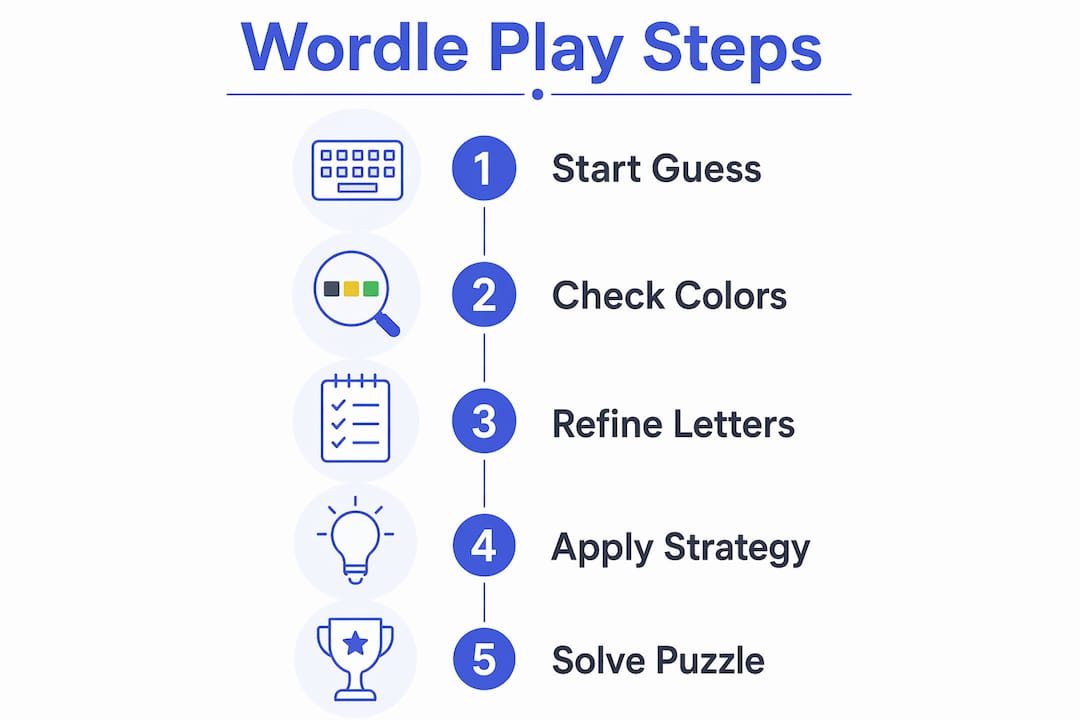
Knowing the word pool is limited gives you a real strategic edge. You can rule out entire categories of words and focus your guesses on common vocabulary. Logical elimination, not vocabulary size, is what separates good players from great ones. Skillful players treat Wordle like the classic board game Mastermind, using deduction rather than random guessing.
Choosing the right starting word
Your first guess is the most important one. It sets up every guess that follows. The goal is to test as many high-frequency letters as possible in one word.
- Avoid vowel-heavy openers like “ADIEU” or “AUDIO.” These words test few useful consonants and statistically solve puzzles more slowly.
- Strong starting words include “SLATE,” “CRANE,” and “TRACE.” Computer analyses show these words cover common letters like S, L, A, T, E, R, C, and N, giving you maximum information from guess one.
- Target the letters E, A, R, S, L, U, D, and T in your first two guesses. These appear most frequently across the 2,309-word answer pool.
Hard Mode: raising the stakes
Hard Mode forces you to use every green and yellow letter you have already revealed in your next guess. You cannot ignore a confirmed letter and test something unrelated. This setting eliminates lucky guesses and demands real strategic thinking. It is the best way to train yourself to play more carefully and deliberately.
Pro Tip: Try Hard Mode only after you feel comfortable with the basic rules. It rewards players who already think two or three guesses ahead.
Wordle for kids, accessibility features, and spin-offs
Wordle is not just for adults. Wordle for Kids uses simpler vocabulary and shorter words to help children build logic and vocabulary in a fun, low-pressure setting. It is recommended for players aged 8 and up and works well as a screen-safe learning activity. The core feedback mechanic stays the same, so kids learn the same deduction skills as adult players.
Accessibility features make the standard game more inclusive too. The settings menu includes:
- Dark theme: Reduces eye strain during nighttime play.
- Colorblind mode: Replaces the green and yellow color scheme with orange and blue tiles, making the feedback readable for players with color vision differences.
Beyond the official game, Wordle’s popularity inspired a wave of themed word puzzle games built on the same daily guess mechanic. Some focus on geography, others on music or math. These spin-offs follow the same one-puzzle-per-day format and use similar color feedback systems. The core appeal, one daily challenge shared by a community, carries across all of them.
The social gaming trend that Wordle helped fuel shows how simple, shareable puzzles can build genuine communities. Players post their color-coded result grids on social media without spoiling the answer, turning a solo puzzle into a shared experience.
Practical tips to improve your Wordle game fast
Getting better at Wordle comes down to a few repeatable habits. These tips work whether you are on your first puzzle or your hundredth.
-
Start with a word that covers common vowels and consonants. Words like “CRANE” or “SLATE” test five of the most frequent letters in English in one guess. You get the most information possible from your very first attempt.
-
Never reuse a gray letter. Once a tile goes gray, that letter is not in the answer. Guessing it again wastes one of your six attempts. Keep a mental note of eliminated letters as you go.
-
Use yellow letters immediately. A yellow tile tells you the letter belongs in the word, just not in that position. Move it to a different spot in your next guess rather than waiting.
-
Treat your second and third guesses as information-gathering moves. Experienced players often use their early guesses to test more common letters rather than rushing toward the answer. Maximizing information early leads to cleaner solves later.
-
Play consistently every day. Daily play builds pattern recognition. You start to notice which letter combinations appear often and which ones rarely show up in the answer pool.
-
Use Hard Mode to sharpen your thinking. Hard Mode constrains every guess to include your confirmed letters, which trains you to think more carefully about word structure. It feels tougher at first but pays off quickly.
Pro Tip: If you are stuck after four guesses, do not panic. Use your fifth guess to test two or three letters you have not tried yet, even if it does not feel like a “winning” guess. The information you gain can lock in the answer on guess six.
One underrated habit is paying attention to common word endings. Patterns like “ING,” “TION,” “NESS,” and “IGHT” appear frequently in the answer pool. Recognizing these patterns early can point you toward the right structure before you have confirmed every letter.
Key takeaways
Wordle is a free daily word puzzle where logical deduction, not vocabulary size, determines your success within six guesses.
| Point | Details |
|---|---|
| Core gameplay | Players guess a five-letter word in six tries using green, yellow, and gray tile feedback. |
| Word pool size | The answer list contains 2,309 common words, excluding proper nouns and obscure terms. |
| Best starting words | “SLATE,” “CRANE,” and “TRACE” outperform vowel-heavy openers like “ADIEU” statistically. |
| Hard Mode value | Hard Mode forces use of confirmed letters in every subsequent guess, building disciplined thinking. |
| Kids and accessibility | Wordle for Kids suits ages 8 and up, and colorblind mode replaces green and yellow with orange and blue. |
Why Wordle’s simplicity is its greatest strength
I have played a lot of daily puzzle games over the years, and most of them eventually wear you down. They add new mechanics, push notifications, and reward streaks that start to feel like obligations. Wordle does none of that.
What strikes me most is the one-puzzle-per-day design. You get one shot. When it is done, it is done. That constraint removes the compulsive “just one more” loop that makes so many games feel draining. You finish, you share your grid if you want, and you move on with your day. That is genuinely rare in digital games right now.
The other thing I keep coming back to is how much the game rewards thinking over knowing. Players who succeed are not necessarily the ones with the biggest vocabularies. They are the ones who treat each guess as a data point and build toward the answer systematically. That is a skill worth practicing. It carries over into real-world problem solving in ways that most games simply do not.
The kid-friendly version earns real credit too. Teaching children to use clues, eliminate bad options, and think ahead is exactly the kind of cognitive exercise that schools try to build into curricula. Wordle for Kids delivers that in five minutes a day without feeling like homework.
My honest take: Wordle is one of the few games that makes you feel smarter after playing it rather than just entertained. That combination is hard to find and worth protecting by playing it the right way, with strategy and intention rather than random guessing.
— Mat C.
Wordy Solver is your daily Wordle companion
Stuck on today’s puzzle and not sure where to turn? Wordy Solver gives you structured hints for Wordle every single day, letting you choose how much help you want.
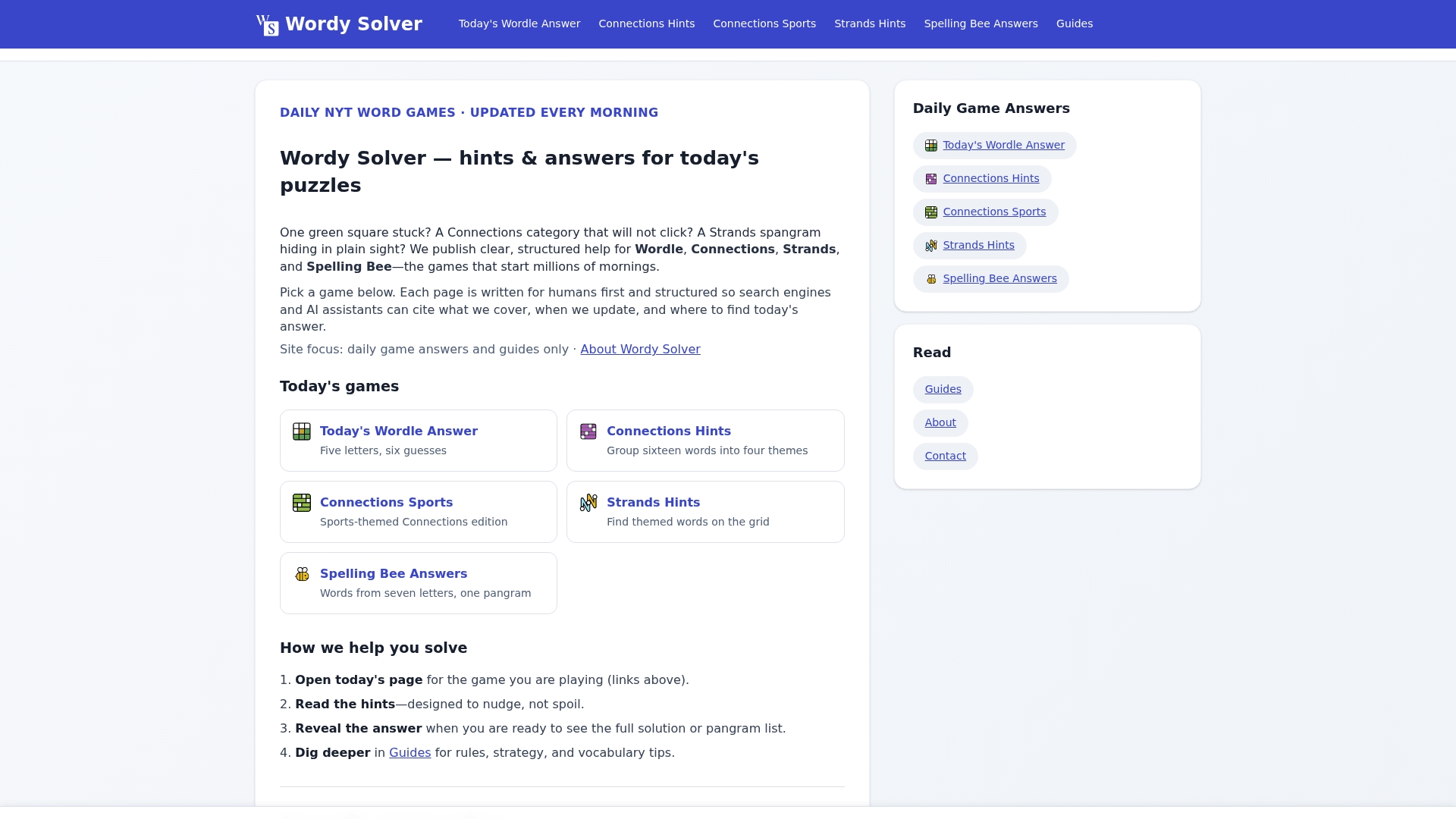
You can grab a gentle nudge to get unstuck or go straight to the full answer when you are short on time. Wordy Solver also covers Connections, Strands, and Spelling Bee, so one bookmark handles your entire daily word game routine. Whether you are a casual player who needs a push or a serious solver building your skills, daily hints and answers are ready and waiting. No subscription required for the essentials.
FAQ
What is Wordle and how do you play it?
Wordle is a free daily word puzzle where players guess a five-letter word in six attempts using color-coded tile feedback. Green means correct letter and position, yellow means correct letter in the wrong spot, and gray means the letter is not in the word.
Is Wordle free to play?
The daily Wordle puzzle is completely free to play on the New York Times website or app. No account or subscription is needed for the daily game, though archive access requires a paid subscription.
What is Wordle for kids?
Wordle for Kids is a simplified version of the game that uses easier vocabulary and shorter words, recommended for players aged 8 and up. It teaches the same logic and deduction skills as the adult version in a more accessible format.
What are the best starting words for Wordle?
“SLATE,” “CRANE,” and “TRACE” are statistically stronger starting words than vowel-heavy options like “ADIEU.” These words cover high-frequency consonants and vowels, giving you the most useful information from your first guess.
What does Hard Mode do in Wordle?
Hard Mode requires you to use every green and yellow letter you have already revealed in your next guess. This setting eliminates lucky guesses and forces more disciplined, strategic play.