 Wordy Solver


Double letters in Wordle are defined as any letter that appears more than once in the five-letter answer, and the game only reveals their presence if your guess explicitly includes them. That single rule is why double letters complicate Wordle more than any other feature. About 25% of all Wordle answers contain a repeated letter, meaning you face a double-letter puzzle roughly seven or eight times every month. The five letters that repeat most often are L, S, E, O, and T, and knowing that fact alone changes how you play. Wordy Solver exists precisely for moments like these, giving you structured hints when the tile colors stop making sense.
Why double letters complicate Wordle’s feedback system
Wordle’s color feedback follows one strict rule: it highlights only as many instances of a letter as that letter actually appears in the answer. This sounds simple until your guess contains a letter twice and the answer contains it only once.
Take the classic example of guessing SPOON against the answer ROBOT. The word ROBOT contains one O. Your guess SPOON contains two O’s. Wordle colors only one O as yellow or green and leaves the second O gray. That gray tile does not mean O is absent from the answer. It means you guessed O more times than the answer uses it. Most players read gray as “this letter is not in the word,” which is exactly the wrong conclusion here.
The confusion compounds in Hard Mode. Normal Mode lets you throw in a completely fresh word to test a theory. Hard Mode forces you to use every confirmed letter in every subsequent guess. That restriction makes double-letter testing far more expensive in terms of guesses.
- Gray on a repeated letter means you have already accounted for all instances of that letter in the answer.
- Yellow on a repeated letter means the answer contains that letter but not in the position you placed it.
- Green on a repeated letter means one instance is correctly placed, but a second instance may or may not exist.
- Two greens on the same letter confirms the answer uses that letter twice.
Pro Tip: If a letter you know is in the answer comes back gray on a second guess, do not eliminate it. Count how many times you guessed it versus how many times the answer likely uses it.
Why do double letters create a harder cognitive challenge?
The primary psychological hurdle is not the word itself. It is the assumption your brain makes before you even start guessing. Players’ phonetic search habits assume uniqueness, meaning your brain automatically scans its mental word list for words where every letter is different. That habit is efficient for most puzzles and catastrophic for double-letter ones.
The word KNOLL is a perfect example. Players who have confirmed K, N, O, and L will cycle through dozens of unique-letter combinations before their brain even considers that L might appear twice. The phonetic shape of KNOLL sounds like a simple four-sound word, so the double L stays invisible until a guess forces it into view.
The difficulty premium of double letters relates less to word rarity and more to limitations in feedback and player deduction patterns, according to data from 1,000 days of Wordle. The puzzle is not harder because the word is obscure. It is harder because the feedback system cannot volunteer the information you need.
Players fall into three predictable mental traps with double-letter puzzles:
- The elimination trap. You mark a letter as “not in the word” after it returns gray, even though you guessed it twice and the answer contains it once.
- The uniqueness trap. You mentally filter your word list to exclude any word with repeated letters, shrinking your options without realizing it.
- The dead-end trap. You have confirmed four letters but cannot find a five-letter word that fits. You keep searching unique-letter words instead of suspecting one confirmed letter is doubled.
Analysis of 730 million Wordle games shows the largest disparity between Normal Mode and Hard Mode failure rates occurs on double-letter words. Hard Mode accentuates this because it forces tight integration of every confirmed clue, making a wrong assumption about doubles far more costly.
Pro Tip: When you have three or four confirmed letters but cannot find a fitting word, immediately suspect a double. Check L, S, E, O, and T first, since those five letters cover 80% of all doubles in Wordle answers.

What patterns and letters appear most in double-letter puzzles?
The statistical picture of double letters in Wordle is clearer than most players realize. Roughly 25% of answers have one pair of doubles, while two pairs of doubles appear in 2.5% of answers and triple letters in 0.5%. That means one in four daily puzzles will trip up players who never adjust their strategy for repeats.
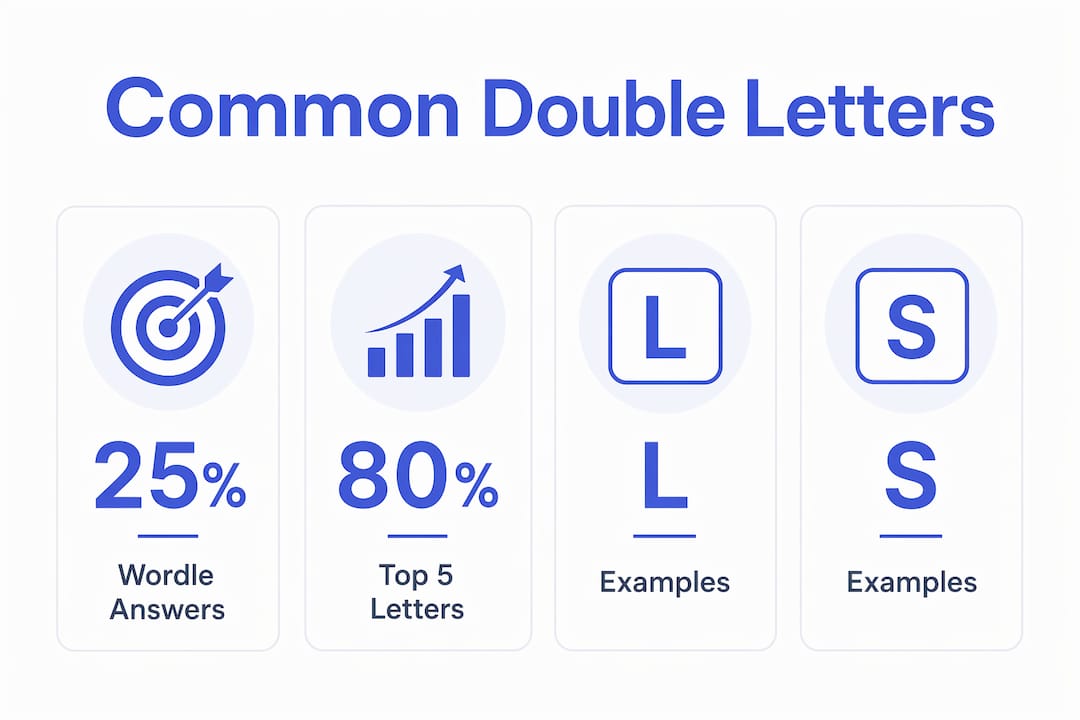
Five letters account for the vast majority of those repeats. L, S, E, O, and T together represent 80% of all double-letter instances in Wordle answers. Targeting these letters when you suspect a double is not guesswork. It is probability working in your favor.
Double vowels deserve special attention. Words like GOOSE, MOOSE, and LOOSE share the OO pattern, and EE words like STEEL and CREEK follow the same structure. Vowel-testing strategies typically assume each vowel appears once, so a double vowel breaks the standard opening-guess logic entirely.
| Letter | Doubles frequency | Example Wordle words |
|---|---|---|
| L | Very high | KNOLL, LLAMA, SPELL |
| S | Very high | SISSY, DRESS, BLISS |
| E | High | STEEL, CREEK, GEESE |
| O | High | GOOSE, VOODOO, IGLOO |
| T | High | ATTIC, BUTTE, LATTE |
On the opposite end, letters like H, J, Q, V, W, X, and Y rarely or never double in English words, which means they almost never appear as doubles in Wordle answers. Crossing these off your double-suspect list immediately narrows your search.
Double consonants tend to cluster at the end of words (SPELL, DRESS, KNOLL) or frame the middle (ATTIC, LATTE). Double vowels most often appear in the middle two or three positions (GOOSE, CREEK). Recognizing these placement patterns gives you a structural shortcut when you are stuck.
What are the best Wordle strategies for double-letter puzzles?
The most effective approach to double letters is treating them as a hypothesis to test rather than a surprise to absorb. Expert players use “double-testing” guesses by guess three or four, deliberately choosing words that contain a known letter twice to confirm or rule out a repeat.
Words like STEEL, CREEK, SPELL, and LLAMA work well as double-testing guesses because they contain common double letters in natural positions. If STEEL returns two greens on the E’s, you have confirmed a double E and can build from there. If both E’s come back gray, you have ruled out a double E in one move.
Here is a practical framework for handling double-letter puzzles:
- Guesses 1 and 2: Use standard opening words that cover common letters. Do not worry about doubles yet.
- Guess 3: If your confirmed letters do not fit any unique-letter word cleanly, consider a double-testing guess.
- Guess 4: If you still have no clear path, prioritize testing L, S, E, O, or T as a double. These five cover the overwhelming majority of cases.
- Guess 5 onward: Commit to the most likely double-letter word based on confirmed positions. Avoid scattering guesses across unrelated words.
Hard Mode players need to plan double-testing earlier. Because Hard Mode forces precise double-letter testing without the luxury of throwaway guesses, suspecting a double by guess three and acting on it by guess four is the difference between solving and failing.
The most common mistake players make is waiting too long to consider doubles. When confirmed letters do not produce a fitting word, the dead end itself is the signal. Treat it as a prompt to check whether one of your confirmed letters appears twice.
Pro Tip: Build a short mental list of double-testing words before you play each day. STEEL, CREEK, SPELL, LLAMA, and ATTIC cover the five most common double letters and give you ready-made pivots when the puzzle stalls.
Key Takeaways
Double letters complicate Wordle because the feedback system only reveals repeats when you guess them directly, forcing players to test doubles deliberately rather than deduce them passively.
| Point | Details |
|---|---|
| Double letters are common | About 25% of Wordle answers contain a repeated letter, making this a frequent challenge. |
| Feedback misleads on repeats | A gray tile on a repeated letter means over-guessing, not absence. |
| Five letters dominate | L, S, E, O, and T account for 80% of all double-letter instances in Wordle answers. |
| Dead ends signal doubles | When confirmed letters fit no word, suspect one letter is doubled before moving on. |
| Double-testing words help | Guesses like STEEL, CREEK, and SPELL confirm or rule out doubles in a single move. |
Double letters taught me to stop trusting my instincts
I spent months getting burned by double-letter Wordle puzzles before I understood what was actually happening. My instinct was always to trust the gray tiles completely, and that instinct cost me more solves than I care to admit.
The shift came when I stopped treating gray as a verdict and started treating it as partial information. A gray tile on a letter I had already confirmed somewhere else is not a contradiction. It is a clue that the answer uses that letter fewer times than I guessed it. Once that clicked, double-letter puzzles stopped feeling like bad luck and started feeling like a solvable pattern.
What I find genuinely exciting about double-letter puzzles is that they reward players who think structurally rather than phonetically. Your brain wants to sound out words. The puzzle rewards players who think about letter frequency and placement instead. That is a skill you can actually build with practice, and every double-letter puzzle you work through sharpens it.
My honest advice: keep a short list of double-testing words ready. Use them without hesitation when you hit a wall. The players who solve double-letter puzzles consistently are not luckier than you. They just act on the dead-end signal faster.
— Mat C.
Wordy Solver and the double-letter puzzle problem
Stuck on a double-letter puzzle with two guesses left? That is exactly the situation Wordy Solver was built for.
Wordy Solver gives you structured hints for daily Wordle puzzles, including the double-letter ones that send most players to the comments section in frustration. You can choose a gentle nudge that keeps the challenge alive, or go straight to the full answer when you need it. The tool covers Wordle, Connections, Strands, and Spelling Bee, so your entire daily word game routine has a reliable backup. No spoilers unless you want them. No judgment either way.
FAQ
What percentage of Wordle answers have double letters?
About 25% of Wordle answers contain at least one repeated letter. That works out to roughly seven or eight double-letter puzzles per month for daily players.
Why does a letter turn gray when I know it’s in the answer?
Wordle only highlights as many instances of a letter as the answer actually contains. If you guessed a letter twice but the answer uses it once, the second instance turns gray. That gray tile signals over-guessing, not absence.
Which letters double most often in Wordle?
L, S, E, O, and T are the five most common doubled letters and account for 80% of all double-letter instances in Wordle answers. Testing these first when you suspect a double is the most efficient approach.
Which letters almost never double in Wordle?
Letters like H, J, Q, V, W, X, and Y rarely or never double in English words, so they almost never appear as repeated letters in Wordle answers. You can safely deprioritize them when hunting for doubles.
What is a double-testing guess in Wordle?
A double-testing guess is a word you choose specifically because it contains a known letter twice, such as STEEL or CREEK. Expert players use this tactic by guess three or four to confirm or rule out a repeated letter in a single move.