 Wordy Solver


Phonics is the foundational decoding skill that explains why phonics connects to word games at a cognitive level. When you understand how sounds map to letters, word games stop being guesswork and start being a genuine mental workout. A 2023 JAMA Network Open study tracked over 10,000 adults and school-age children and found that regular word puzzle activities improve reading fluency and spelling accuracy. That result is not accidental. Phonics builds the mental infrastructure that makes every letter tile, every five-letter guess, and every spelling challenge feel purposeful rather than random.
Why phonics connects to word games: the cognitive link
Phonics gives you a system. Without it, word games rely on visual pattern matching and luck. With it, you decode words the way a musician reads sheet music, letter by letter, sound by sound, with speed and accuracy.
The technical term educators use is phoneme-grapheme mapping. A phoneme is the smallest unit of sound in a word. A grapheme is the letter or letter combination that represents it. When you play a word game, your brain performs this mapping in real time. You hear the word in your head, break it into sounds, and match those sounds to letters on the board or screen. That process is phonics in action.
Word games reinforce this skill through several mechanics:
- Sound blending: Combining individual phonemes into a whole word, which is exactly what you do when you test a guess in a daily word puzzle.
- Segmenting: Breaking a word apart to check if each sound fits the available letters.
- Sound manipulation: Swapping one phoneme for another to generate new valid words, the core mechanic behind word chaining games.
- Orthographic mapping: Locking the visual form of a word to its sound pattern in long-term memory, so you recognize it instantly next time.
Phonics-based games like word chaining target orthographic mapping by blending phonemes and graphemes in real-time print changes. Each move in the game forces your brain to encode a new sound-to-print connection. That is why players who practice word chaining report faster word recognition over time.
Pro Tip: Before you play any spelling-based word game, say the target word aloud and count its phonemes. This activates your phonics knowledge and gives you a structural advantage before you place a single letter.
What does research say about phonics and word games?
The science behind combining phonics with word games is clear and consistent. Sound pattern decomposition is faster and more accurate than guessing based on visual patterns alone. Players who rely on phonics knowledge decode words more quickly and make fewer random errors.
The 2023 JAMA Network Open findings confirmed that word puzzle engagement produces measurable literacy gains. The study’s scale, over 10,000 participants, makes it one of the most significant data points in this area. The takeaway is that the benefits are real, but they depend on how you engage with the games.
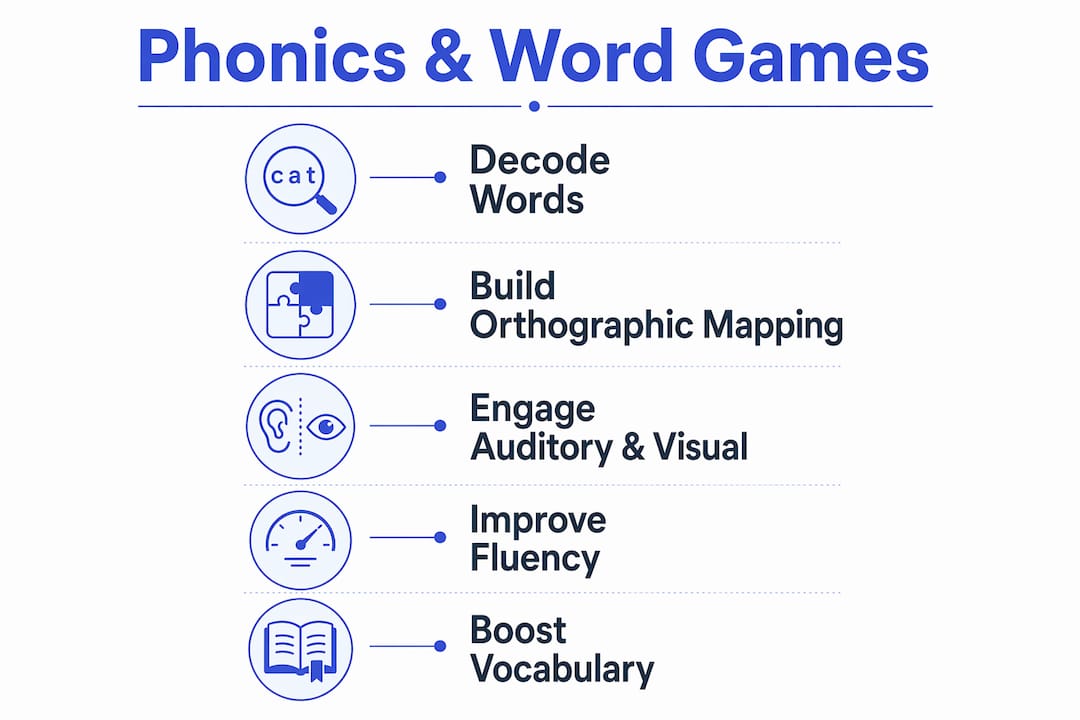
Spaced retrieval practice is the mechanism that makes word games so effective for memory. Active retrieval during games creates deeper neural encoding than recognition alone. Every time you struggle to recall a word and then succeed, your brain strengthens that memory pathway more than if you had simply read the word in a list.
There is an important nuance here. Word games improve vocabulary and verbal fluency but do not increase general IQ. A 2016 cognitive scientists’ consensus confirmed that benefits are specific to linguistic abilities. Think of word games as a targeted vocabulary workout, not a general intelligence booster.
| Research finding | What it means for players |
|---|---|
| Word puzzles improve reading fluency in children | Phonics-based games accelerate literacy development when used consistently |
| Active retrieval beats passive reading for memory | Struggling to recall a word in a game encodes it more durably than reading it |
| Benefits are specific to linguistic abilities | Word games sharpen vocabulary and verbal speed, not broad cognitive skills |
| Phonics foundation required for maximum benefit | Players without basic decoding skills gain less from spelling-based games |
“Without phonemic awareness, word games become guesswork rather than cognitive skill-building. Sound-symbol mastery improves speed and decoding accuracy significantly.”
The table above shows that the benefits of word games are real but targeted. Phonics knowledge is what converts casual play into genuine literacy gains.
How phonics-based word games differ from general word puzzles
Not all word games are equal. General word puzzles, like crosswords or anagram solvers, primarily test vocabulary recall and pattern recognition. You search your memory for a word that fits a definition or a letter arrangement. Phonics knowledge helps, but it is not the core mechanic.
Phonics-based word games are different in a specific way. They require you to actively decode sound-to-letter relationships under time pressure or within tight constraints. The game rules force phonics engagement rather than allowing you to bypass it.
Auditory and visual processing working together
Phonics games engage both auditory and visual processing at the same time. You hear the word in your head, visualize the letters, and check whether the sounds match the available graphemes. General puzzles often skip the auditory step entirely. A player can solve a crossword clue by recognizing a visual pattern without ever sounding the word out. That shortcut is not available in a well-designed phonics game.
Morphological awareness as the next level
Advanced players manipulate internal word structures to boost reading comprehension and puzzle performance. This is morphological awareness, the understanding of prefixes, suffixes, and roots. It sits one level above basic phonics. A player who knows that “un” negates a root and “tion” converts a verb to a noun can generate valid words far faster than someone relying on phonics alone. Morphological awareness is the natural next step after phonics mastery, and the best word games reward it.
General puzzles rarely require this depth. They reward broad vocabulary. Phonics-based games reward structural knowledge of how words are built, which is a more transferable literacy skill.
Practical ways to combine phonics with word games daily
Combining phonics learning with word games does not require a formal curriculum. A few deliberate habits make the connection work.
-
Start with phonics basics. Before playing any spelling or word-building game, confirm you can segment and blend the words you encounter. If a word stumps you, break it into phonemes before guessing. This turns every failed attempt into a phonics lesson.
-
Choose games that force decoding. Word chaining, spelling bees, and letter-tile games all require active sound-to-letter mapping. Pattern-matching games that reward visual memory alone do not build the same phonics skills.
-
Use timed games for retrieval practice. Word games under time pressure train neural pathways differently than untimed play. The friction of recalling a word quickly strengthens memory retention. Set a timer even when the game does not require one.
-
Play with others. Social word games add a motivation layer that solo play cannot replicate. When someone else challenges your word, you are forced to defend it phonetically. That verbal defense deepens encoding.
-
Rotate game types. Cover phonological skills with sound-based games and morphological skills with prefix and suffix challenges. Variety prevents the plateau that comes from repeating the same game mechanic.
Word games reinforce literacy best when a phonics foundation is already in place. Educational experts recommend phonics assessment before introducing spelling-based games. If you are building skills from scratch, spend two to four weeks on phoneme-grapheme mapping exercises before moving to competitive word games.
Pro Tip: Keep a running list of words that stumped you during gameplay. At the end of the week, practice segmenting each one into phonemes. This spaced retrieval habit accelerates vocabulary retention faster than any passive review method.
Key takeaways
Phonics is the cognitive engine that converts word game play into lasting vocabulary and reading gains.
| Point | Details |
|---|---|
| Phonics enables decoding | Sound-to-letter mapping turns word game guesses into structured cognitive skill-building. |
| Research confirms literacy gains | A 2023 JAMA Network Open study of over 10,000 participants linked word puzzles to improved reading fluency. |
| Active retrieval beats passive reading | Struggling to recall a word in a game encodes it more durably than reading it in a list. |
| Phonics foundation comes first | Players without basic decoding skills gain significantly less from spelling-based word games. |
| Morphological awareness extends the benefit | Understanding prefixes, suffixes, and roots is the natural next level after phonics mastery. |
Phonics and word games: what I have seen actually work
I have watched a lot of players approach daily word games the same way. They scan the board visually, look for familiar letter clusters, and guess based on what looks right. Some get lucky. Most plateau quickly and wonder why their vocabulary is not growing despite playing every day.
The players who improve consistently do something different. They slow down for one second before each guess and ask: what sounds does this word make? That one habit, rooted in phonics, changes everything. It shifts the game from visual pattern matching to active decoding. The brain encodes the word differently. The vocabulary sticks.
What the research confirms, and what I find genuinely underappreciated, is that phonics is not just for children learning to read. It is the underlying skill that separates a word game player who plateaus from one who keeps growing. Adults who revisit basic phoneme-grapheme mapping often report a noticeable jump in their game performance within weeks.
The other thing worth saying plainly: morphological awareness is where the real fun starts. Once you understand that “phon” means sound and “graph” means writing, a word like “phonograph” is not something you memorize. It is something you build. That shift from memorization to construction is what makes advanced word games genuinely exciting rather than just repetitive.
— Mat C.
Wordy Solver: where phonics meets daily word game practice
Wordy Solver is built for players who want to engage more deeply with daily word challenges like Wordle, Connections, Strands, and Spelling Bee. Every puzzle on the platform rewards the kind of sound-to-letter thinking that phonics builds.
Whether you need a structured hint to decode a tricky word or want to check a full answer after exhausting your guesses, Wordy Solver gives you both options without spoilers. That flexibility means you can practice active retrieval, the same mechanism that cognitive science identifies as the key to durable vocabulary retention, at your own pace. Play daily, apply your phonics instincts, and watch your word game performance climb.
FAQ
Why does phonics help with word games?
Phonics gives players a system for decoding words by mapping sounds to letters. That system replaces visual guessing with structured reasoning, which improves both speed and accuracy in word games.
Do you need phonics knowledge to enjoy word games?
You can enjoy word games without phonics, but your vocabulary growth will be limited. Players with a phonics foundation gain more from each game session because they encode words more deeply through active sound-to-letter mapping.
What is orthographic mapping in word games?
Orthographic mapping is the process of connecting a word’s sound pattern to its written form in long-term memory. Word chaining games specifically target this process, making word recognition faster over time.
Are word games good for reading fluency?
Yes. A 2023 JAMA Network Open study of over 10,000 participants found that regular word puzzle activities improve reading fluency and spelling accuracy, particularly in school-age children.
What is morphological awareness and why does it matter?
Morphological awareness is the understanding of prefixes, suffixes, and word roots. It builds on phonics and allows players to construct and decode complex words faster, which is a major advantage in advanced word games.