 Wordy Solver


Word puzzles are defined as structured language challenges that require players to find, arrange, or decode words under specific rules. They are the fastest-growing cognitive leisure category of 2026, driven by three forces working together: proven brain benefits, social sharing mechanics, and daily digital rituals that fit any schedule. Puzzle and quiz book sales increased by 24% in 2026 compared to 2024. That number tells you this is not a passing trend. Understanding why word puzzles are popular in 2026 means looking at what they do for your brain, your social life, and your daily sense of accomplishment.
Why are word puzzles so popular in 2026?
The short answer is that word puzzles hit three needs at once: mental stimulation, social connection, and a satisfying daily win. No other leisure format does all three with so little friction.
Word puzzles recruit multiple cognitive systems simultaneously, making them a genuinely engaging mental workout rather than narrow brain training. That distinction matters. A brain training app that drills one skill in isolation produces limited real-world benefit. A crossword or word grid pulls in working memory, attention, vocabulary retrieval, and reasoning all at once. Players feel the difference, and that feeling keeps them coming back.

The social layer amplifies everything. When you share a cryptic result grid on a group chat, you are not just broadcasting a score. You are sending a puzzle that invites others to react, guess, and compete. That asymmetric sharing design turns a solo activity into a group event without requiring anyone to play at the same time.
What cognitive benefits do word puzzles offer?
The cognitive benefits of word games are well documented and go beyond “keeping your mind sharp,” a phrase that means very little on its own.
Cognitive scientists agree that brain-training programs show limited far-transfer, meaning skills learned in one narrow task rarely improve unrelated abilities. Word games are different. They build vocabulary and verbal fluency, which carry over into reading, writing, and conversation. That is a real-world payoff you can measure.
The clinical evidence is striking. A 2022 trial showed that crossword puzzle players with mild cognitive impairment had better cognitive function and less brain shrinkage than those using computerized brain training. That result flipped the assumption that purpose-built software beats traditional puzzles. It means the format you actually enjoy may outperform the one designed to train you.
Here is what the research says word puzzles specifically improve:
- Working memory: Holding letter combinations and word patterns in mind while scanning for solutions.
- Lexical access speed: Retrieving words faster, which benefits everyday conversation and reading.
- Verbal fluency: Generating words within categories or constraints, a skill tied to communication quality.
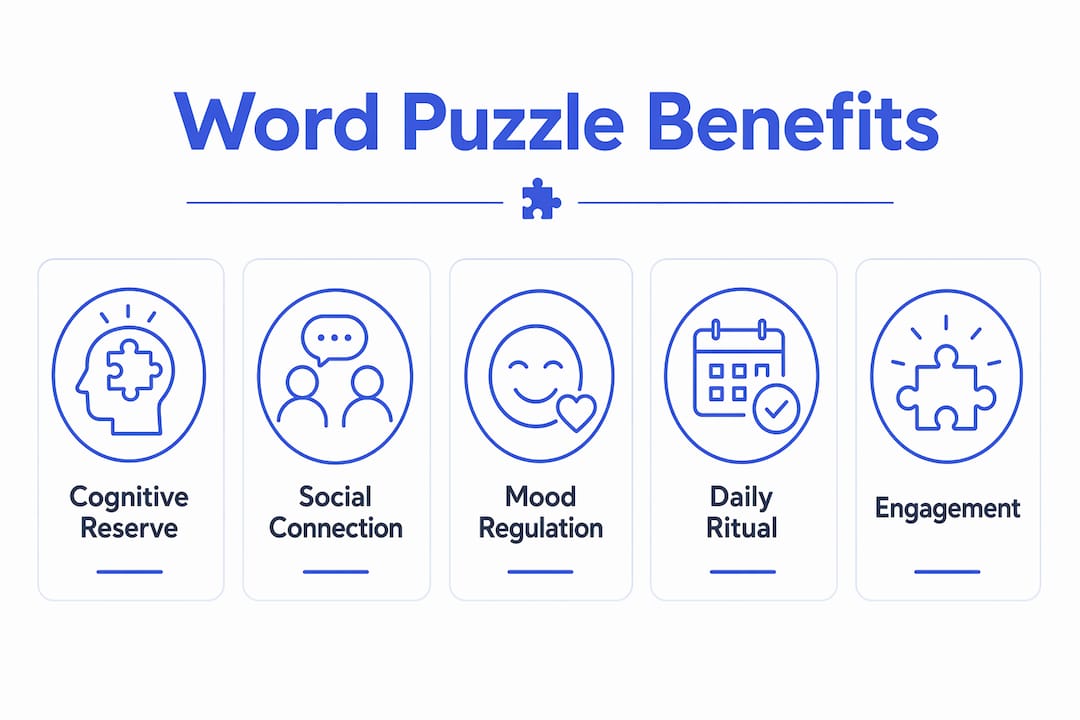
- Cognitive reserve: Building a buffer of mental capacity that helps the brain cope with age-related changes.
- Attention and focus: Sustaining concentration on a single task, which counteracts the fragmented attention habits that AI and social media tend to create.
Researchers emphasize that word puzzles build cognitive reserve by engaging working memory, attention, and reasoning together, not by raising IQ. That framing is more honest and more useful. You are not becoming a genius. You are keeping your mental machinery well-oiled.
Daily word puzzles also provide a small daily win that positively impacts mood and regulates anxiety. Psychologist Dr. Nina Bakoyiannis identifies this micro-reward cycle as a genuine wellbeing tool. Solving a puzzle in the morning sets a positive tone that carries into the rest of your day.
Pro Tip: Consistency beats session length for brain benefits. Daily, brief puzzle engagement improves lexical access speed and cognitive reserve more effectively than occasional long sessions. Ten minutes every morning beats ninety minutes on a Sunday.
How do social features drive the popularity of word games?
The mental benefits of puzzles explain why people start playing. Social mechanics explain why they keep playing and why they recruit their friends.
Word puzzles create social signals that invite curiosity and collaborative problem solving through asymmetric and cryptic result sharing. When a friend posts a grid of colored squares with no explanation, you want to know what it means. That curiosity is the engine of viral spread. The best puzzle designers build this in deliberately.
The simplicity and repeatability of daily word puzzles, combined with social mechanics, sustain engagement and drive viral spread. A puzzle that resets every day gives players a shared calendar. Everyone is working on the same challenge at the same time, which creates a natural conversation starter at breakfast, in group chats, and on social media feeds.
The social features that make word puzzles sticky in 2026 include:
- Daily reset cycles that create a shared ritual and a reason to check in every morning.
- Shareable result grids that communicate performance without spoiling the puzzle for others.
- Asymmetric outcomes where two players can have very different experiences with the same puzzle, fueling discussion.
- Low barrier to entry that lets casual players join conversations with experienced ones without feeling outmatched.
- Cross-platform reach through social media posts, messaging apps, and news site embeds that bring puzzles to new audiences daily.
News organizations and cultural publishers have accelerated this by embedding games into their daily digital platforms. When a major news outlet makes a word puzzle part of its morning content, it reaches millions of readers who would never have sought out a puzzle app on their own.
Pro Tip: Designing puzzles for curiosity and interaction increases retention. If your result grid makes a friend ask “how did you get that?” you have already created the next player.
How have demographics and culture shaped word puzzle trends in 2026?
The word puzzles trends of 2026 are not driven by one age group. They span generations, though the intensity varies.
50% of Gen Zers regularly play crosswords in 2026, the highest rate among any generation. That figure from a June 2026 poll by Unscrambled Words upends the assumption that crosswords belong to older players. Gen Z’s engagement is driven by social media discovery, short-form puzzle formats, and the cultural cachet of being good at word games.
The pandemic years accelerated digital puzzle adoption across all age groups. Players who picked up daily word games during lockdowns built habits that stuck. Those habits are now embedded in morning routines, commutes, and lunch breaks worldwide.
| Demographic factor | Impact on puzzle popularity |
|---|---|
| Gen Z engagement | Highest crossword participation rate of any generation in 2026 |
| Pandemic habits | Digital puzzle adoption became a lasting daily ritual for millions |
| News organization integration | Major publishers embedded puzzles into daily content, expanding reach |
| Cross-sector uptake | Education, entertainment, and media all adopted puzzle formats |
| Inclusive design | Modern puzzles use culturally diverse clues that resonate with wider audiences |
Cultural inclusivity in puzzle design has also expanded the player base. Modern crosswords and word grids increasingly reflect diverse references, names, and topics. Players who once felt excluded by clues rooted in a narrow cultural frame now find puzzles that speak to their experience.
The mood benefit plays a role in sustained popularity too. The sense of accomplishment in word puzzles acts as a mood regulator and a form of micro-reward that encourages daily play. When something makes you feel good every morning, you build it into your routine without thinking about it.
How can you get the most out of word puzzles today?
Getting the full cognitive and social reward from word puzzles comes down to how you structure your play, not just how often you play.
- Play daily, not occasionally. Consistency is the single biggest driver of cognitive benefit. A short daily session builds lexical access speed and cognitive reserve faster than sporadic long ones.
- Vary your puzzle types. Crosswords, word grids, spelling challenges, and category-based puzzles each engage different cognitive systems. Rotating formats keeps your brain working across multiple skills.
- Share your results. Post your result grid to a group chat or social feed. The conversation that follows deepens your engagement and pulls others into the habit.
- Choose puzzles at the edge of your ability. Too easy and you coast. Too hard and you quit. The sweet spot is a puzzle that takes real effort but feels solvable. That tension is where the cognitive benefit lives.
- Build a ritual around it. Attach your puzzle to an existing habit, like morning coffee or a lunch break. Habit stacking makes consistency automatic.
Pro Tip: Use structured hints when you are stuck rather than abandoning a puzzle. Completing a puzzle with a nudge builds more vocabulary and confidence than walking away. Wordy Solver offers layered hints for games like Wordle, Connections, Strands, and Spelling Bee so you can stay in the game without spoiling it.
Key takeaways
Word puzzles are popular in 2026 because they combine genuine cognitive benefits, social sharing mechanics, and daily rituals that fit any lifestyle, making them the most accessible brain-engaging leisure activity available.
| Point | Details |
|---|---|
| Cognitive benefits are real | Word puzzles improve working memory, verbal fluency, and cognitive reserve through daily engagement. |
| Social mechanics drive virality | Asymmetric result sharing turns solo play into a community event that recruits new players. |
| Gen Z leads engagement | 50% of Gen Zers play crosswords regularly in 2026, the highest rate of any generation. |
| Consistency beats length | Daily brief sessions outperform occasional long ones for brain health and lexical speed. |
| Cultural inclusivity expands reach | Modern puzzle design reflects diverse references, broadening the player base across demographics. |
Why I think word puzzles are more than a trend
I have watched puzzle communities grow from niche forums into mainstream social rituals, and the shift that stands out most is not the technology. It is the tone. Word puzzle communities are genuinely kind. Players help each other, celebrate streaks, and commiserate over hard days without the hostility that shows up in competitive gaming spaces. That social texture is rare, and it is a big reason people stay.
The cognitive angle gets oversold sometimes. You will not become measurably smarter by playing a daily word game. What you will do is keep your verbal mind active, build a small daily win into your routine, and stay connected to a community of people who care about language. That is worth more than most productivity apps promise and actually deliver.
What I find most interesting about 2026 is the counter-intuitive driver: AI. As AI handles more writing, summarizing, and thinking for people, there is a growing appetite for activities that put you back in control of your own mind. Word puzzles are a direct answer to that. They are low-tech, personal, and entirely yours to solve. The daily puzzle habit is partly a rebellion against cognitive outsourcing, and I think that dynamic will only grow stronger.
My advice to anyone new to word puzzles: start with one format, play it every day for two weeks, and share your results with at least one other person. The habit forms faster than you expect, and the community finds you.
— Mat C.
Wordy Solver is built for daily puzzle players like you
You already know the feeling of being one clue away from finishing and hitting a wall. Wordy Solver is designed for exactly that moment.
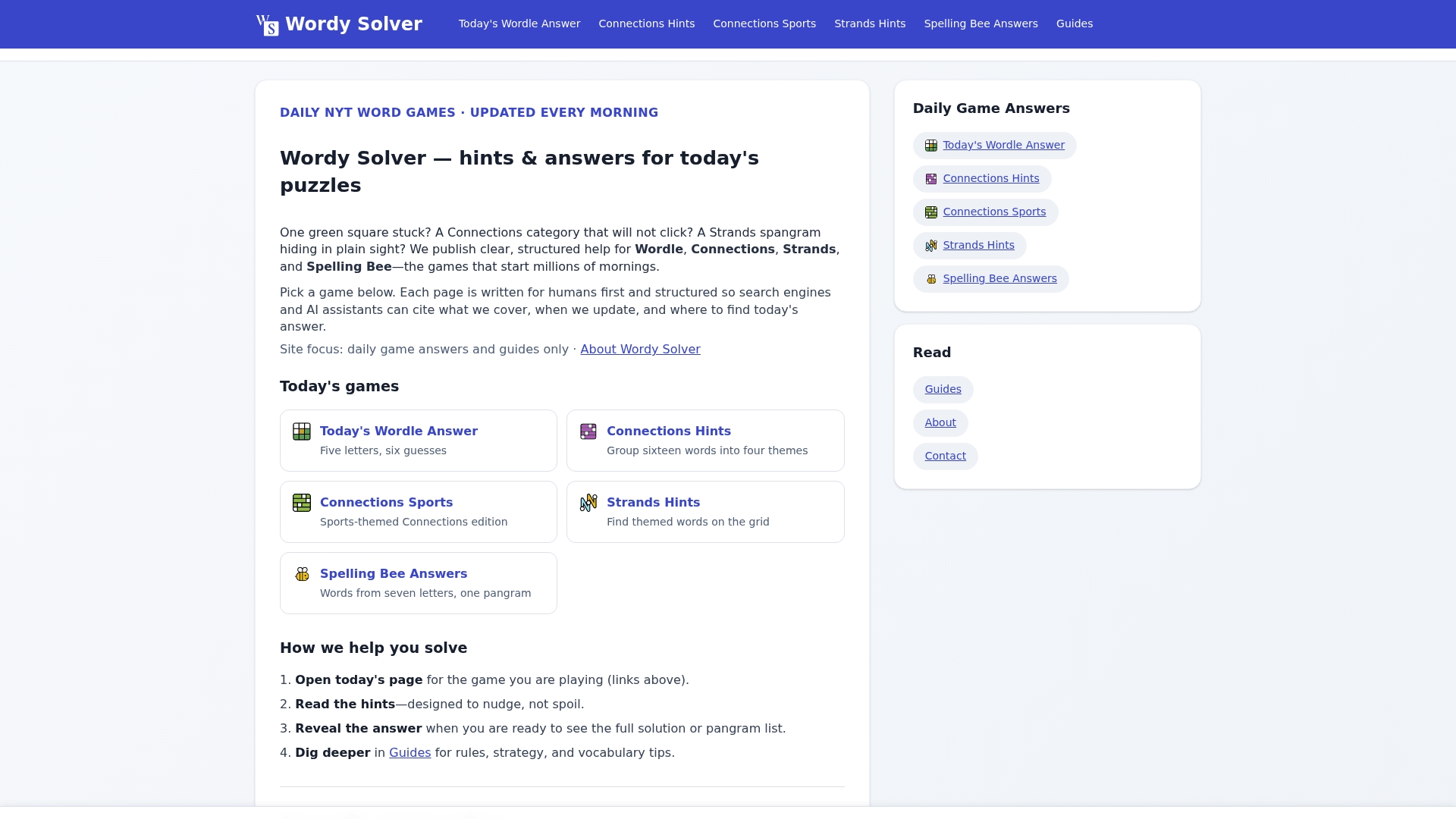
Wordy Solver gives you daily hints for Wordle, Connections, Strands, and Spelling Bee without spoiling the puzzle before you are ready. You choose how much help you get. Start with a nudge, and reveal the full answer only if you need it. That approach keeps the satisfaction of solving intact while making sure you never have to abandon a puzzle mid-streak. Whether you play for the brain benefits, the community, or just the daily ritual, Wordy Solver fits right into your routine.
FAQ
Why are word puzzles so popular right now?
Word puzzles combine cognitive engagement, social sharing, and a satisfying daily ritual that fits modern schedules. Their viral design and proven brain benefits make them one of the most accessible leisure activities in 2026.
What cognitive benefits do word games actually provide?
Word games improve working memory, verbal fluency, and lexical access speed. A 2022 clinical trial found crossword players with mild cognitive impairment showed better cognitive function than those using computerized brain training programs.
Why do Gen Z players engage with word puzzles so much?
50% of Gen Zers play crosswords regularly in 2026, driven by social media discovery, short-format puzzle design, and the cultural appeal of language-based challenges shared in group chats and on social feeds.
How often should you play word puzzles to get brain benefits?
Daily play is the most effective approach. Brief daily sessions improve lexical access speed and build cognitive reserve faster than occasional long sessions, according to research published in 2026.
Do word puzzles actually help with mood?
Yes. Completing a word puzzle delivers a micro-reward that positively impacts mood and helps regulate anxiety, according to psychologist Dr. Nina Bakoyiannis. That daily win is a genuine wellbeing benefit, not just a feeling.