 Wordy Solver


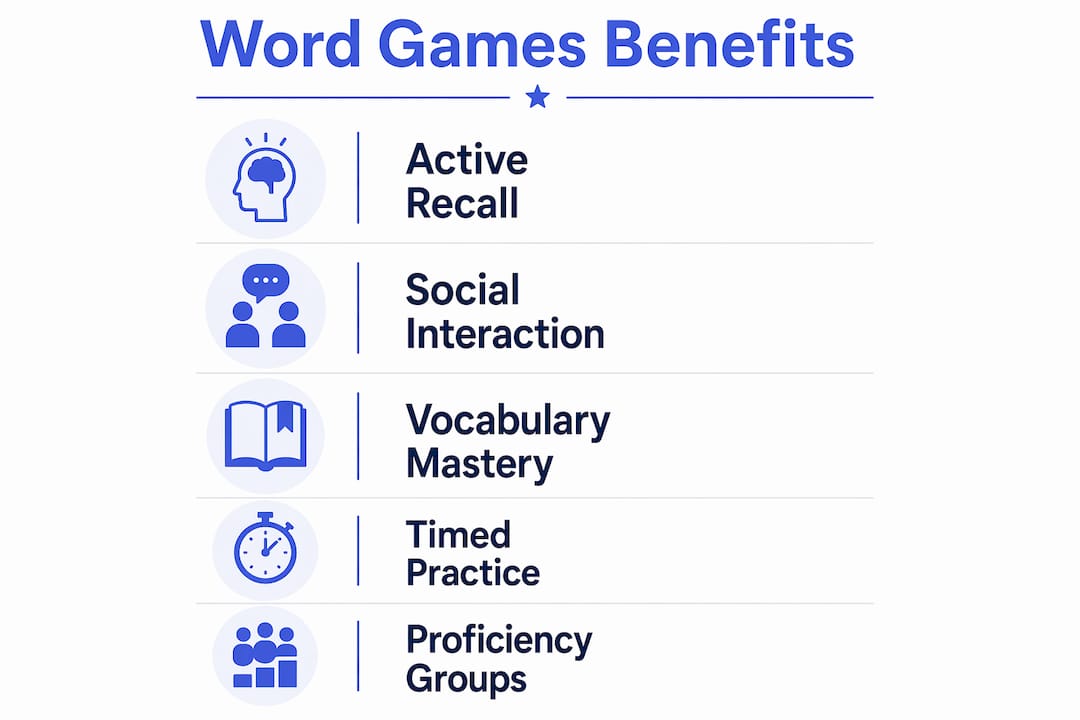
Word games are the most effective method for ESL vocabulary building because they force active recall, social interaction, and immediate word use in a single activity. Research confirms that learners using word games outperform traditional learning groups by a measurable margin, with game-based groups scoring a mean gain of 30.13 points versus 25.53 points for conventional study. That gap is not a coincidence. It reflects how the brain encodes words differently when they arrive through play, pressure, and laughter rather than through a vocabulary list. Whether you are an intermediate adult learner or a beginner building your first 1,000 words, the right word game can make vocabulary stick in ways that flashcards simply cannot match.
What are the best tools for word games ESL vocabulary building?
Strong vocabulary games start with the right materials. Without them, even the best game idea falls flat in the first five minutes.
The core toolkit for ESL vocabulary games includes:
- Word lists matched to your current level (A2, B1, B2 on the CEFR scale)
- Bingo cards printed with target vocabulary or definitions
- Printable crossword and word search puzzles built around a specific theme
- Digital word puzzle apps that offer instant feedback and adaptive difficulty
- A timer (even a phone timer works) to add urgency and energy
Vocabulary selection is the most overlooked preparation step. Choosing words that are too easy produces boredom. Choosing words that are too hard produces frustration. The sweet spot is words you have seen once or twice but have not yet fully owned. That zone is where games do their best work.
Structured lesson planning is also critical for managing noise levels and proficiency gaps, especially in group settings. Teachers and self-directed learners alike report that games without clear rules and time limits quickly lose focus.
Pro Tip: Group learners by proficiency level when possible. A B1 learner competing against a B2 learner in a fast-paced word game will disengage quickly. Same-level grouping keeps everyone in the game and keeps motivation high.
How do word chain, bingo, and word puzzles reinforce ESL learning?
These three game formats cover different vocabulary skills. Used together, they build a complete picture of a word: its spelling, its sound, its meaning, and its use in context.
1. Word chain games
Word chain is simple: one player says a word, and the next player must say a word that starts with the last letter of the previous word. “Apple” leads to “elephant,” which leads to “tiger,” and so on. The mechanics are easy to learn in under two minutes, which makes word chain ideal for the start of a study session.
The cognitive payoff is real. Classroom studies show that word chain games can raise vocabulary mastery scores from 43.05 to 72.47 across two rounds of practice. That is a 68% improvement from a game that requires zero materials. The pressure of thinking on your feet forces your brain to scan its vocabulary bank fast, which strengthens recall pathways over time.
2. ESL bingo adaptations
Standard bingo is passive. You hear a word, you find it on your card, you mark it. That teaches recognition but not production. The smarter version requires learners to use words in sentences before they can mark their card. The caller says “describe a time you felt nervous,” and the learner must produce a sentence using the word “anxious” to claim the square. That one change transforms bingo from a listening drill into a speaking and grammar exercise.

3. Word puzzles and crosswords
Crossword puzzles force you to think about a word from two directions at once: its meaning (the clue) and its letter pattern (the grid). That dual processing is what makes crosswords so effective for spelling and retention. A learner who has to figure out that a seven-letter word meaning “to make something better” is “improve” will remember that word far longer than someone who read it in a list.
Pro Tip: Add a timer to any word puzzle. Time-pressured word games train your brain to think directly in English instead of translating from your native language first. Even 90 seconds of pressure per round builds fluency faster than untimed practice.
Which word puzzle apps best support second language learners?
Digital word puzzle apps fit into the pockets of a busy day in a way that classroom games cannot. A five-minute commute becomes a vocabulary session. A lunch break becomes a spelling drill.
When choosing a word puzzle app for ESL vocabulary development, look for these features:
- Instant feedback on every guess, so you learn from mistakes in real time
- Adaptive difficulty that adjusts to your current skill level
- Multiplayer or social options that add the competitive energy of a live game
- Daily challenges that build a consistent practice habit
- No translation crutch — the best apps push you to work out meaning from context
The difference between a useful app and a time-wasting one comes down to how it handles errors. Apps that simply mark an answer wrong and move on teach nothing. Apps that show you why an answer was wrong, offer the correct word in context, and then retest you on that word later are the ones that build real vocabulary.
| Feature | Why it matters for ESL learners |
|---|---|
| Instant feedback | Corrects errors before they become habits |
| Adaptive difficulty | Keeps you in the optimal challenge zone |
| Daily puzzles | Builds consistent vocabulary exposure |
| Context clues | Reduces reliance on native language translation |
| Social or multiplayer mode | Adds motivation and speaking practice |
A hybrid approach that combines self-paced individual app play with group game sessions produces the best vocabulary results. Solo play builds accuracy and confidence. Group play builds speed and real-world usage. Neither alone is as powerful as both together.
Daily word puzzle platforms like Wordy Solver offer structured hints for popular puzzles including Wordle, Connections, Strands, and Spelling Bee. For ESL learners, working through these puzzles daily builds pattern recognition, spelling intuition, and contextual vocabulary in a format that is genuinely fun to return to.
What challenges come up with word games in ESL learning?
Word games are not automatically effective. The way you run them determines whether they build vocabulary or just burn time.
The most common pitfalls and how to fix them:
- Anxiety from competition. Leaderboards and timed elimination games motivate short-term but can spike anxiety in learners who are already self-conscious about their English. Balance competitive formats with cooperative games where the group works toward a shared goal.
- Proficiency gaps. A mixed-level group playing the same game produces winners and quitters. Adapt rules so advanced learners must use words in full sentences while beginners only need to produce the word itself.
- Irrelevant vocabulary. Games built around words you will never use outside the classroom feel pointless. Tie vocabulary to real topics: job interviews, travel, cooking, or whatever matters to your life right now.
- Poor time management. Games without clear time limits drag on and lose energy. Set a hard stop at 15–20 minutes per game and move on.
“Effective classroom implementation of word puzzle games requires structured lesson planning to mitigate noise and proficiency disparities.” — Research finding from teacher and student perspective studies on vocabulary word puzzle games.
The fix for most of these problems is preparation. Thorough preparation and management before a game session, including pre-selected word lists, clear rules, and defined time limits, is what separates a vocabulary-building session from a chaotic free-for-all. Spend ten minutes preparing and you save thirty minutes of confusion.
My take on making word games work long-term
Why the Goldilocks zone is the real secret
I have watched learners burn out on vocabulary games that were either too easy or too hard, and the pattern is always the same. Too easy and they coast. Too hard and they shut down. The Goldilocks zone for vocabulary games is the narrow band where you know about 70% of the words and have to work for the other 30%. That tension is where learning actually happens.
My strongest recommendation is to mix formats deliberately. Use a timed individual game like a daily word puzzle to build speed and spelling. Then use a cooperative group game like sentence bingo to build speaking and usage. Neither format alone covers everything. The research on hybrid gamification backs this up clearly: blending individual autonomy with social collaboration produces better outcomes than either approach alone.
The other thing I push hard on is using mistakes as data, not as failures. When you get a word wrong in a game, that is the exact moment your brain is most ready to learn it. Do not skip past errors. Stop, look at the word, use it in a sentence out loud, and then keep playing. That thirty-second pause turns a miss into a memory.
Word games also do something that vocabulary lists never can: they make you feel something. You feel the rush of getting a word right under pressure. You feel the mild embarrassment of blanking on a word you thought you knew. Those emotions are memory anchors. The words that made you laugh or groan during a game are the ones you will still remember six months later.
— Mat C.
Wordy Solver and your daily vocabulary practice
Word games work best when they are part of a daily habit, not a once-a-week event. That is exactly where Wordy Solver fits in.
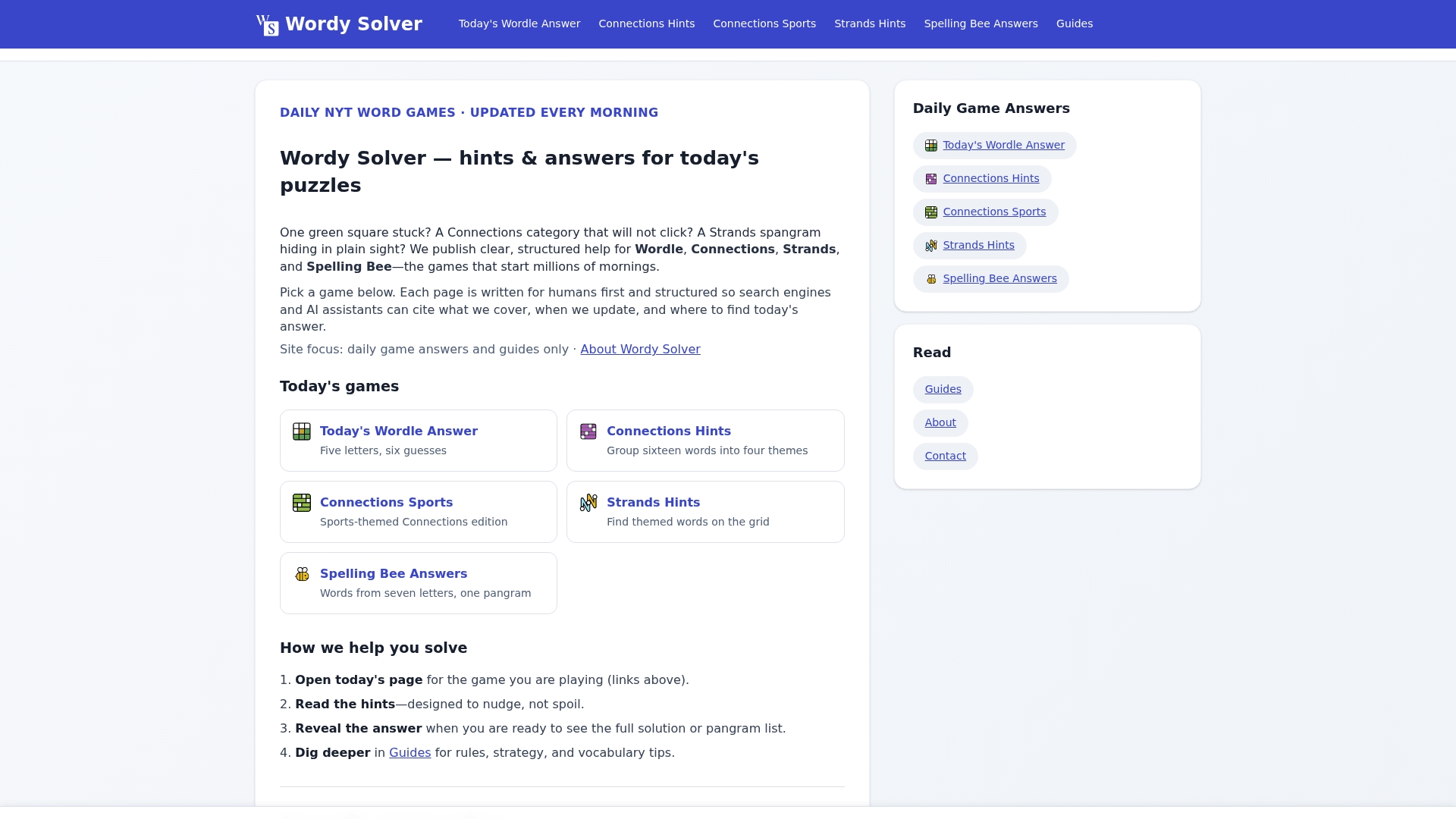
Wordy Solver supports daily word puzzle practice with structured hints and full solutions for Wordle, Connections, Strands, and Spelling Bee. For ESL learners, these puzzles are a low-pressure way to encounter new words, test spelling intuition, and build pattern recognition every single day. You can work through a puzzle independently, use a hint when you are stuck, or check the full answer when you want to understand the logic behind a solution. Visit Wordy Solver to add a daily vocabulary challenge to your routine and watch your word bank grow one puzzle at a time.
FAQ
How do word games improve ESL vocabulary retention?
Word games improve vocabulary retention by requiring active recall and immediate word use, which encodes words more deeply than passive reading or memorization. Interactive engagement can produce retention rates as high as 85%, far above traditional study methods.
Are word games effective for adult ESL learners?
Word games are highly effective for adult ESL learners because they combine motivation, repetition, and real-time feedback in a format that respects adult learning preferences. A hybrid approach mixing self-paced digital games with group play produces the strongest vocabulary gains for adults.
What is the best daily word game for ESL fluency building?
Daily word puzzles like Wordle and Spelling Bee are among the best options because they expose you to new words every day and require you to think about spelling and word structure actively. Platforms like Wordy Solver add hints and solutions that help ESL learners understand the reasoning behind each answer.
How do you handle mixed proficiency levels in word games?
Adapt the rules so that advanced learners must produce full sentences while beginners only need to identify or spell the target word. Structured grouping and rule adaptation prevent frustration and keep every learner engaged regardless of level.
Why do timed word games build fluency faster?
Timed games force your brain to retrieve words without pausing to translate from your native language first. That direct-in-English thinking is a core fluency skill, and time-pressured practice is one of the fastest ways to build it.
Key takeaways
Word games build ESL vocabulary faster than traditional methods because they combine active recall, social pressure, and immediate feedback in every single round.
| Point | Details |
|---|---|
| Games beat traditional study | Word game learners score measurably higher gains than conventional study groups in vocabulary mastery tests. |
| Mix individual and group play | A hybrid approach combining solo digital puzzles and group games produces the strongest vocabulary results. |
| Stay in the Goldilocks zone | Choose games where you know about 70% of the words so challenge stays high without causing frustration. |
| Use timed formats for fluency | Time pressure trains your brain to think directly in English, cutting out the native language translation step. |
| Preparation prevents failure | Pre-selected word lists, clear rules, and defined time limits are what make game sessions genuinely productive. |