 Wordy Solver


Word games are defined as active learning tools that force your brain to retrieve, evaluate, and apply words under pressure, making them one of the most effective methods for vocabulary expansion available today. The word games vocabulary expansion benefits go far beyond entertainment. Research shows that gamified vocabulary tools produce large effect sizes for both vocabulary success and retention compared to traditional methods. Games like Scrabble, Wordle, and Spelling Bee train your brain to use words actively, not just recognize them passively. Wordy Solver users experience this firsthand every day, building sharper language skills one puzzle at a time.
1. How do word games actively expand your vocabulary?
Word games move words from passive recognition into active use. That shift is the core mechanism behind real vocabulary growth. When you play a crossword or Wordle, your brain performs active retrieval, pulling words from memory under time pressure or constraint. That process strengthens neural connections far more than reading a word list ever could.

Repeated exposure is the other engine at work. Spaced repetition, the practice of encountering a word multiple times across different sessions, is built into most word game formats naturally. You see “QUAFF” in a crossword on Monday, then again in Spelling Bee on Thursday. By the second encounter, your brain starts filing it as usable vocabulary.
Contextual learning also separates word games from rote memorization. In a chain game, you must connect words by their last letter, forcing you to think about word structure and meaning simultaneously. In Scrabble, you weigh letter values against word placement, which deepens your understanding of spelling patterns. That kind of layered thinking locks words in far more effectively than flashcards alone.
- Play crossword puzzles to build deep recall of obscure vocabulary
- Use chain games to sharpen verbal retrieval speed and word flexibility
- Try Wordle daily to reinforce five-letter word patterns and spelling accuracy
- Practice Spelling Bee to expand your recognition of root words and suffixes
Pro Tip: When you encounter an unknown word during gameplay, look it up immediately and use it in a sentence before moving on. That one extra step dramatically increases the chance you will remember it.
2. What are the cognitive benefits of playing word games regularly?
Regular word game play delivers cognitive benefits that extend well beyond language skills. Studies show that brief daily sessions of 5–10 minutes improve verbal retrieval speed, working memory capacity, and vocabulary breadth. That means even a quick Wordle round before breakfast is doing real cognitive work.
Here are the key cognitive functions that word games train:
- Working memory. Holding multiple letter combinations in mind while solving a puzzle exercises the same mental muscle you use in complex conversations and reading comprehension.
- Pattern recognition. Games like Connections and Strands train your brain to spot relationships between words, a skill that transfers directly to reading speed and analytical thinking.
- Executive function. Planning your next Scrabble move, weighing risk versus reward, and adapting when your strategy fails all build decision-making and problem-solving skills.
- Verbal agility. Rapid-fire word games push you to retrieve words faster, which shows up as sharper, more confident speech in real life.
- Cognitive resilience. Research links regular puzzle play to a 15% lower risk of cognitive decline and dementia symptoms in older adults across a study of over 10,000 people.
Word puzzles act as a stretching routine for the brain, maintaining cognitive fitness and verbal agility. They are not a replacement for broader health habits, but they are a genuinely powerful supplement.
Pro Tip: Aim for 5–15 minutes of word game play daily rather than one long weekly session. Consistency beats duration every time when it comes to cognitive gains.
3. Which word game types give you the best vocabulary gains?
Different word game formats train different cognitive muscles. Mixing game types is the fastest path to broad vocabulary and cognitive skill development.
| Game type | Primary vocabulary benefit | Cognitive skill trained |
|---|---|---|
| Crossword puzzles | Deep recall of obscure and specialized words | Long-term memory, general knowledge |
| Scrabble | Strategic spelling and high-value word use | Planning, spatial reasoning |
| Wordle | Five-letter word patterns and spelling accuracy | Working memory, deductive reasoning |
| Connections | Thematic grouping and word relationships | Pattern recognition, categorization |
| Chain games | Rapid word retrieval and linguistic flexibility | Processing speed, verbal agility |
| Spelling Bee | Root words, suffixes, and word construction | Morphological awareness, focus |
| Digital adaptive games | Personalized difficulty and spaced repetition | Motivation, retention across levels |
Crosswords build the deepest vocabulary because they require you to recall specific words from clues, not just recognize them. Scrabble adds a strategic layer, forcing you to think about letter frequency, word placement, and scoring simultaneously. That combination of language and strategy is unusually effective for cementing new words.
Chain games and rapid-fire formats like Strands train a different skill entirely: verbal retrieval speed and flexibility. When you must produce a word that starts with the last letter of the previous one, you are scanning your entire vocabulary under pressure. That pressure is exactly what builds fluency.
Digital games with adaptive difficulty add one more layer. Tools that filter words by difficulty keep you in the zone of proximal development, the sweet spot where a challenge is hard enough to stretch you but not so hard that you disengage. That balance drives better vocabulary gains than any fixed-difficulty format.
4. How families and individuals can build a word game habit that sticks
Consistency is the single biggest factor in vocabulary retention through games. A daily puzzle habit creates a psychological feedback loop: solving a puzzle feels satisfying, that satisfaction reinforces the behavior, and the behavior compounds into real vocabulary growth over weeks and months.
Here is how to build that habit effectively:
- Mix your game formats. Play at least two different game types each week. Crosswords and chain games train completely different skills, and mixing formats prevents skill plateau.
- Integrate lookup habits. Keep a dictionary app open during play. When you hit an unknown word, look it up and write it down. That active engagement amplifies the retrieval effect.
- Play socially when possible. Cooperative and competitive gameplay forces real-time word retrieval and evaluation. Social play is especially powerful for children because it adds unpredictability and peer motivation.
- Set a realistic daily time goal. Ten minutes is enough. The goal is daily contact with words, not marathon sessions. Wordle, Spelling Bee, and Connections each take under 10 minutes.
- Use guided tools for structured practice. Platforms like Wordy Solver offer daily hints for Wordle, Connections, Strands, and Spelling Bee, giving you a structured entry point when you are stuck and want to keep learning rather than quit.
Families benefit most from making word games a shared activity. A nightly Scrabble round or a shared Wordle attempt at breakfast creates a language-rich environment that benefits players of all ages. Research confirms that social gameplay enhances vocabulary learning by forcing unpredictable, real-time word retrieval, especially for children.
Key takeaways
Word games build vocabulary faster than passive study because they force active retrieval, spaced repetition, and contextual word use simultaneously.
| Point | Details |
|---|---|
| Active retrieval drives growth | Word games move words from passive recognition into active use, strengthening neural connections. |
| Daily consistency beats duration | Sessions of 5–15 minutes daily produce stronger vocabulary and cognitive gains than occasional long sessions. |
| Mix game formats | Crosswords, chain games, and digital puzzles each train different skills; use all three for broad gains. |
| Social play amplifies learning | Cooperative and competitive gameplay adds real-time pressure that accelerates vocabulary retention. |
| Digital tools extend the benefit | Adaptive platforms like Wordy Solver maintain optimal challenge levels and keep motivation high. |
Why I think most people underestimate word games
People treat word games as a pastime. I think that framing sells them short by a wide margin.
After years of playing Scrabble, Wordle, and Spelling Bee daily, I have noticed something that research now confirms: the words you fight hardest to recall during a game are the ones you never forget afterward. That struggle is the point. It is not a sign you are failing. It is the exact moment your brain is building a stronger connection to that word.
The other thing most people miss is the compounding effect. One puzzle session does not feel like much. But 90 days of daily play produces a measurable shift in how quickly and confidently you reach for words in conversation, writing, and reading. I have seen this in my own communication and in the people I have played with regularly.
My honest recommendation: do not specialize. Play crosswords for depth, chain games for speed, and Wordle for pattern recognition. Rotate formats the way an athlete rotates training drills. Each format targets a different cognitive muscle, and the combination produces results that no single game can match on its own.
— Mat C.
Sharpen your vocabulary with Wordy Solver
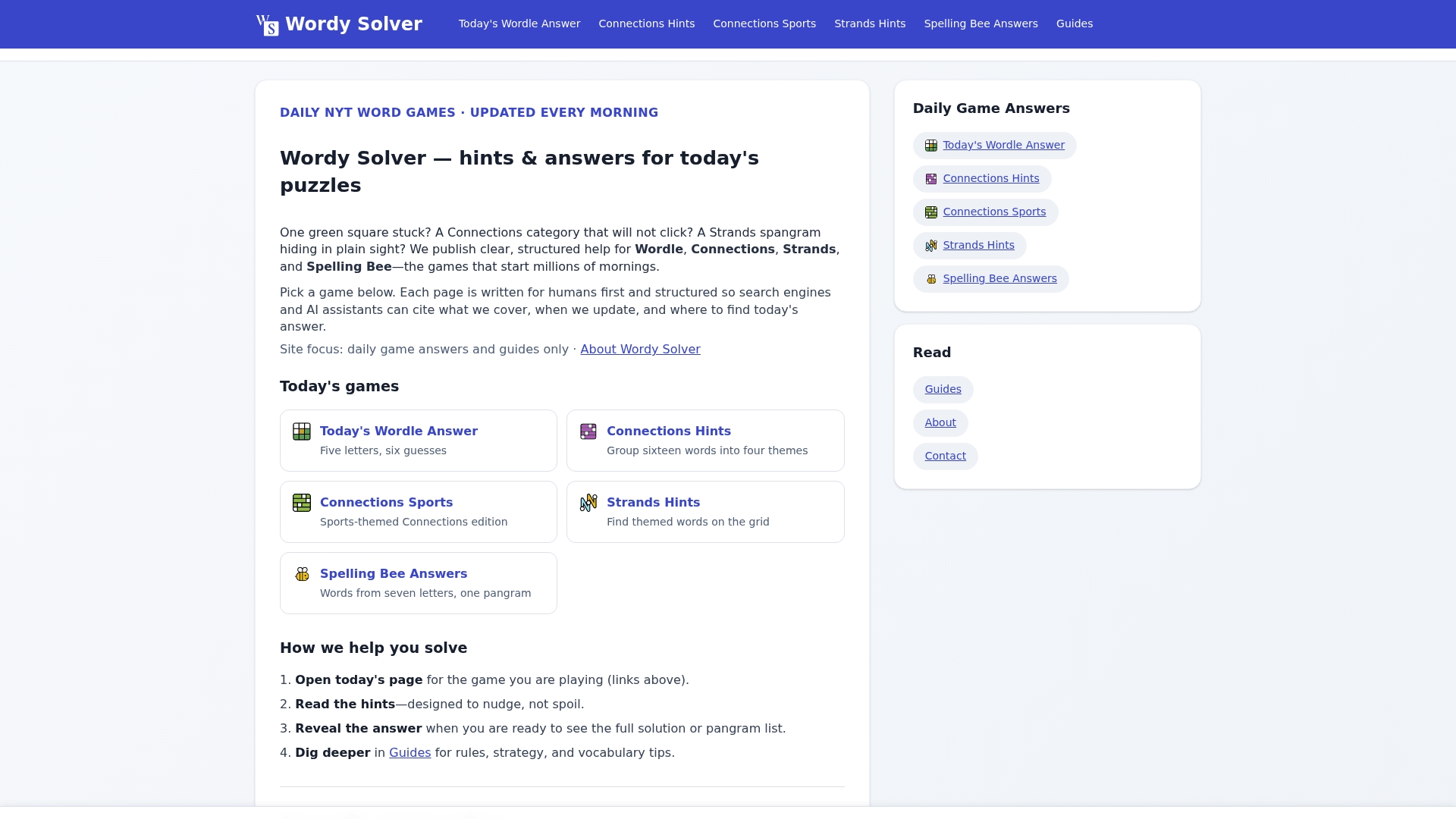
Wordy Solver is built for players who want to get more out of their daily word games. Whether you play Wordle, Connections, Strands, or Spelling Bee, Wordy Solver gives you structured hints that keep you in the game without spoiling the challenge. You choose how much help you want: a gentle nudge or the full answer. That flexibility makes it a genuinely useful tool for building vocabulary at your own pace. Players who use daily word game hints consistently report sharper pattern recognition and a growing confidence with unfamiliar words. Start with today’s puzzle and see the difference a guided approach makes.
FAQ
Do word games actually improve vocabulary?
Yes. Research shows that gamified vocabulary tools produce significantly larger vocabulary gains and retention rates than traditional study methods, with effect sizes of η² = 0.23 for vocabulary success.
How long should you play word games each day?
Studies show that 5–10 minutes daily is enough to improve verbal retrieval speed, working memory, and vocabulary breadth. Consistency matters more than session length.
Are word games good for older adults?
Research tracking over 10,000 older adults found that regular word game play is linked to a 15% lower risk of cognitive decline and dementia symptoms over five years.
Which word game is best for vocabulary building?
Crossword puzzles build the deepest vocabulary recall, while chain games and Spelling Bee train word flexibility and morphological awareness. Mixing formats produces the broadest gains.
Can children benefit from word games too?
Absolutely. Social and cooperative word gameplay forces real-time word retrieval and evaluation, which accelerates vocabulary learning in children more effectively than solo study.