 Wordy Solver


Every Wordle guess you make is a spelling lesson in disguise. Strategic guessing in Wordle is defined as choosing letters that maximize information gain rather than simply guessing likely words. Players who use this approach to wordle guess improve spelling skills see measurable gains in orthographic memory, pattern recognition, and vocabulary retention. Research shows that an information theory approach to Wordle boosts classroom spelling averages by 12% within two weeks. That number is not a coincidence. It reflects how the game’s color-coded feedback trains your brain to recognize letter patterns the same way structured spelling exercises do.
How does strategic Wordle guessing improve spelling skills?
Strategic guessing works because it forces active engagement with letter placement, not passive recognition. When you guess a word like CRANE or STALE as your opener, you are testing five high-frequency letters at once. Your brain processes each color result as feedback about English spelling patterns, which is exactly how orthographic memory gets built.
The difference between random guessing and strategic guessing is the difference between luck and learning. Random guessing might land you the answer, but it teaches you nothing repeatable. Strategic guessing, grounded in information theory, trains you to think about which letters appear most often in five-letter English words and where they tend to sit.
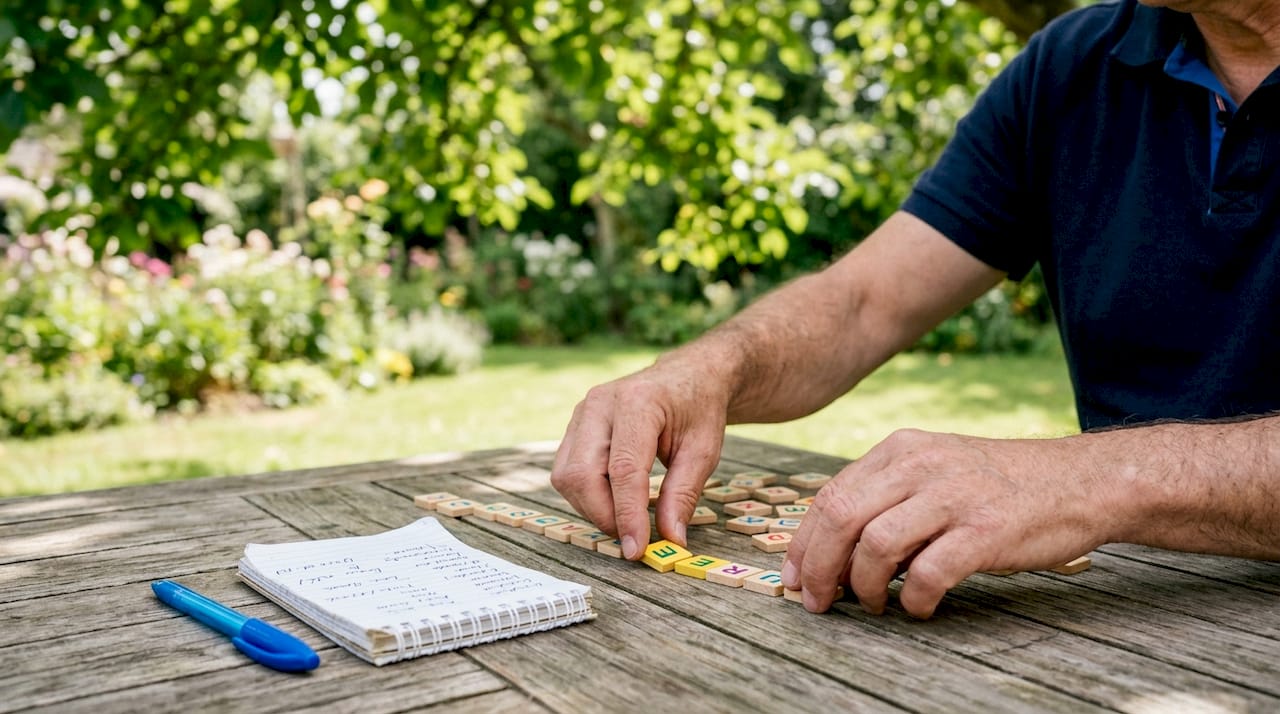
Consistent Wordle play reinforces spelling patterns of uncommon words and strengthens orthographic memory through predictive letter placement. That means you start to internalize rules like “double letters often appear in the third or fourth position” without ever opening a grammar textbook. The game does the heavy lifting when you play with intention.
Pro Tip: Choose opening words that cover the five most common English consonants and at least two vowels. Words like STARE, CRANE, or AUDIO give you maximum letter coverage on your first guess.
The key pitfall most players fall into is guessing words they think are likely answers too early. This feels productive but actually limits how many new letters you test. The smarter move is to scout broadly first, then narrow down once you have solid feedback.
- Scouting guesses test new letters across the full alphabet
- Narrowing guesses refine position based on confirmed letters
- Spelling pattern guesses target specific structures like double letters or common suffixes
- Reflection guesses revisit words you found surprising or unfamiliar
What tools and habits make Wordle a real spelling practice?
Wordle works best as a spelling tool when you pair it with a few deliberate habits. The game alone gives you exposure, but exposure without reflection fades fast. Players retain words better when they look them up after play rather than relying on passive exposure during the game. That single habit separates players who improve from those who just play.
Standard Mode is the right choice for spelling learners. Hard Mode restricts scouting guesses, which are the guesses that test multiple new letters and speed up learning. Standard Mode lets you use each guess strategically, even if it means guessing a word you know is not the answer, purely to gather letter information.
A simple word log makes a big difference. After each game, write down any word you did not immediately recognize or any letter combination that surprised you. Review that log once a week. This habit turns Wordle from a five-minute distraction into a genuine spelling skill exercise.
| Habit | Why it works | How often |
|---|---|---|
| Look up unfamiliar answer words | Builds meaning association and retention | After every game |
| Log surprising letter combinations | Reveals personal orthographic gaps | After every game |
| Review your word log | Reinforces patterns over time | Once per week |
| Play in Standard Mode | Allows scouting guesses for broader learning | Every session |
| Read answers aloud | Activates phonological memory alongside spelling | After every game |
Consistency matters more than intensity. Playing daily for ten minutes beats playing for an hour once a week. The daily repetition of seeing new words, processing feedback, and reflecting on results is what builds lasting spelling improvement.
- Keep a physical or digital word log specifically for Wordle discoveries
- Use a dictionary app or Merriam-Webster online to look up every unfamiliar answer
- Set a two-minute reflection timer after each game to review your guesses
- Pair Wordle with reading to reinforce words you encounter in the game
Step-by-step: how to play Wordle to build spelling skills
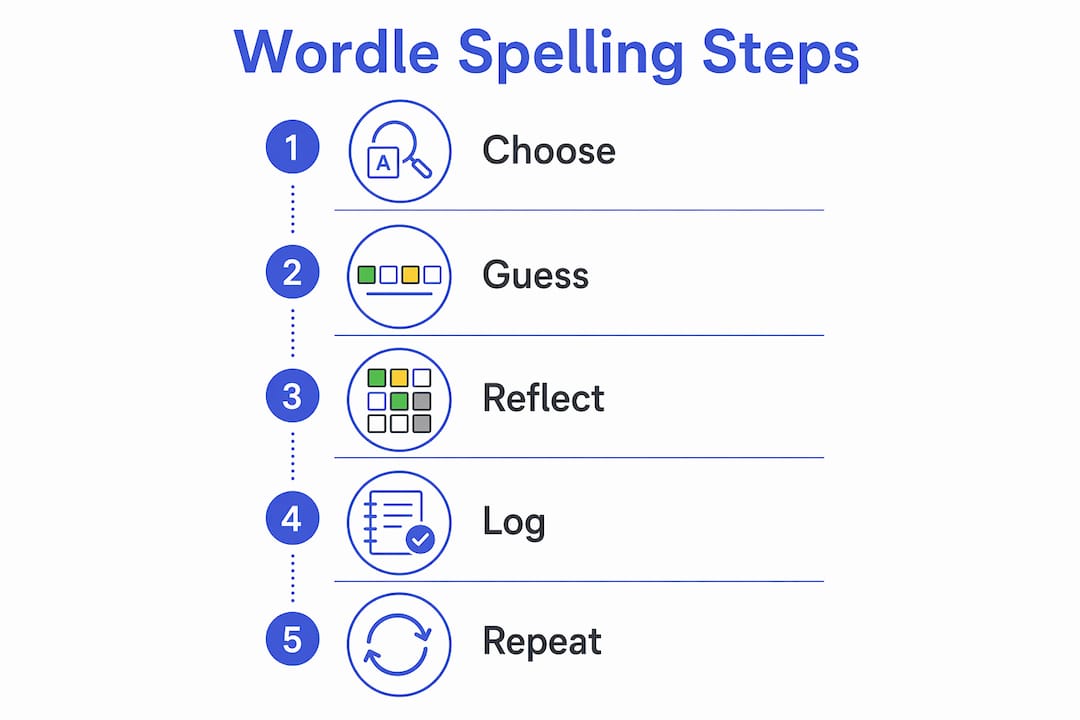
A structured approach to each game turns casual play into focused spelling practice. Follow these steps every session.
-
Choose a high-entropy opening word. Pick a word that covers common letters across varied positions. STARE, CRANE, RAISE, and AUDIO are strong openers because they test frequent vowels and consonants. Avoid words with repeated letters on your first guess since they waste information.
-
Use your second guess to scout new letters. Do not immediately chase the letters you confirmed in guess one. Instead, pick a second word that tests five entirely new letters. This is the scouting phase. Maximizing expected uncertainty reduction leads to fewer total guesses and better pattern recognition over time.
-
Read the color feedback as a spelling lesson. Green means correct letter, correct position. Yellow means correct letter, wrong position. Gray means the letter is not in the word. Each result tells you something about how English words are structured. A yellow S in position one, for example, tells you S appears elsewhere, which is common in words ending in S or containing clusters like ST or SP.
-
On guess three, start applying spelling patterns. Now you have enough information to think about word structure. Ask yourself: does this word likely end in a common suffix like -ING, -ED, or -LY? Does it have a double letter? Does it follow a consonant-vowel-consonant pattern? These questions are the same ones spelling teachers ask students.
-
Narrow by position, not just by letter. Many players confirm a letter is in the word but keep placing it in the wrong spot. Focus on position. If you know the word contains A and it is not in position two or four, mentally place it in positions one, three, or five and test words that fit.
-
After the game, write down the answer and say it aloud. This step takes thirty seconds and dramatically improves retention. Saying the word activates phonological memory, which works alongside orthographic memory to cement spelling.
Pro Tip: If you get stuck after four guesses, do not just guess randomly. Use your fifth guess to test two or three new letters you have not tried yet. You learn more from a strategic loss than from a lucky win.
The information theory approach that researchers identified improves Wordle success rates from 90% to 99%. The same logic that wins puzzles also trains your brain to recognize spelling patterns faster and with more confidence.
What spelling weaknesses does Wordle reveal?
Wordle exposes orthographic gaps you did not know you had. The most common ones involve doubled consonants, uncommon vowel pairings, and tricky suffixes. If you consistently miss words like KNOLL, ABBEY, or FLUFF, you are seeing a pattern in your own spelling knowledge, not just bad luck.
Wordle reveals specific spelling weaknesses like doubled consonants or common endings such as -Y, -ING, and -ED. Tracking these recurring errors helps you target your weakest orthographic areas. This is the same principle behind personalized spelling tutoring, except the game generates the data automatically.
“Reflection after gameplay, especially justifying guesses, transforms Wordle from a passive activity into a high-utility micro-assessment exercising orthographic memory and analytical reasoning.” — Wordle as a Micro-Assessment for Vocabulary
The fix is not to play more randomly. The fix is to track your errors with intention. After each game, note which type of spelling pattern tripped you up.
- Doubled consonants: Words like SPELL, CLIFF, or GROSS catch players off guard. Practice by listing five-letter words with double letters each week.
- Silent letters and uncommon vowel pairs: Words like KNEEL or QUEUE expose gaps in phonics knowledge. Look these up and read them aloud.
- Common suffixes: Missing -LY, -ED, or -ER endings in your guesses means you are not applying suffix awareness. Build this by guessing suffix-heavy words early in your scouting phase.
- Vowel placement confusion: Mixing up where vowels sit in a word is a classic orthographic gap. Focus your reflection on vowel position after each game.
Tracking recurring errors, not just outcomes, is the key to turning Wordle into a personalized spelling tutor. One loss tells you nothing. Ten losses with the same pattern tell you exactly where to focus.
Key takeaways
Strategic Wordle play is one of the most time-efficient spelling skill exercises available because it combines active pattern recognition, immediate feedback, and daily repetition in a format that feels like a game, not a lesson.
| Point | Details |
|---|---|
| Strategic guessing beats random guessing | Choosing high-entropy words trains spelling pattern recognition faster than guessing likely answers. |
| Standard Mode supports learning | Standard Mode allows scouting guesses that test new letters, which Hard Mode blocks. |
| Reflection deepens retention | Looking up answers and logging new words after each game builds lasting orthographic memory. |
| Wordle reveals personal spelling gaps | Recurring errors with doubled consonants or suffixes point to specific areas for targeted practice. |
| Daily consistency drives improvement | Ten minutes of intentional daily play outperforms occasional long sessions for spelling skill gains. |
Why I think most players leave real learning on the table
I have watched a lot of word game players treat Wordle like a speed test. Get the answer, share the result, move on. That approach is fine for entertainment, but it wastes the actual educational value sitting right there in the feedback grid.
The moment that changed how I think about this was reading about active classroom Wordle use boosting student engagement by 48% and cutting morning tardiness by 74%. Those numbers are not about the game being fun. They are about the game creating a daily ritual of active thinking. That ritual is what builds skills.
The players who improve their spelling are not the ones who win the most. They are the ones who spend two minutes after each game asking why they guessed what they guessed. That reflection habit, paired with looking up unfamiliar words, is the entire secret. You do not need a tutor or a workbook. You need a daily puzzle and the discipline to pause before closing the tab.
My honest suggestion: treat every gray tile as a gift. It tells you a letter is not in the word, which is information you can use to build a mental map of English spelling. Most players see gray as failure. The best players see it as data.
Wordle works best when you bring early literacy strategies into adult play, specifically the habit of connecting new words to meaning and sound, not just spelling. That connection is what makes a word stick.
— Mat C.
Wordy Solver makes daily spelling practice effortless
Wordle is most powerful when you show up for it every day. Wordy Solver gives you exactly that, a daily hub for Wordle, Connections, Strands, and Spelling Bee that keeps your practice consistent and your skills growing.
When you hit a wall mid-puzzle, Wordy Solver offers structured hints that guide your thinking without giving away the answer. You stay in control of how much help you get. That balance between challenge and support is what keeps the learning real. Players who want to sharpen their word skills daily will find everything they need in one place, from gentle nudges to full solutions when the day calls for it. Show up, play smart, and watch your spelling improve one guess at a time.
FAQ
Does playing Wordle actually improve spelling?
Yes. Consistent Wordle play strengthens orthographic memory through pattern recognition and predictive letter placement. Classroom research shows spelling test averages improve by 12% with strategic play over two weeks.
What is the best first word to guess in Wordle for learning?
Words like STARE, CRANE, or RAISE are strong openers because they test high-frequency vowels and consonants across varied positions. The goal is maximum letter coverage, not guessing the likely answer.
Should I play Wordle in Hard Mode to improve spelling faster?
No. Hard Mode restricts scouting guesses, which are the most valuable guesses for spelling development. Standard Mode gives you the freedom to test new letters strategically.
How does reflection after Wordle improve spelling?
Justifying your guesses after each game activates analytical reasoning and cements orthographic learning. Looking up the answer word and saying it aloud adds phonological reinforcement that passive play cannot provide.
How often should I play Wordle to see spelling improvement?
Daily play is the most effective approach. Short, consistent sessions build the pattern recognition and vocabulary retention that occasional longer sessions cannot replicate.