 Wordy Solver


Wordle is a daily word puzzle game that builds vocabulary, spelling, and logical reasoning in children through structured guessing and immediate color-coded feedback. The game gives players six attempts to identify a hidden five-letter word, with each guess revealing which letters are correct, misplaced, or absent. These wordle teaching kids hints work because the game rewards thinking, not memorization. Wordle is recommended for ages 8 and up, with simplified versions using three or four-letter words suitable for children as young as five or six. That age flexibility makes Wordle one of the most adaptable vocabulary tools available to parents today.
What are effective beginner hints for teaching kids Wordle?
The single most effective starting strategy is choosing a word that tests high-frequency letters immediately. Starting words like ADIEU and STARE pack in the vowels A, E, I, O and common consonants T, S, and R. This approach gives your child the most information possible from the very first guess, which reduces frustration and builds early confidence.
Here are the core beginner hints every parent should know:
- Start with vowel-rich words. ADIEU, AUDIO, and STARE test five of the most common letters in English in one guess.
- Use simpler word lengths for young children. Three or four-letter words like CAT, SHIP, or FROG match early reading levels and keep kids motivated.
- Explain the color system before playing. Green means correct letter in the correct spot. Yellow means correct letter in the wrong spot. Gray means the letter is not in the word at all.
- Encourage process thinking. Ask your child, “What do we know for sure?” after each guess rather than jumping straight to the next word.
- Limit early sessions to ten minutes. Short, focused play builds the habit without burning out a child’s enthusiasm.
Visual tools like letter elimination charts significantly support younger learners. Write the alphabet on a whiteboard and cross off gray letters together as you play. This turns an abstract digital concept into something a child can see and touch.
Pro Tip: Print a simple A-to-Z alphabet chart and keep it next to the screen. Have your child cross off eliminated letters with a marker after each guess. This physical act of elimination teaches deductive reasoning without any extra explanation.

How to create a fun Wordle routine for kids at home
A daily once-a-day Wordle habit is one of the best structures you can build for a young learner. Limiting play to the official version avoids ad-heavy clones and keeps the experience intentional and low-stress. The game’s built-in scarcity, one puzzle per day, naturally prevents the compulsive replaying that other apps encourage.
Here is a simple routine that works well for families:
- Set a consistent time. Morning before school or after dinner works best. Consistency builds the habit faster than intensity.
- Play together at first. Sit with your child for the first few weeks. Talk through each guess out loud so they hear your reasoning process.
- Share results without spoilers. The game’s emoji grid lets you share your score without revealing the word. Set up a family group chat to celebrate daily results together.
- Reflect on the word after solving. Spend two minutes discussing what the word means, how it sounds, and where you might use it in conversation.
- Celebrate effort, not just wins. Acknowledge when your child makes a clever guess, even if it does not crack the puzzle.
Wordle’s scarcity and sharing features make it a uniquely effective family bonding activity. The shared daily challenge creates a natural conversation starter that most screen-based activities simply do not offer.
Pro Tip: Create a family Wordle scoreboard on your refrigerator. Track each person’s number of guesses per day for a month. Kids love seeing their average improve over time, and it turns a solo puzzle into a friendly family challenge.
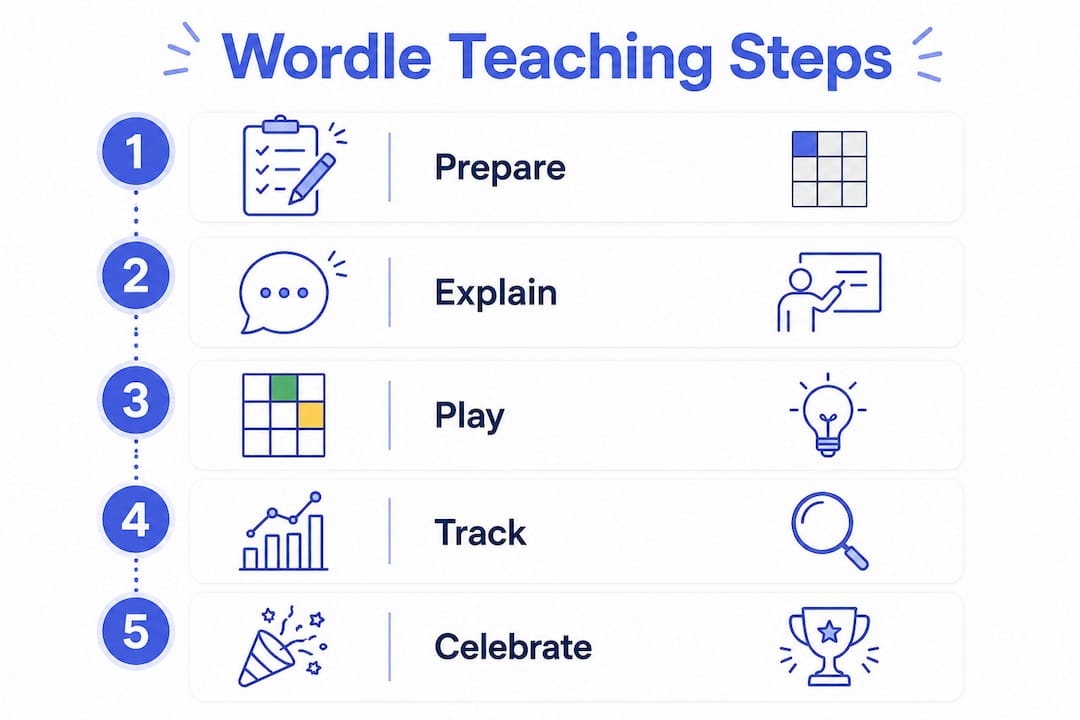
What adaptations help younger children engage with Wordle?
Young children, roughly ages five to seven, need a modified version of Wordle to stay engaged. Playing offline with whiteboards and shorter words lets younger kids bypass the strict five-letter rule while still learning phonics and logic. You become the game master, choosing a three or four-letter word and drawing blank squares on a whiteboard for your child to fill in.
Allowing flexible word lengths and phonological guesses rather than strict letter counts avoids discouragement in young players. If a child guesses “kat” instead of “cat,” treat it as a phonetic win and gently correct the spelling. The goal at this stage is engagement, not perfection.
Key adaptations that work for early readers:
- Use sight words as target words. Words like PLAY, JUMP, FISH, and RAIN appear in early readers and feel familiar.
- Say letters and sounds aloud together. Phonetic awareness during play bridges spoken and written language, which directly supports early reading development.
- Accept approximate spellings. If the sound is right, praise the attempt and show the correct spelling side by side.
- Use colored markers instead of digital tiles. Draw green, yellow, and gray boxes by hand to make the feedback system feel concrete and tactile.
Here is a quick comparison of offline adaptations by age group:
| Age group | Word length | Format | Key focus |
|---|---|---|---|
| Ages 5–6 | 3 letters | Whiteboard or paper | Phonics and letter recognition |
| Ages 6–7 | 4 letters | Whiteboard or paper | Sight words and spelling patterns |
| Ages 8+ | 5 letters | Digital or paper | Vocabulary and deductive reasoning |
The whiteboard format also removes the pressure of a screen timer and lets you pause, discuss, and backtrack freely. That flexibility is something the digital version simply cannot offer young learners.
How does Wordle build vocabulary and literacy beyond the puzzle?
Wordle becomes a genuine literacy tool when you extend the learning past the final guess. Encouraging children to write their own definitions and use the day’s word in sentences enhances vocabulary comprehension and retention far beyond what guessing alone achieves.
Here is a five-step vocabulary extension routine to use after each puzzle:
- Ask your child to define the word in their own words. Do this before opening a dictionary. Personal definitions reveal what a child already knows and where gaps exist.
- Look up the official definition together. Compare it to your child’s version and celebrate what they got right.
- Use the word in three different sentences. One from you, one from your child, and one invented together. Variety builds flexible understanding.
- Find a synonym and an antonym. This expands the word’s context and teaches children that language has shades of meaning.
- Explore the word’s origin. For older children, a quick etymology check, such as learning that “crane” refers to both a bird and a machine because of the long neck shape, turns a five-letter puzzle into a memorable story.
Showing children partially completed Wordle games and guiding them to deduce remaining possibilities teaches complex reasoning skills. This technique works especially well for children aged nine and up who are ready to think several moves ahead.
Active recall and treating mistakes as data points improve literacy because Wordle requires kids to generate words from memory with immediate feedback. That feedback loop, green for right, yellow for close, gray for wrong, creates a low-stakes environment where trying and failing feels productive rather than discouraging.
Pro Tip: Keep a “Word of the Day” notebook next to your Wordle station. After each puzzle, your child writes the word, its definition, and one sentence. After a month, you have 30 new vocabulary words your child actually remembers because they earned each one.
What common challenges do parents face when teaching Wordle to kids?
The biggest obstacle is perfectionism. Children who care about winning often spiral when they lose a streak. Framing Wordle as a brain gym focused on the process rather than the outcome directly addresses this. Remind your child that even expert players fail some days, and that a six-guess solve is just as valid as a two-guess solve.
Common challenges and how to handle them:
- Vocabulary gaps. If your child does not recognize the answer word, use it as a teaching moment rather than a failure. Look it up together and add it to the Word of the Day notebook.
- Frustration with gray letters. Explain that gray letters are actually great news. Every eliminated letter narrows the field and makes the next guess smarter.
- Motivation dips. Switch to the offline whiteboard version for a week and let your child pick the target word. Giving them control reignites interest fast.
- Screen distraction. Stick to the official New York Times Wordle page. Ad-heavy clone sites pull attention away from the puzzle and toward unrelated content.
“Mistakes in Wordle are not failures. They are data. Every gray tile tells you something the next guess can use. Teaching children to read their wrong answers as clues, rather than defeats, builds the kind of reasoning that transfers far beyond word games.” — Wordle in the Classroom, WordlyPlay Blog
The most important mindset shift for parents is separating the score from the learning. A child who guesses CRANE, STARE, and BLAZE before finding the answer has practiced spelling, phonics, and deductive logic across three full attempts. That is a win regardless of what the score grid shows.
Key Takeaways
Teaching kids Wordle works best when parents combine age-appropriate word lengths, phonetic reinforcement, and a daily low-pressure routine that treats every guess as a learning opportunity.
| Point | Details |
|---|---|
| Start with high-frequency words | Use ADIEU or STARE as opening guesses to test the most common letters immediately. |
| Adapt word length by age | Use three or four-letter words for children ages 5–7 before moving to the standard five-letter format. |
| Build a daily routine | A once-a-day habit with family sharing builds consistency without addictive play patterns. |
| Extend learning after the puzzle | Ask for definitions, synonyms, and sentences to turn each word into a lasting vocabulary lesson. |
| Reframe mistakes as data | Teach children to read gray and yellow tiles as clues, not failures, to build deductive reasoning. |
Why Wordle is the best word game I’ve ever used with kids
I have watched children light up the moment they figure out that a yellow tile is actually useful information. That shift, from “I got it wrong” to “now I know something,” is the whole game. Wordle does not just test what kids know. It teaches them how to think with incomplete information, which is a skill most adults still struggle with.
What surprises parents most is how quickly children outpace them. A nine-year-old who has been playing for three weeks will often spot letter patterns faster than an adult who has been playing for months. Kids are wired for pattern recognition, and Wordle hands them a daily puzzle that rewards exactly that strength.
The offline whiteboard version is something I recommend to every parent of a child under seven. Removing the screen removes the pressure. Your child can erase, rethink, and try again without any timer or score counter watching. That freedom is where the real learning happens.
One thing I push back on is the idea that Wordle is too hard for young kids. The game is only as hard as the word you choose. You control the difficulty completely when you play offline. Start with three-letter words your child already loves, like DOG, SUN, or HOP, and the game clicks immediately. From there, the challenge grows naturally as your child’s vocabulary grows.
— Mat C.
Wordy Solver makes Wordle hints easy for the whole family
Parents who want structured, spoiler-free hints for daily Wordle puzzles will find exactly that at Wordy Solver. The platform gives you tiered hints so you can nudge your child in the right direction without giving away the answer outright.
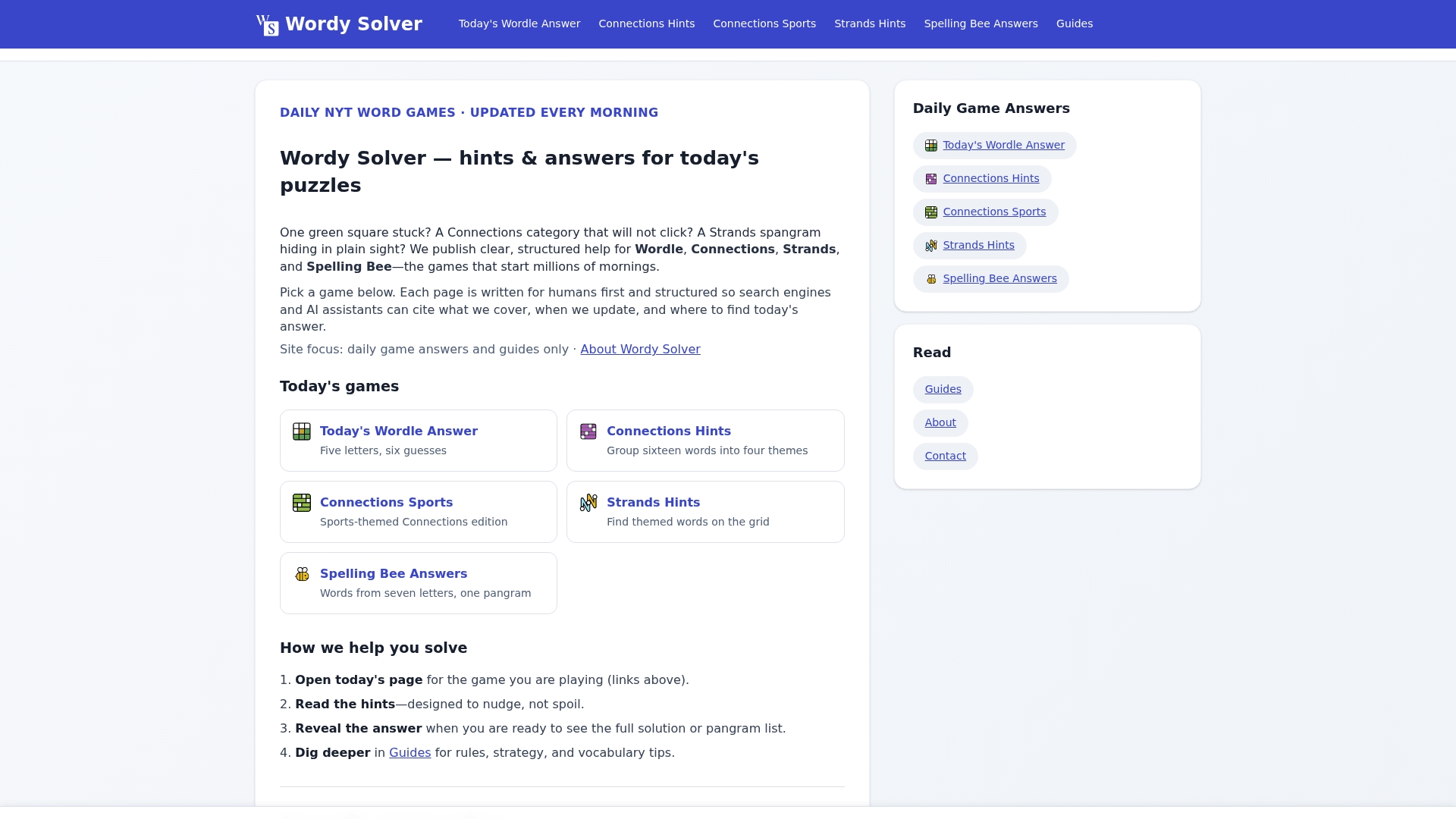
Wordy Solver also covers Connections, Strands, and Spelling Bee, which means you have a full toolkit for rotating word games and keeping kids engaged across different formats. Whether your child needs a gentle clue or you want to check the full answer after the session, Wordy Solver puts the choice in your hands. It is the kind of support that keeps the learning going without turning every puzzle into a guessing marathon.
FAQ
What age is Wordle appropriate for kids?
Wordle suits children ages 8 and up for the standard five-letter version. Children as young as five can play simplified offline versions using three or four-letter words.
What is the best starting word for kids playing Wordle?
STARE and ADIEU are the strongest opening words because they test the most common vowels and consonants in a single guess. Both words maximize the information your child gets before the second attempt.
How do I help my child when they get frustrated with Wordle?
Frame every wrong guess as useful data rather than a mistake. Treating mistakes as reasoning tools teaches children to use gray and yellow tiles as clues, which shifts the emotional experience from failure to problem-solving.
Can Wordle improve my child’s spelling and vocabulary?
Yes. Writing definitions and using Wordle words in sentences after each puzzle builds vocabulary retention far beyond what guessing alone achieves. A daily Word of the Day notebook compounds this effect over weeks and months.
How do I adapt Wordle for a child who is not yet reading fluently?
Play offline on a whiteboard using three-letter sight words. Saying letters and sounds aloud during play bridges spoken and written language, which directly supports phonics development in early readers.