 Wordy Solver


Uncommon words in Wordle are five-letter answers that appear in the curated answer pool but fall outside everyday conversation, giving players who know them a real edge. This wordle uncommon words guide covers the exact distinction between Wordle’s answer list and its larger valid guess list, explains how letter frequency shapes which rare words matter, and connects those insights to a research-backed strategy that wins 99% of the time. You will also find concrete examples of uncommon Wordle answer words, common mistakes to avoid, and a practical framework for weaving rare words into every solve. If you want to move past lucky guesses and build a real wordle vocabulary list, this is where to start.
What is the wordle uncommon words guide approach?
Wordle’s word lists are not one single database. The game draws answers from a curated pool of about 2,309 words, while accepting over 10,000 valid guesses. That gap is the most important fact in any wordle strategy discussion. The answer pool is smaller because the New York Times editorial team removed obscure, offensive, and overly technical words before publishing the game.
That editorial filter is good news for players. It means the answer will almost never be a word you have genuinely never seen. The bad news is that the pool still contains hundreds of words most players skip right past, words like CYNIC, GLYPH, KNAVE, VOUCH, and ZONAL. These are real, recognizable English words, but they sit outside the mental shortlist most players run through during a solve.
| Category | Size | Notes |
|---|---|---|
| Curated answer pool | ~2,309 words | Common enough to be fair, selective enough to surprise |
| Valid guess list | 10,000+ words | Includes proper nouns, obscure terms, and technical vocabulary |
| Retired answers | 1,700+ as of mid-2025 | Never repeated; shrinks the active pool |
| Active remaining answers | ~600 as of mid-2025 | Pool gets smaller every day |
The shrinking pool matters. As of mid-2025, over 1,700 answers have been retired, leaving roughly 600 words still in play. That means the proportion of uncommon words in the remaining pool is rising. Players who only practice common words are working from an increasingly outdated map.
How do you identify uncommon but effective Wordle answer words?
Letter frequency is the fastest filter for spotting which rare words are worth your attention. Rare letters like Q, Z, and X appear in fewer than 2% of Wordle answers, while E, A, R, O, and S dominate the list. That statistic tells you two things at once. First, words built around Q, Z, or X are genuinely rare but not impossible. Second, uncommon words that still use high-frequency letters are far more likely to appear as answers.
Words worth adding to your wordle vocabulary list include:
- CYNIC (skeptic; uses C, Y, N, I, C with no rare letters)
- GLYPH (a carved symbol; G, L, Y, P, H covers uncommon but valid letters)
- KNAVE (a rogue or jack in cards; K, N, A, V, E blends common and uncommon)
- VOUCH (to confirm; V, O, U, C, H tests the V position early)
- ZONAL (relating to zones; Z, O, N, A, L is rare but fully in the answer pool)
- CAULK (to seal gaps; C, A, U, L, K is a common word players forget)
- TRYST (a secret meeting; T, R, Y, S, T repeats T, which trips up many players)
The trap most players fall into is confusing “uncommon” with “obscure.” GLYPH is uncommon in daily speech but widely recognized. XYLYL, by contrast, is a chemical term the NYT would never use as an answer. The editorial filter already removed the truly obscure words, so your job is to learn the words that feel unfamiliar but are still fair game.
Vowel placement also matters more than most players realize. Uncommon words often cluster vowels in unusual positions, like OUIJA (O-U in positions 1 and 2) or QUEUE (four vowels in five letters). Recognizing those patterns helps you guess them confidently when the letter grid points that direction.
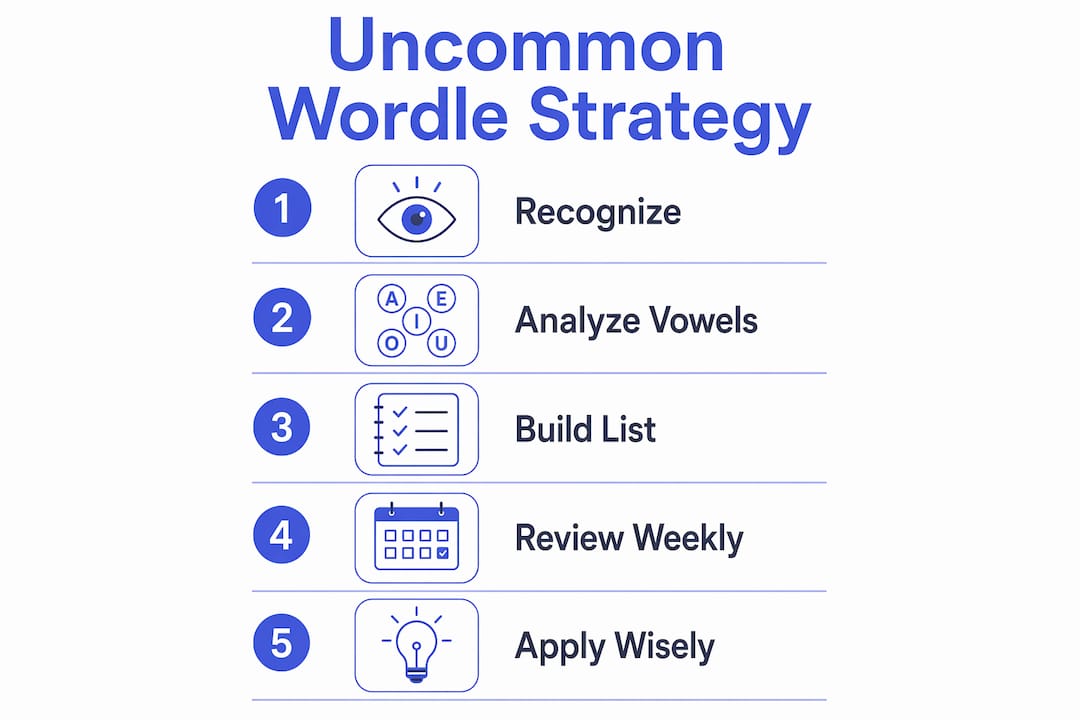
Pro Tip: Build a personal list of 20 to 30 uncommon words you keep forgetting. Review it once a week. Familiarity with rare words for Wordle is the fastest way to stop being surprised by them.
How does information theory make uncommon words more powerful?
The biggest shift in Wordle strategy thinking came from a 2026 Binghamton University study that applied Shannon entropy to guess selection. Shannon entropy is a measure of information gain. A guess with high entropy eliminates the most possible words from the remaining pool, regardless of whether that guess is likely to be the answer.
The 2026 Binghamton University study found that information-theory-based guessing raises the Wordle win rate to 99%, compared to 90% for strategies that prioritize guessing likely answers first. The difference is not luck. It is math.
That finding reframes how uncommon words fit into your game. A rare word that covers five untested letters can be a perfect “scout” guess in round two or three, even if it has almost no chance of being the answer. Researchers recommend prioritizing information gain over answer likelihood, which is exactly what a well-chosen uncommon word delivers.
A practical sequence looks like this:
- Round 1: Start with a high-frequency opener like SLATE, CRANE, or STARE. These starters cover the most common letters and generate maximum early data.
- Round 2: If round 1 reveals only one or two letters, use an uncommon word that tests a different set of high-value positions. VOUCH, for example, tests V, O, U, C, and H in one shot.
- Round 3: With two rounds of data, you now have enough information to narrow toward the answer. Uncommon words have done their job as scouts.
- Round 4 onward: Shift to likely answers. The entropy-based approach has already eliminated most of the field.
The key insight is that uncommon words serve a different function than answer guesses. They are information tools. Using GLYPH in round two is not a wild swing. It is a calculated move to test G, L, Y, P, and H simultaneously, five letters that a SLATE opener never touches.
Avoid wasting rare letters too early. Guessing a Z-word in round one burns a guess on a letter that appears in fewer than 2% of answers. Save uncommon letters for rounds two and three, when you have context to make them count.
What mistakes do players make with uncommon Wordle words?
The most common error is guessing words that feel right rather than words that generate information. The biggest trap for Wordle players is chasing intuition instead of elimination. Uncommon words make this worse when players guess them randomly, hoping to get lucky, rather than placing them deliberately in a sequence.
Watch out for these specific mistakes:
- Guessing truly obscure words. The NYT answer pool excludes overly scientific and confusing words. Obscure words waste guesses because they will never appear as answers, and they test letters that rarely show up anyway.
- Repeating retired answers. Wordle never reuses an answer. Tracking retired words eliminates a growing portion of the guess space and saves you from guessing ABBEY or AFOOT again.
- Memorizing rare words without a system. Knowing 50 uncommon words does nothing if you cannot place them at the right moment in a solve. Vocabulary without strategy is just trivia.
- Using uncommon words in round one. Opening with ZONAL or GLYPH tests low-frequency letters before you have any context. That is the opposite of the entropy approach.
- Ignoring letter position data. Uncommon words often have unusual consonant clusters. TRYST, for example, ends in ST, which is a common ending. Recognizing that pattern helps you place the word correctly in your sequence.
Mindset matters as much as vocabulary. The goal is not to show off rare words. The goal is to solve the puzzle in as few guesses as possible. Uncommon words are tools, not trophies.
Pro Tip: Keep a running log of past Wordle answers. Cross-reference it before each game. Knowing which words are already retired sharpens your guess selection and stops you from wasting a turn on an impossible answer.
Key takeaways
Mastering uncommon Wordle words requires pairing a strong vocabulary list with an information-first strategy, not just memorizing rare words and hoping they appear.
| Point | Details |
|---|---|
| Answer pool is selective | Wordle draws from ~2,309 curated words, not the full 10,000+ valid guess list. |
| Rare letters are genuinely rare | Q, Z, and X appear in fewer than 2% of answers; focus on uncommon words with common letters. |
| Uncommon words work as scouts | Use rare words in rounds 2–3 to maximize information gain, not as opening guesses. |
| Entropy strategy wins more | Information-theory guessing reaches a 99% win rate versus 90% for intuition-based play. |
| Track retired answers | Over 1,700 answers are permanently retired; knowing them eliminates impossible guesses. |
Why I think most players are using uncommon words backwards
I have spent a lot of time watching players treat rare words as a flex rather than a function. Someone learns that KNAVE or VOUCH is a valid Wordle answer, and the next day they open with it. That is backwards. You are spending your most valuable guess, round one, on a word that tests low-frequency letters before you have any context at all.
The shift that actually changed my results was treating uncommon words as round-two and round-three tools. After a SLATE opener, I might have two confirmed letters and three grays. That is when an uncommon word like VOUCH earns its place. It tests five fresh letters, including V and H, which SLATE never touches. The answer might not be VOUCH, but the result tells me something about every letter in it.
The other thing players miss is that the active answer pool is shrinking fast. With roughly 600 words left as of mid-2025, the proportion of less familiar words in that pool is higher than it was in 2022. The game is quietly getting harder for players who only practice common vocabulary. Players who track history and adapt their wordle word suggestions accordingly are the ones who keep winning.
The wordle strategy tips that actually hold up over time are not about memorizing a magic starter word. They are about building a flexible system where uncommon words play a specific, deliberate role. Vocabulary plus timing plus information theory. That combination is what separates consistent solvers from lucky ones.
— Mat C.
Wordy Solver has the rare word edge you need
Knowing uncommon words is one thing. Knowing which ones to guess today, given the current active pool, is another challenge entirely.
Wordy Solver gives you daily Wordle hints that include rare and uncommon word suggestions, structured so you can choose how much help you want. Need just a nudge? Get a letter hint. Want the full answer with context? That is available too. Wordy Solver also covers Connections, Strands, and Spelling Bee, so your word game skills keep growing across every daily puzzle. Visit Wordy Solver and put today’s uncommon word to work before the clock runs out.
FAQ
What makes a word “uncommon” in Wordle?
An uncommon Wordle word is one that appears in the curated answer pool but falls outside everyday vocabulary. The NYT answer list contains about 2,309 words, and some of them, like GLYPH or KNAVE, are valid but infrequently used in daily speech.
Should I open with an uncommon word in round one?
No. Opening with a high-frequency starter like SLATE or CRANE covers the most common letters and generates the most useful data. Save uncommon words for rounds two and three, where they work best as information-gathering scout guesses.
How does information theory apply to rare Wordle words?
The 2026 Binghamton University study found that guessing words with high Shannon entropy, meaning words that eliminate the most possibilities, raises the win rate to 99%. Uncommon words with five untested letters fit this role perfectly in the middle rounds of a solve.
Will Wordle ever reuse an answer word?
No. The New York Times permanently retires every used answer. Over 1,700 words have been retired as of mid-2025, which means guessing a past answer wastes a turn. Tracking retired answers is one of the most underrated wordle strategy tips available.
How many uncommon words should I add to my practice list?
A focused list of 20 to 30 uncommon but recognizable words is enough to make a real difference. Prioritize words that use common letters in unusual combinations, like VOUCH, CAULK, or TRYST, since those are the most likely to appear in the shrinking active pool.