 Wordy Solver


The Wordle vocabulary learning approach is a targeted method that combines daily word puzzle gameplay with deliberate reflection to accelerate vocabulary acquisition and spelling awareness. Traditional list-based memorization has roughly a 20% retention rate after one week. Game-based recall techniques, like those built into Wordle, push that number significantly higher by forcing active retrieval every single round. If you play Wordle daily but never stop to analyze the words you encounter, you are leaving most of the learning value on the table.
How does the Wordle vocabulary learning approach work?
Wordle is a five-letter word puzzle game published by The New York Times. Each guess produces color-coded feedback: green means the letter is correct and in the right position, yellow means the letter exists but is misplaced, and gray means the letter is not in the word. That feedback loop is the engine of the entire learning process.
The game builds spelling and pattern recognition by pushing you to test hypotheses about letter placement rather than guess randomly. You are not just recalling a word. You are reasoning about English phonics, common vowel clusters, and consonant patterns in real time. That cognitive process is far more demanding than scanning a vocabulary list.
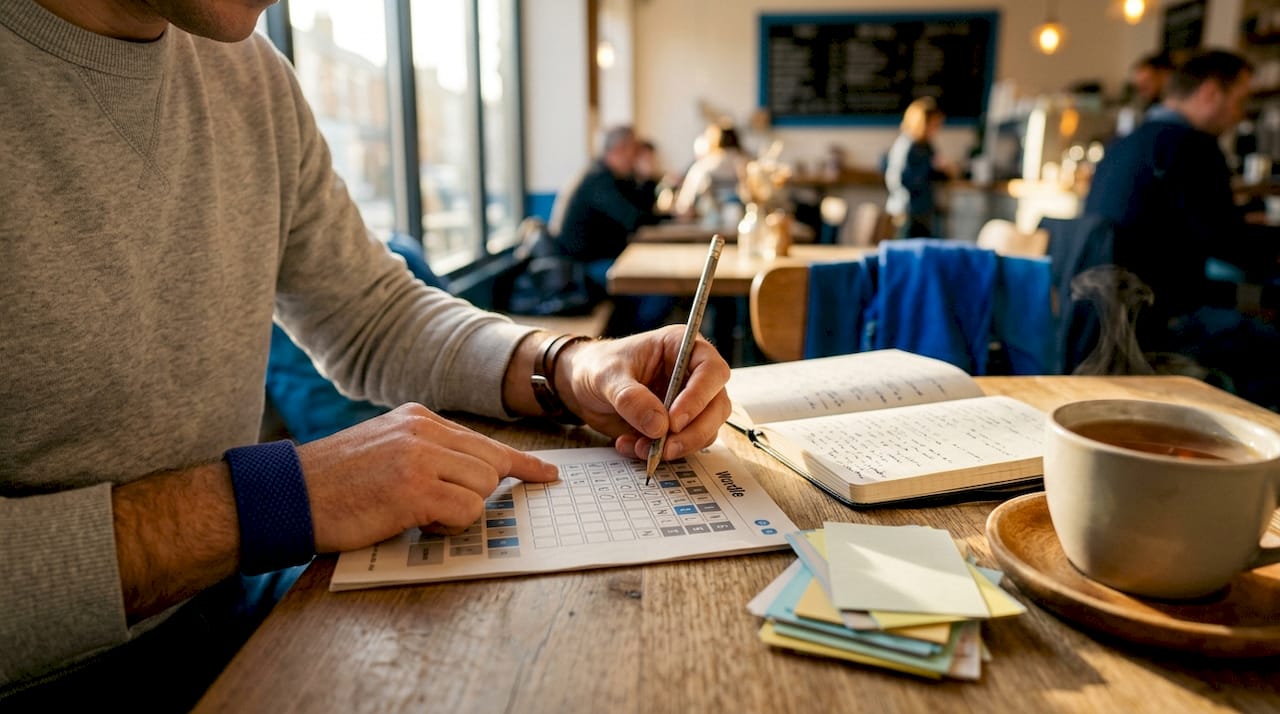
Wordle also trains tolerance for uncertainty. You will not always know the answer after two guesses. Working through that ambiguity, and adjusting your thinking with each new clue, mirrors the mental flexibility that strong readers use when encountering unfamiliar words in context.
Here is what the feedback system specifically trains:
- Spelling awareness: You notice which letter combinations appear frequently in five-letter English words, such as TION, IGHT, and OUGH patterns.
- Vowel placement: English words follow predictable vowel structures. Wordle makes those structures visible through repeated play.
- Morphological clues: Words like GROAN, GRAIN, and GRAIL share a GR root. Noticing that connection deepens word knowledge beyond the single puzzle.
- Word retrieval speed: Repeated exposure to common five-letter words builds faster mental access to vocabulary during reading and writing.
Pro Tip: After each game, write down the answer word and spend 60 seconds identifying its root, any prefix or suffix, and one related word. That single habit compounds into serious vocabulary gains over weeks.
What are the best strategies to maximize vocabulary learning with Wordle?
Winning Wordle is satisfying. Learning from it requires a few extra steps that most players skip entirely.
1. Reflect actively after every round. Do not close the browser the moment you solve the puzzle. Look at the answer word and ask: Do I know this word’s full meaning? Can I use it in a sentence? Words like STOIC, TROVE, or INANE appear regularly in Wordle. Each one is worth a 30-second vocabulary audit.
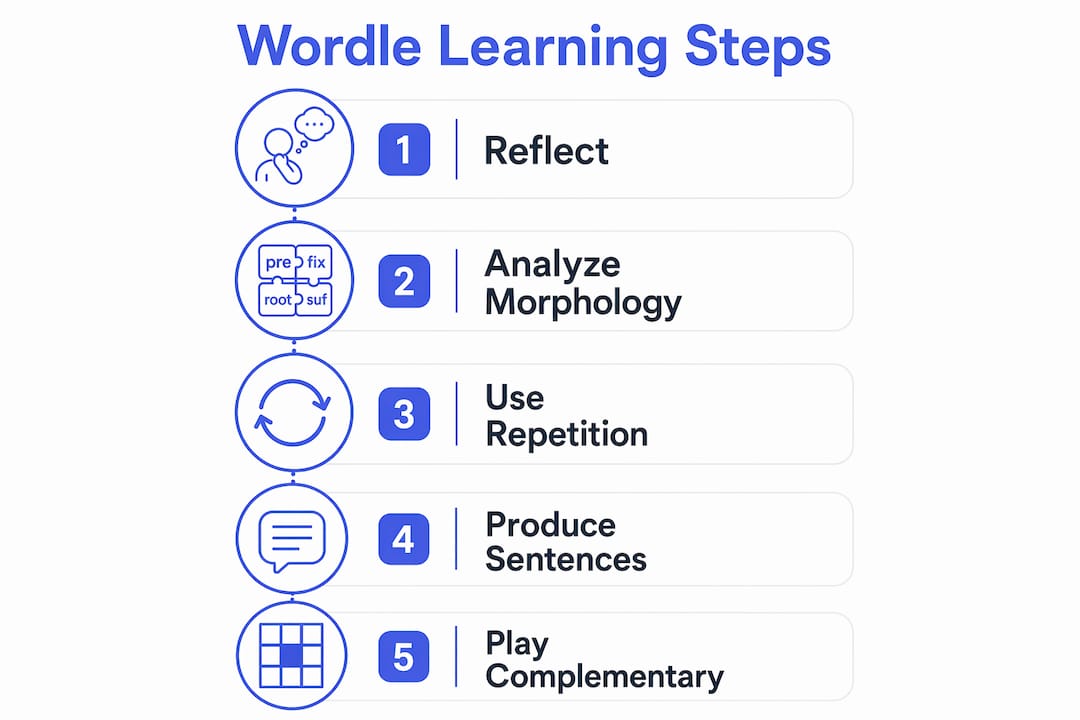
2. Analyze morphology. Morphological awareness training helps you decode unfamiliar words by recognizing common affixes and root patterns. The word REBUS contains the Latin prefix RE. The word NATAL connects to birth-related vocabulary across multiple languages. Spotting these patterns boosts reading comprehension well beyond the puzzle itself.
3. Use spaced repetition to lock in new words. Keep a running list of every Wordle answer you did not immediately recognize. Review that list every three days using a flashcard app like Anki or Quizlet. Spaced repetition is the most research-supported method for long-term vocabulary retention.
4. Pair recognition with production. Recognition, knowing a word when you see it, is only half the job. Write a sentence using the answer word. Define it in your own words. Production tasks force deeper encoding and make the word stick far longer.
5. Play complementary word games. Pairing Wordle with NYT Connections and Strands broadens vocabulary practice by training different skills. Connections trains semantic categorization. Strands trains inference and thematic grouping. Together, these games cover spelling, meaning, and context, which are the three pillars of genuine vocabulary knowledge.
Pro Tip: Start each Wordle game with a consistent opening word that covers common vowels and high-frequency consonants. CRANE, AUDIO, and STARE are popular choices. A strong opener gives you maximum information on the first guess and sets up better pattern analysis.
How can educators and self-learners use Wordle in vocabulary practice?
Wordle fits naturally into structured learning routines because it takes under five minutes and requires zero materials. That low barrier makes it one of the most practical vocabulary building games available.
Five-minute Wordle warm-ups improve spelling pattern recognition and build vocabulary habits without eating into lesson time. Teachers can project the puzzle on a screen, let students guess collaboratively, and then spend two minutes discussing the answer word’s meaning and morphology. That structure turns a casual game into a focused micro-drill.
A suburban high school piloted a Wordle variant using academic vocabulary and saw vocabulary quiz scores rise 14% after six weeks of Wordle-based instruction paired with explicit teaching. The key was combining gameplay with direct instruction, not replacing one with the other.
Self-learners can structure sessions using this simple framework:
- Set a vocabulary target before you play. Decide you want to notice any word containing a Latin root or a specific suffix. That intention focuses your attention during and after the game.
- Use Wordle as a diagnostic tool. If you consistently struggle with words containing uncommon vowel patterns, that signals a gap worth addressing through targeted reading.
- Scaffold difficulty. Beginners benefit from playing with a dictionary open. Intermediate learners should guess first, then check. Advanced learners can add a production task after every game.
- Balance frequency. Daily play is ideal. Playing multiple rounds back to back reduces the novelty effect that drives attention and retention.
| Learner level | Recommended approach | Supplementary activity |
|---|---|---|
| Beginner | Play with dictionary access | Write the definition of the answer word |
| Intermediate | Guess first, then verify | Identify one root or affix in the answer |
| Advanced | Full game without aids | Write two sentences using the answer word |
| ESL learner | Collaborative play with a partner | Discuss pronunciation and word family |
What common mistakes limit vocabulary learning in Wordle?
Most players make the same errors. Recognizing them is the first step to fixing them.
Random guessing without strategy limits Wordle’s vocabulary benefits because it bypasses the pattern recognition process entirely. When you guess ZZZZZ or QWXYZ, you learn nothing about English word structure. Strategic guessing, using what you know about common letter placements, is where the real learning happens.
Skipping post-game reflection is the single biggest missed opportunity. The moment you close the puzzle without analyzing the answer, you lose the retrieval practice benefit. Your brain encoded a guess, not a word. Reflection is what converts a guess into a memory.
Focusing only on speed or winning shifts your goal from learning to performance. Speed is fine for experienced players, but if you are using Wordle to build vocabulary, slow down. Spend time with each guess. Ask why a letter appears where it does.
Neglecting vocabulary production after recognition keeps new words passive. You might recognize TRYST or KNAVE when you see them, but can you use them in conversation? Production tasks, even brief ones, close that gap.
Overusing a single puzzle type creates a ceiling on your vocabulary growth. Wordle covers spelling and letter patterns well. It does not train semantic relationships or contextual inference as effectively as games like NYT Connections or Strands. Rotating across puzzle types keeps your vocabulary development broad and prevents the plateau that comes from repetition without variety.
Key takeaways
The Wordle vocabulary learning approach works best when daily play is paired with active reflection, morphological analysis, and spaced repetition to convert game moments into lasting word knowledge.
| Point | Details |
|---|---|
| Active recall beats memorization | Game-based retrieval significantly outperforms list memorization, which retains only 20% after one week. |
| Reflection drives retention | Analyzing the answer word’s root and meaning after each game converts recognition into durable vocabulary. |
| Morphology multiplies gains | Identifying prefixes, suffixes, and roots in Wordle answers helps decode thousands of related words. |
| Complementary games fill gaps | Pairing Wordle with NYT Connections and Strands trains semantics and inference alongside spelling. |
| Production seals the learning | Writing sentences with new words moves vocabulary from passive recognition to active use. |
Why I think most players are one habit away from real vocabulary growth
I have played Wordle almost every day for years, and the single biggest shift in my vocabulary came not from playing more but from pausing longer. Most players treat the post-solve screen as the end of the game. I started treating it as the beginning of the actual learning session.
The habit that changed everything was writing down words I did not immediately recognize and then looking up their etymology. TROVE comes from Old French. KNAVE has Germanic roots. Those connections made the words feel alive, not arbitrary. They stuck because they had a story.
I also noticed that players who struggle with Wordle consistently are often struggling with vowel patterns, not obscure vocabulary. English has predictable vowel structures, and Wordle exposes them fast. Once you start seeing those patterns, your puzzle confidence grows quickly. That confidence spills over into reading and writing in ways that surprise you.
My honest recommendation: treat every Wordle session as a two-minute vocabulary class that happens to be disguised as a game. The game is the hook. The reflection is the lesson. You do not need to spend hours studying. You just need to spend two extra minutes with each answer.
— 16
Wordysolver makes your daily puzzle routine count
Wordysolver is built for players who want more than a daily win. Whether you are stuck on a tricky five-letter word or want to check your reasoning before committing to a final guess, Wordysolver gives you structured hints and full answers on your terms.
Visit Wordysolver to access daily hints for Wordle, Connections, Strands, and Spelling Bee. You can choose a gentle nudge or the full solution, depending on how much support you want that day. For learners using word puzzles to build vocabulary, having that safety net means you spend less time frustrated and more time actually learning. Make Wordysolver part of your daily word game routine and watch your puzzle confidence grow.
FAQ
What is the Wordle vocabulary learning approach?
The Wordle vocabulary learning approach is a method that combines daily Wordle gameplay with active reflection, morphological analysis, and spaced repetition to build lasting vocabulary knowledge. It treats each puzzle as a structured retrieval practice session rather than a casual game.
How does Wordle help ESL learners improve English?
Wordle builds spelling awareness, vowel pattern recognition, and word retrieval skills through repeated low-stakes practice. ESL learners benefit especially from the color-coded feedback system, which makes English letter placement rules visible and concrete.
How often should I play Wordle to improve vocabulary?
Daily play is the most effective frequency. One focused game per day with post-game reflection builds vocabulary habits without creating repetition fatigue.
What word games work best alongside Wordle?
NYT Connections and Strands complement Wordle effectively. Connections trains semantic categorization and Strands builds thematic inference, covering vocabulary dimensions that Wordle’s spelling focus does not address.
Does Wordle work for academic vocabulary building?
Yes. A high school pilot program using a Wordle variant with academic vocabulary saw quiz scores rise 14% after six weeks when gameplay was paired with explicit instruction.